

Bitcoin’s recent move has left many traders waiting signs of an altcoin season, and a post shared by crypto analyst Crypto Nova offers another way to understand when this will actually start.
The statement, supported by charts from 2017 and 2021, shows that altcoins have historically delivered their best performance while Bitcoin’s price action was already rising, and not after it had peaked. The charts she shared show how those previous cycles unfolded and why the timing of Bitcoin’s rise was the important factor each time.
Altseasons occur during Bitcoin’s strongest peaks
This outlook runs counter to the projection of many crypto analysts, who have been waiting for a decline in Bitcoin dominance characterized by outflows from Bitcoin to the altcoin market.
Related reading
However, careful technical analysis shows that the biggest and most explosive altcoin seasons didn’t happen after Bitcoin completed its run. Instead, they developed while Bitcoin was already aiming for new price highs.
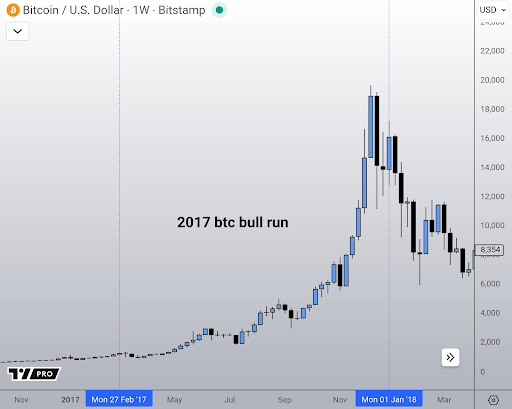
The 2017 cycle illustrated this most clearly. Bitcoin’s dominance began to decline during an altcoin season, even as BTC rose from around $1,000 to almost $20,000. The chart shows a waterfall-like collapse in dominance from 95% in early 2017 to less than 40% in early 2018, right when Bitcoin was booming. Altcoins were already outperforming the leading cryptocurrency long before Bitcoin broke just below $20,000.
A similar pattern played out in 2021. Bitcoin’s dominance peaked in January of that year and began to decline, as the Bitcoin price rose from around $30,000 to its mid-cycle high above $60,000. While altcoins took a little longer to rise compared to 2017, most of their performance still came during Bitcoin’s rapid upward trajectory, rather than after it stalled or reversed.
The charts below clearly highlight this synchronicity: dominance moves lower while Bitcoin candles continue to stretch higher.
Bitcoin needs a confirmed bottom and a new peak
Nova noted that traders are making a mistake by focusing solely on Bitcoin’s dominance, without considering Bitcoin’s broader market structure. It is important to note that dominance does not decrease simply because Bitcoin moves sideways or peaks.
Related reading
Instead, dominance usually declines when Bitcoin is in a strong, sustained uptrend, but the altcoin niche witnesses more inflows compared to the leading cryptocurrency. This means that an altcoin season is unlikely to start until Bitcoin prints a confirmed bottom and its rally is convincing the inflow into altcoins.
As noted by the analyst, Bitcoin is currently in a downtrend, and without a trend shift, dominance metrics alone cannot trigger the altcoin momentum. This position challenges the frequent claims circulating online that offseason is here or is about to start.
As it stands, the crypto industry is still logged into a Bitcoin season, with the CMC altcoin seasonal index sitting on 19 and the CMC Bitcoin Domination at 58.7%.
Featured image from Adobe Stock, chart from Tradingview.com