
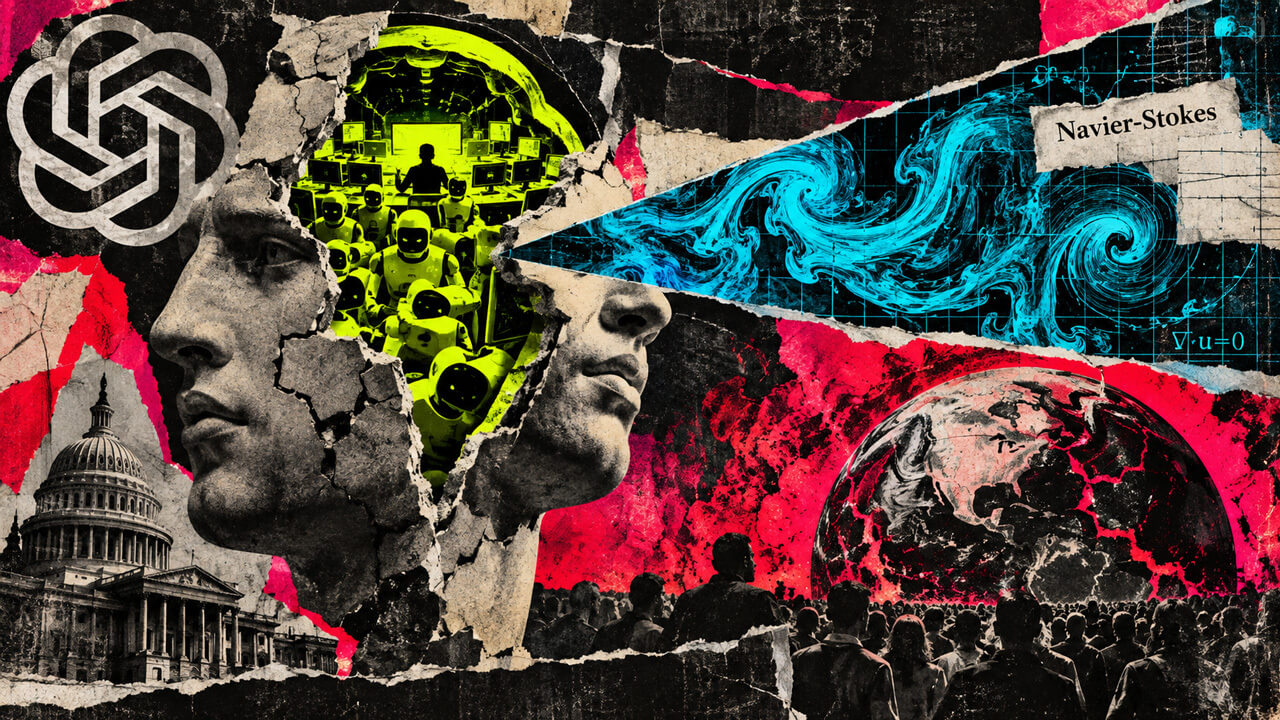
OpenAI recently made headlines by announcing that its latest AI system was able to solve a 90-year-old math problem in just 88 hours, sparking concerns about the potential implications of runaway intelligence. The company revealed that a more advanced model than its previously released GPT-6 Astra coordinated around 10,000 AI agents to tackle the Navier-Stokes existence and smoothness problem, which is one of mathematics’ prestigious Millennium Prize Problems.
The AI agents exchanged a staggering 2.7 million messages and generated approximately 130 billion output tokens during the process. Following this, Astra spent an additional 17 hours formalizing and verifying the solution in Lean. The breakthrough proved that smooth fluid motion can develop a singularity in finite time, resolving a question that has puzzled mathematicians since the 1930s. Despite the significant achievement, OpenAI stated that they do not intend to claim the $1 million prize from the Clay Mathematics Institute, and the proof must undergo further scrutiny before being universally accepted.
The mathematics community reacted strongly to the news, with the American Mathematical Society calling it a “milestone advance in human knowledge.” The scale of the AI agents’ capabilities surpassed expectations, surprising individuals working with current cutting-edge models. Simon Smith, an executive vice president at Klick Health, expressed shock at the rapid progress, highlighting the significant leap in capability from the recently released Astra model to the new Navier-Stokes system.
However, the celebration of the achievement quickly turned into a discussion about the growing gap between public and private AI capabilities. Joseph G. Allen, a professor at Harvard T.H. Chan School of Public Health, raised concerns about the economic implications of such advancements. He pointed out that while researchers were using publicly available AI tools to make progress, OpenAI’s deployment of a more advanced private model with thousands of agents highlighted the potential challenges faced by companies and industries that do not have access to such advanced technology.
The speed at which OpenAI’s internal model achieved the breakthrough raised alarm bells among researchers who fear the uncontrollable advancement of AI systems. Jacob Coxon, who recently resigned from Anthropic after working on pretraining research at OpenAI, warned about the dangers of self-improving superintelligence and expressed concerns about the competitive pressures driving labs to develop more powerful systems without clear control mechanisms in place.
The rapid gains made by OpenAI’s AI system have reignited discussions about the risks associated with AI development and the need for regulatory oversight. Calls to halt the AI race and implement safeguards to prevent the uncontrolled advancement of AI technology are gaining traction, with proposed legislation to prohibit the development of artificial superintelligence and establish safety regulations. The debate surrounding the responsible development of AI systems is intensifying, with policymakers and industry leaders grappling with the challenge of establishing effective control mechanisms before it’s too late.