
- US House adjusts a stable action, aimed at more stablecoin transparency and regulations.
- Tether CEO proposes a ‘stablecoin multiversum’, which predicts the worldwide acceptance of digital assets.
The US House Financial Services Committee has moved ahead With a Stablecoin Regulation Bill supported by the Republicans.
It has adopted the Stablecoin transparency and accountability for a Better Ledger Economy (Stable) act with a vote of 32-17 on 2 April.
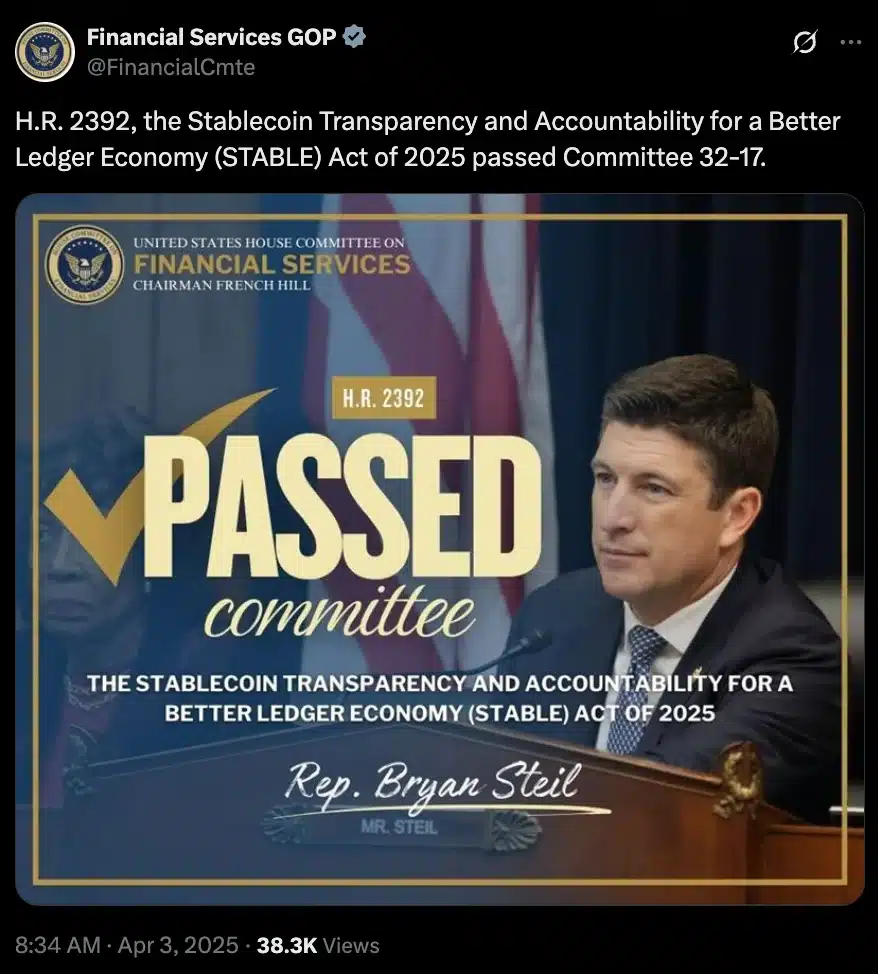
Source: Financial Services Gop/X
How does this account benefit the Stablecoin market?
The bill, which is now set to a complete vote of the house, is intended to bring more transparency and accountability to the growing market for Stablecoin.
Earlier this year introduced by committee chairman French Hill and Bryan Steil, chairman of the subcommittee of Digital Assets, has received remarkable support from Tether, the world’s largest stabile owner.
This marks a different effort from the committee to regulate Stablecoins after a similar bill in 2023 staggered in the midst of political disagreements, whereby the Republicans blam the Biden government for the legislative stagnation.
During discussions on 2 April, various changes were proposed aimed at the connections of President Donald Trump with the crypto industry, rescue provisions and the regulation of foreign issues.
As the bills demand, both the Senate and the House must reconcile their various approaches – in particular on how national and federal rules will govern emenniters and how foreign entities such as Tether will be treated.
Not everyone voted for the bill
However, not everyone was for the bill.
Maxine Waters, the top democrat in the House Financial Services Committee, quickly expressed its opposition against the bill and released concern about Trump’s involvement in the crypto space.
Waters said,
“With this Stablecoin bill, this committee forms an unacceptable and dangerous precedent and validates the president and efforts of his insiders to write the road rules that will enrich themselves at the expense of all others.”
How does it differ from the EU and UK regulation of Stablecoin?
So, while the Stablecoin market continues to grow in complexity and size, financial institutions in the UK and EU are increasingly investigating ways to integrate these assets into their activities, whether it is treasury management, payments, settlement or customer services.
Recent regulatory actions, such as the Micar of the EU and the proposed digital assets regime of the British government, emphasize a reinforced focus to ensure that Stablecoins, like all digital assets, are subject to extensive regulatory protectors.
At the end of 2023 both HM Treasury and the UK Financial Conduct Authority (FCA) outlined their regulatory frameworks for the issue and custody of Stablecoin, where the FCA also plans to release a consultancy about Stabile support and repayment processes in the first half of 2024.
What is more?
In the midst of this, Tether Paolo Ardoino has also outlined an ambitious vision for the future of digital assets, which he calls the ‘Stablecoin Multiversum’.
Ardoino emphasized the growing significance of stablecoins in the worldwide financial landscape and predicts their widespread acceptance by both private companies and government institutions.
Therefore, while Stablecoins continue to evolve, their integration into traditional financial systems could play a crucial role in shaping the future of digital finances.