
Zcash (ZEC), the market’s leading privacy-focused cryptocurrency, has seen tremendous performance, with year-to-date facts showing that ZEC is up over 1,200%, dramatically outperforming the major coins. Cardano (ADA), on the other hand, was in a very different position, with the same period seeing a bounce back of around 66%.
The difference is so pronounced that Zcash briefly surpassed Cardano in market capitalization, making ZEC the eleventh largest cryptocurrency on May 10.
Why Zcash is catching investors’ attention
Market expert Alex Carchidi highlighted several drivers in a new one reportwith great accumulation being mentioned as one of the most important themes. For example, Multicoin Capital announced in early May that it has built up a significant position in Zcash since February.
That kind of accumulation is not limited to one company. Cypherpunk Technologies has also amassed an additional 295,000 Zcash tokens, representing approximately 1.7% of the coin’s circulating supply.
Related reading
Carchidi noted that the network’s privacy usage appears to be rising in parallel with the price. About 30% of Zcash’s circulating supply is now held at shielded addresses.
These addresses rely on specialized cryptography to encrypt transaction data, thus preserving user privacy – a capability that comes standard withublic blockchains do not offer the same.
Importantly, this share has almost quadrupled over the past two years, a trend that Carchidi says strongly suggests adoption and usage are increasing alongside ZEC’s market momentum.
Cardano has no clear path to a breakout
At the same time, the expert argues that the comparison with Cardano is different in almost every respect, apart from the market capitalization. Carchidi pointed out that Cardano was built as a smart contract blockchain and was designed to compete in decentralized finance (DeFi), but its traction is relatively limited.
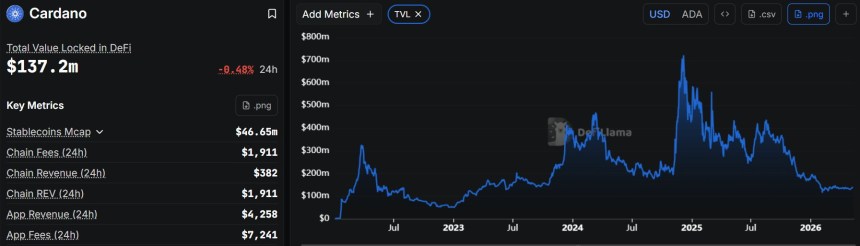
As of May 12, Cardano had reportedly only locked about $137 million in total value (TVL), placing it 26th among all blockchains. That figure also reflects a notable decline from about $410 million a year earlier.
Carchidi believes that Cardano is in what he described as a “tricky valley.” He argues that it is too slow and relatively expensive to compete effectively with fast, high-throughput chains like Solana (SOL).
At the same time, even though Cardano is cheaper than the blockchain it was originally created for – Ethereum (ETH), it remains a bit slower and does not have nearly the same ecosystem scale.
From this perspective, the expert views market behavior as a reflection of a widening gap in persuasion narratives. According to Carchidi, institutional capital tends to favor stories that can withstand criticism.
He claims that Zcash has such a story, while Cardano’s story in recent years has largely consisted of “waiting for better times” – without sufficient clarity on how the better times will be realized by what the developers are building now.
What could make ADA higher?
Carchidi suggested that a possible approval for a spot Cardano exchange-traded fund (ETF) in the second half of 2026 could be the clearest reason to hold in the near term.
Still, he doubts investors would be eager to hold Cardano through an ETF without a strong investment thesis supporting purchases at current levels.
Related reading
Ultimately, Carchidi’s conclusion is direct. He argues that given the lack of clear catalysts and uncertainty about what would drive the recovery, it may make sense to sell Cardano. Zcash, on the other hand, could be attractive if a portfolio needs exposure to privacy coins or scarce stores of value.
At the time of writing, ZEC was trading around $545, with an additional 63% gain in just two weeks. During the same period, ADA posted a gain of 9%, with a trading value of approximately $0.27.
Featured image created with OpenArt, chart from TradingView.com