
The long-running debate over XRP’s market cap ignores the real question, according to Digital Ascension Group CEO Jake Claver: Can the network absorb payment flows on an institutional scale without inflating execution costs? In a March 26 video, Claver argued that market cap is a poor measure of a digital asset’s functional strength and said the price of XRP would need to rise significantly if it is ever to support bank-scale settlement.
Clover framed the case surrounding what he called a “liquidity index,” a model he said is designed to measure “the true usefulness and stability of a digital asset,” rather than just its nominal valuation. His framework combines six variables: market depth, liquidity continuity, slippage, available supply, settlement speed and access. When these factors are assessed together, the main requirement for a payment method is not a speculative benefit, but a price high enough to make large transactions workable.
Related reading
“The assets that will power the next financial system cannot be just volatile speculation,” Claver said. “They actually need a high, stable price to function on a global scale.”
Why XRP needs a much higher price
His argument starts with the offer. Claver likened XRP to a scarce collectible, saying the relevant figure is not just the total issuance, but how many tokens are actually available to trade. If demand rises while more of the supply is effectively locked up, the remaining supply becomes more valuable. He tied that directly to XRP’s payment thesis, describing it as “fixed supply, growing demand,” with the reduced amount left in the market doing more of the pricing work.
From there, Claver focused on market depth, which he viewed as the central constraint on institutional use. He compared XRP’s liquidity to a pool of water that must be deep enough to absorb a major newcomer without chaos. If a bank wanted to move $100 million across the border using XRP, he said, a shallow market would not cleanly absorb the flow and price dislocation would follow.
“The lever for that has to be price,” he said. “If XRP is worth $1 each and you need to move $100 million into the network, you need a hundred million tokens in the pool to absorb that transaction. But as the pool grows and let’s say XRP is worth $100 each, you only need a million tokens to absorb the same $100 million transaction.”
Related reading
That logic extended to slippage, which Claver described as one of the clearest reasons why banks aren’t yet using crypto rails for large-dollar transfers. He said a $100 million XRP trade today could lose “somewhere around 10% just because of slippage,” or roughly $10 million, while traditional stock markets can absorb a similar size for less than half a percent. To narrow that gap, he argued, order book value would need to grow roughly 20 to 100 times. If the token supply is fixed, the price should do “all that work,” he said.
Claver also argued that the available XRP supply could tighten further over time. He pointed to ETF products, corporate and bank government bonds, and DeFi pools as sources of locked up tokens that would not be available for exchange liquidity. In that setup, he said, rising demand would collide with the shrinking float and the price would not “gradually slide upward,” but the gap would widen as sellers became scarce.
Speed is the other pillar of the thesis. Claver said XRP’s 3- to 5-second settlement time gives the same capital pool much more turnover than slower networks, allowing market makers to recycle liquidity more efficiently. But he emphasized that speed alone is not enough. “If every trade costs you 1 to 2% in slippage,” he said, “the speed advantage becomes a faster way to lose money.”
He concluded by arguing that market cap only provides a superficial snapshot because it assumes that each token can be valued at its last traded price. For a network intended to handle cross-border value at scale, he said, the real test is whether its order books can absorb institutional volume without destroying capital. According to Claver, this makes higher XRP prices less a matter of hype than a structural requirement for the network to do the work its proponents intend.
At the time of writing, XRP was trading at $1.3337.
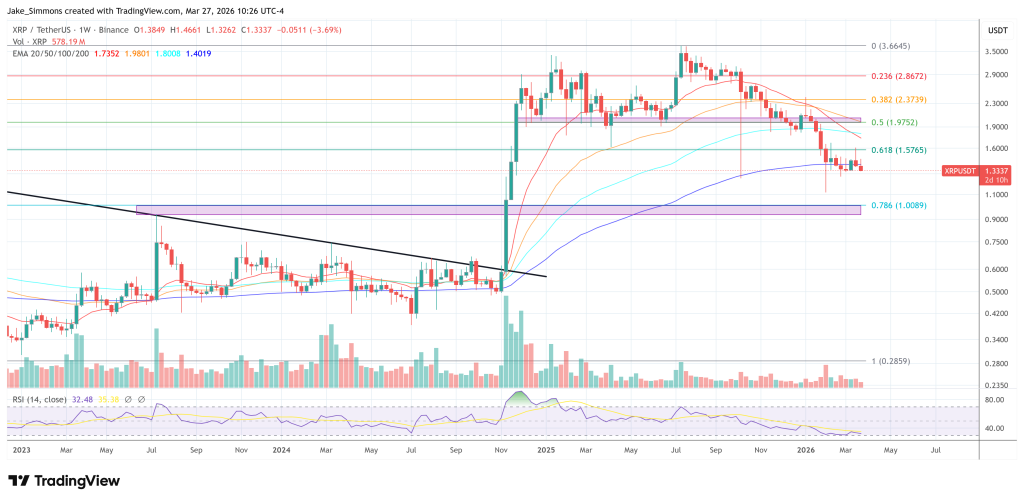
Featured image created with DALL.E, chart from TradingView.com