
Understanding open source protocols
Open source protocols have become a mainstay in the tech world and are gaining popularity due to the numerous advantages they offer over their proprietary counterparts.
The protocols are generally created with the intention of being used by the public, so that anyone can examine, modify, and share their code. The benefits of open source protocols are multifaceted, ranging from their inherent transparency to their broader accessibility.
Additionally, they rely on peer evaluations, a cost-effective and inclusive model that sets them apart from their own counterparts. Prominent examples of open source software include commonly used operating systems such as Linux and Android and the popular web browser Firefox.
When it comes to open-source cryptographic protocols, the Bitcoin, Ethereum, Cardano, and Polkadot networks, among others, stand out as notable examples of blockchain protocols.
Open source versus proprietary protocols
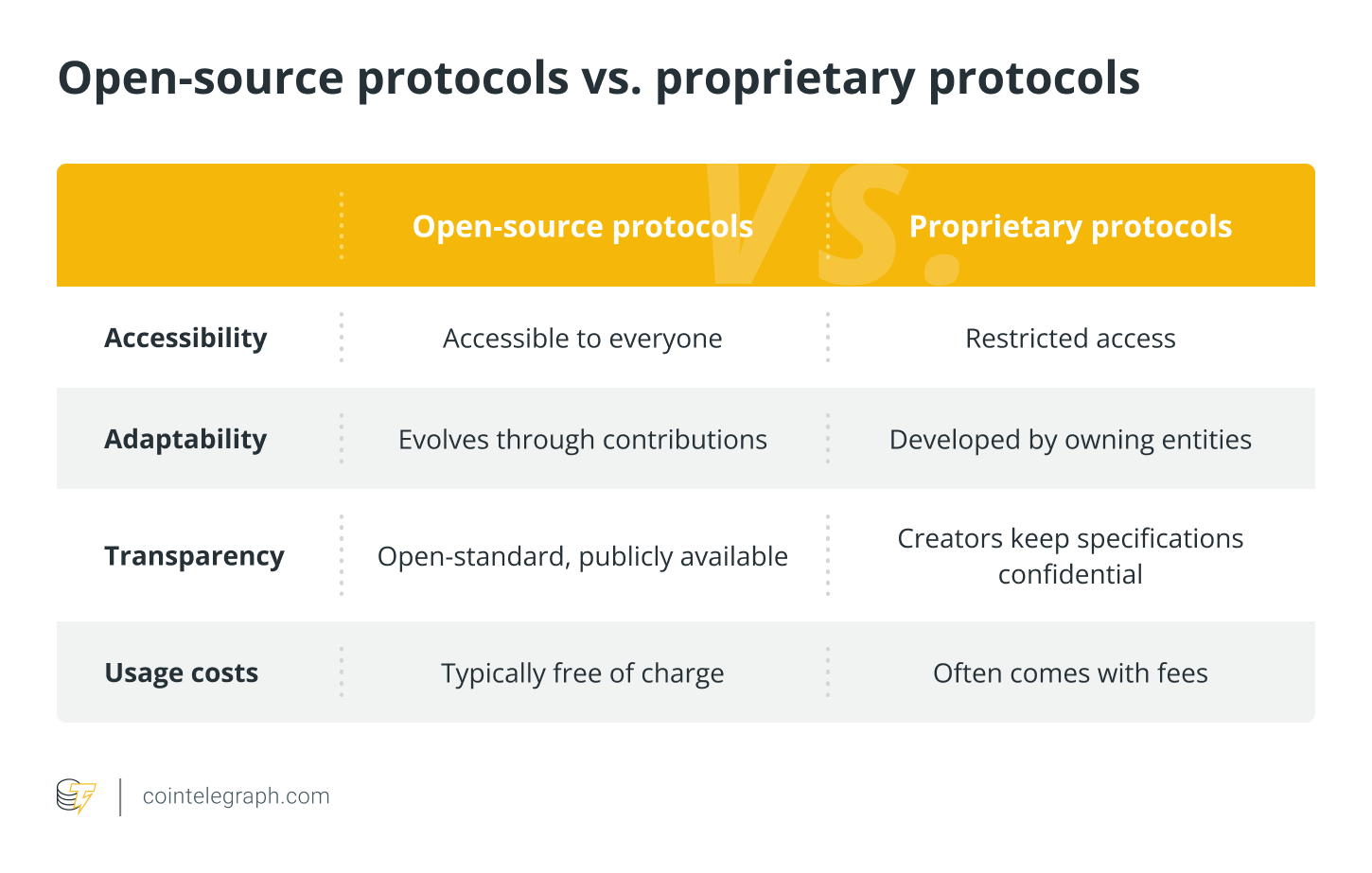
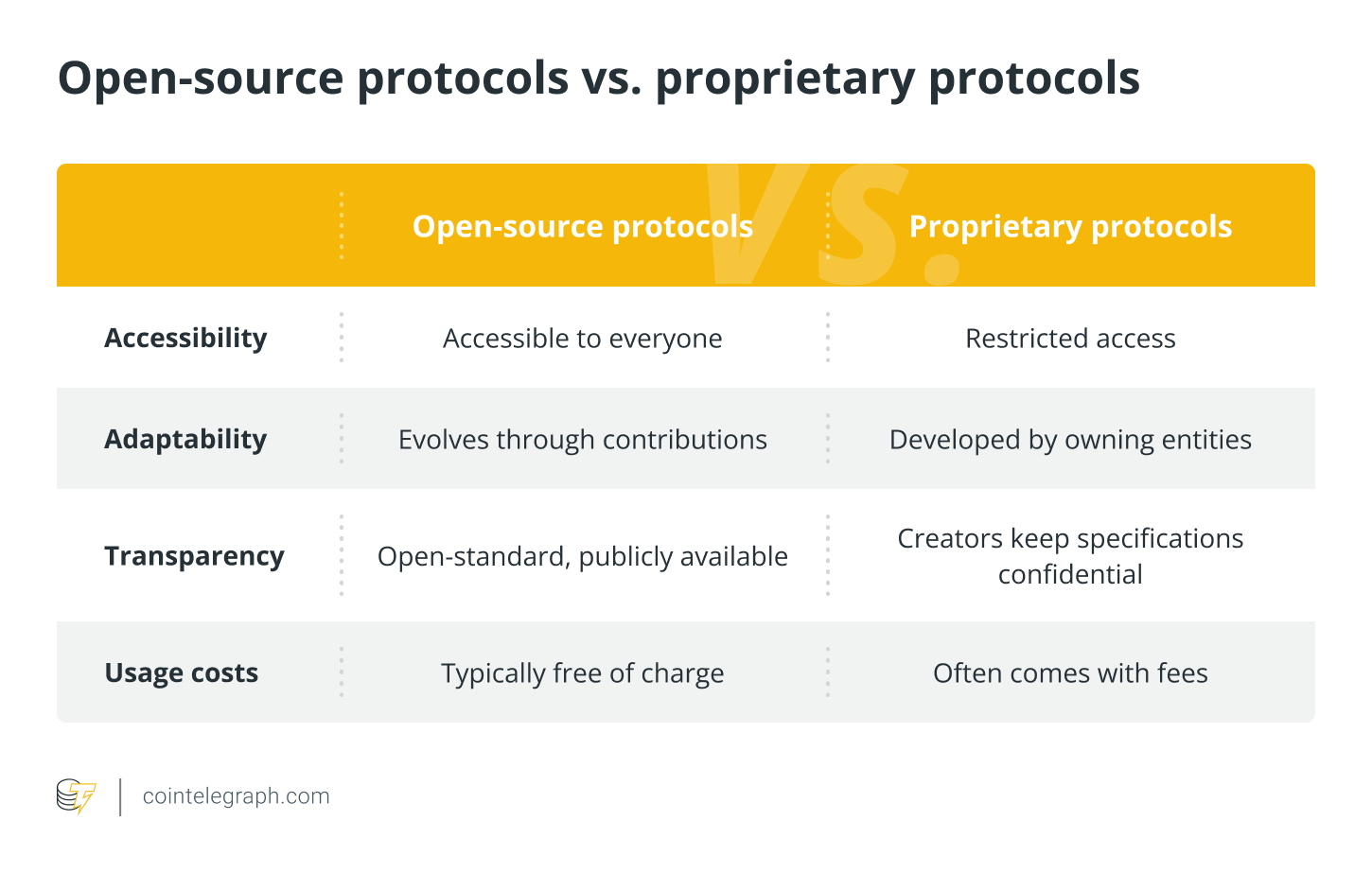
Open-source and proprietary protocols represent two different approaches to protocol development, each with its own principles when it comes to protocol implementation.
The following is a breakdown of their key differences:
What is the development process for open source protocols?
The development of open source protocols involves several phases, each of which is an integral part of a protocol’s evolution. It all starts with the conceptualization phase, where developers lay the foundation that defines the standards and purpose of the protocol.
Usually the basic concept is based on an existing protocol with some improvements. The conceptualization phase serves as the foundation upon which developers meticulously outline the architecture and features, forming a robust theoretical foundation. In this phase, developers release a well-defined roadmap, similar to a strategic plan, that guides the project’s trajectory.
The next step in the development process is usually the prototyping phase. In this phase, developers create a functional model of the protocol that contains the main proposed features. The prototype is usually made available to the public as a beta version.
By releasing the beta version, the software is subjected to real-world scenarios and user interactions, allowing developers to distinguish its strengths and weaknesses. The stage also provides an opportunity for developers to get feedback from the open source community on potential new features that could be included before the final protocol is released. Therefore, this phase is aptly called the beta testing or user acceptance testing (UAT) phase.
Continuous feedback and updates ensure that the protocol continues to respond to the changing needs and expectations of its user base. After implementing relevant protocol upgrades to address many of the known stability and reliability issues, the protocol reaches a level of stability that warrants the designation of a ‘stable release’. The stable release version is usually as reliable as developers can make it.
However, the process does not culminate in stable releases. Open source projects require ongoing protocol maintenance. The process usually involves releasing bug fixes, such as security patches, and updating the code for improved compatibility.
Are open source protocols protected by copyright?
When a developer publishes his code as open source, he shares it with the public so that others can use, modify, and distribute it. However, making the code public does not translate into unlimited use.
Copyright laws apply here, just as they do for proprietary software. The laws automatically protect all original creative work, including open source protocols, giving the software maker exclusive rights to control its use and distribution.
When it comes to open-source protocol licenses, the developer typically attaches a license to it, which acts as a set of guidelines that clearly delineates what is allowed and what is not allowed regarding the code.
Open source licenses often grant users extensive permissions without explicit approval from the original author. That said, there are two main types of open source licenses: permissive and copyleft.
A permissive license, also called a BSD or Apache style license, sets minimum requirements for how the software can be modified or redistributed. However, projects using these types of licenses are required to include a warranty disclaimer. A classic example of a permissive license is the MIT license. The license allows anyone to use, modify and distribute the code without prior permission.
Projects using MIT-licensed code must generally include the original copyright notice and a disclaimer that explicitly states that the software is provided without warranty of any kind. The disclaimer clarifies that the copyright holders have no responsibility for any claims or liabilities arising from the use of the software.
The license is extremely permissive and is designed to give developers maximum freedom, even allowing the inclusion and distribution of the code in commercial products.
With regard to copyleft licenses, projects that use them are also required to include a liability disclaimer. They bring more restrictions, especially regarding the distribution of modified protocol versions. For example, the copyleft GNU General Public License (GPL), a widely used open source license, guarantees that the software remains open and free. Like the MIT license, the GPL requires a warranty disclaimer.
Copyleft licenses guarantee that open source protocols or software can be used, modified and shared without restrictions. However, any modified work must adhere to the same conditions, maintaining the openness of the protocol in all future versions.
When it comes to proprietary protocols, the landscape changes dramatically. The protocols impose strict restrictions on their protocol documentation, often including restrictions on modifying or reverse engineering the code.
To maintain protocol security, proprietary projects usually include confidentiality clauses in their licenses, preventing users from disclosing the operation of their protocols or any proprietary information they come across.
In terms of cost, permissive and copyleft licenses are free, allowing users to use and distribute the software at no cost. Proprietary licenses, on the other hand, often require users to pay to access and use the software.
The future of open source protocols
As the world becomes increasingly digital and interconnected, open source protocols are poised to play a key role in enabling innovation, especially when it comes to supporting interoperability between different systems, applications and devices.
This shift is driven by the widespread, concurrent use of protocols created by different developers every day. As a result, open source protocols, especially those that allow third-party modifications and support interoperable systems, will undoubtedly play a central role in the new technological frontier.
Based on current trends, open source projects are also likely to focus on sustainability, energy efficiency and problem solving, in line with the global push for environmentally friendly technological solutions.
In addition, open source network protocol initiatives are expected to continue to develop peer-to-peer (P2P) Internet protocols. The protocols facilitate direct communication between systems, eliminating the need for centralized intermediary systems. P2P protocols have a growing range of applications, especially in enabling P2P transactions and communications over decentralized protocols.