
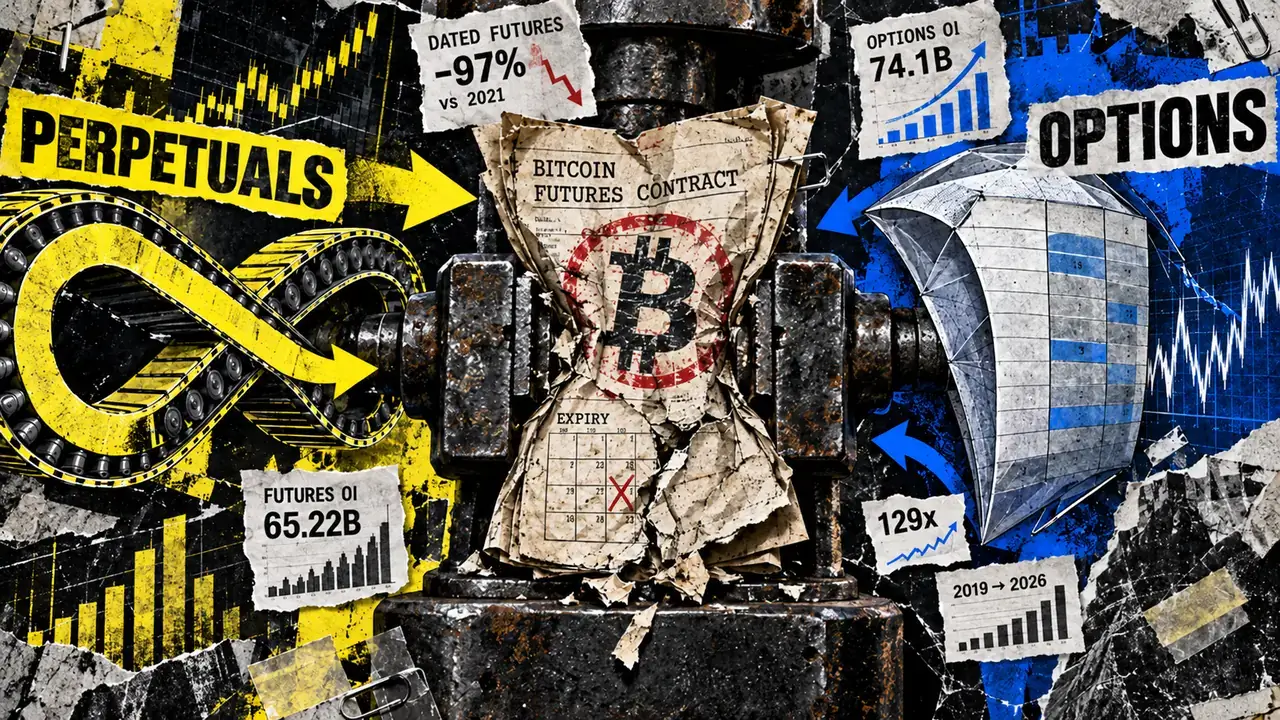
The evolution of Bitcoin’s derivatives market over the past five years has been nothing short of remarkable. Institutions now play a significant role, exchanges offer more sophisticated products, and traders have become more adept at managing risk. However, one key product that played a pivotal role in building this market has seen a significant decline in activity on crypto-native platforms.
According to data from Glassnode, dated futures volume on offshore venues has plummeted to 97% below its 2021 levels. In contrast, options have seen a surge in popularity, accounting for nearly half of crypto-native Bitcoin derivatives open interest. This shift has reshaped the landscape of the derivatives market, with perpetual futures and options emerging as the preferred instruments for different types of risk management.
Perpetual futures, which do not have an expiry date, have become the go-to choice for traders looking for leveraged exposure to Bitcoin without the hassle of managing contract expirations. On the other hand, options have gained traction for hedging, volatility management, downside protection, and executing trades based on specific price levels or dates.
The rise of options has been particularly notable, with Bitcoin options open interest surpassing futures open interest for the first time in January 2026. This trend reflects a broader shift towards more sophisticated risk management strategies in the market.
The decline in dated futures activity can be attributed to the growing popularity of perpetual futures and options, which offer more tailored solutions for different risk profiles. Perpetual futures provide leveraged exposure without the need to roll contracts, while options allow for finer control over risk parameters such as volatility and downside protection.
The increasing value of options can be attributed to changes in Bitcoin ownership dynamics. As more institutional players enter the market, there is a growing need for risk management tools that go beyond simple directional bets. Options provide a flexible way to hedge existing positions, manage downside risk, and capitalize on volatility without necessarily taking a view on price direction.
Moreover, the shift towards stablecoin and cash-like margin collateral has made the derivatives market more resilient to market fluctuations. This move away from Bitcoin-backed leverage has reduced the risk of cascading liquidations during periods of high volatility.
While dated futures still have a place in the market, particularly on regulated platforms like CME, their role has become more specialized. Institutional players may continue to use standardized futures for specific purposes, but the bulk of leveraged trading activity has shifted towards perpetual futures and options.
In conclusion, the changing dynamics of the Bitcoin derivatives market reflect a maturation of trading practices and risk management strategies. Perpetual futures and options have emerged as the preferred instruments for different types of risk, signaling a more sophisticated approach to trading in the cryptocurrency space.