



Publicly traded Bitcoin miners liquidated more than 32,000 Bitcoin in the first quarter of 2026, marking a record sell-off as the industry’s largest operators diverted billions in capital to artificial intelligence.
This historic shift is unfolding right as the economics of Bitcoin validation reaches a critical pressure point.
With mining profitability hovering near cyclical lows, weighted production costs rising, and the network hashrate showing continued signs of stress, the infrastructure giants that defined the last crypto boom are fundamentally redesigning their business models.
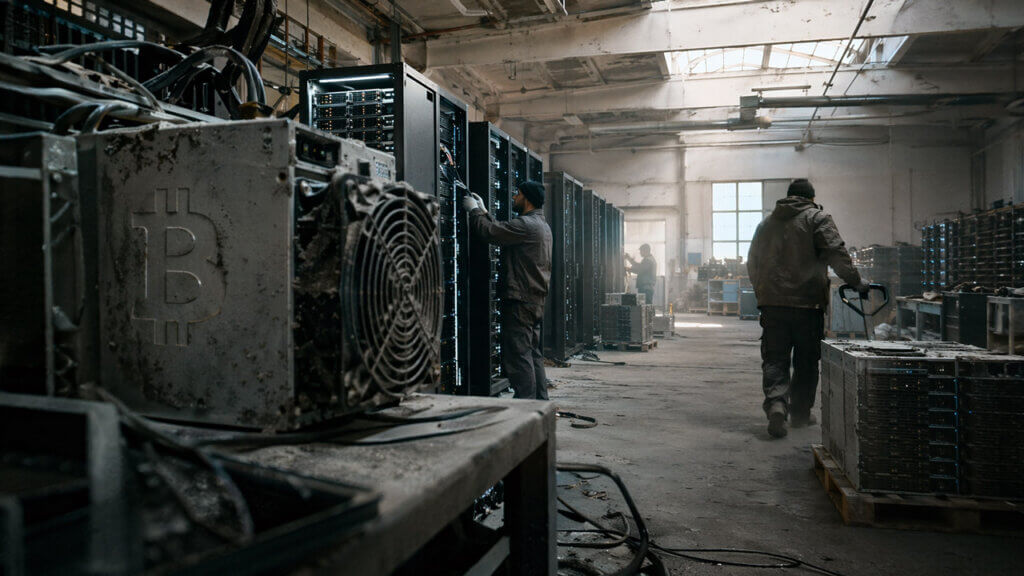
Public BTC miners turn to balance sheet
The scale of the liquidation in the first quarter alone reflects the severity of the capital turnaround.
Public mining companies unloaded more Bitcoin in the first three months of 2026 than in all of 2025.
To contextualize the size of the sell-off, the first quarter outflow easily exceeded the approximately 20,000 Bitcoin dumped by the industry during Terra-Luna’s chaotic collapse in the second quarter of 2022.
According to on-chain facts of CryptoQuant, miner reserves have been steadily eroded over the cycle, with prominent operators now using their digital government bonds as vital liquidity engines rather than long-term strategic investments.
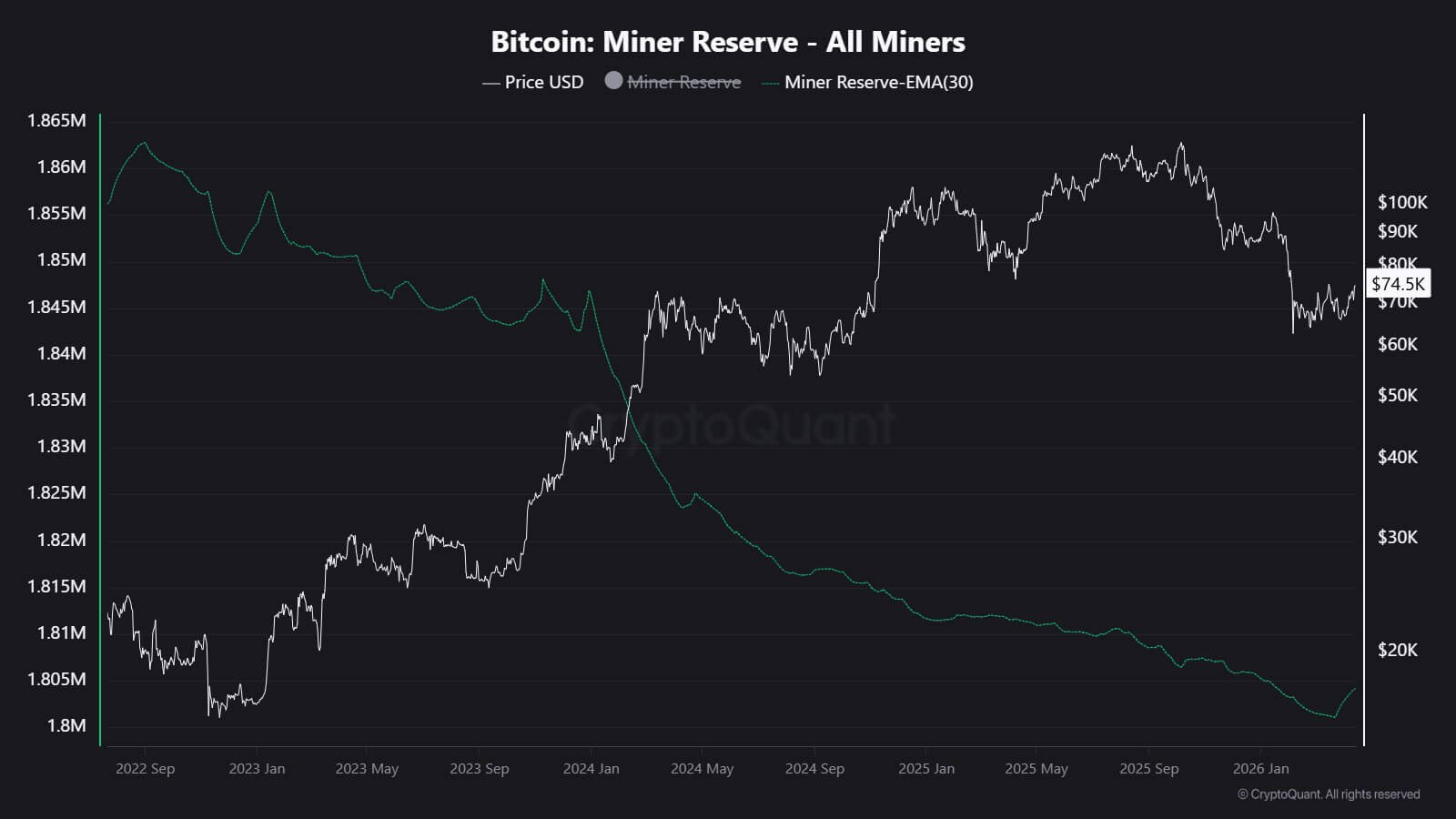
The company noted that miners have recorded a net sale of 61,000 BTC since the start of the current cycle. This heavy selling activity is led by Marathon Digital, which sold over 13,000 BTC and has since dropped out of the top three Bitcoin holders.
Other BTC miners selling their assets include Cango, which sold 2,000 Bitcoin for about $143 million to pay off Bitcoin-backed debt and clean up its balance sheet. Core Scientific released approximately 1,900 Bitcoin in January to raise $175 million, while Riot Platforms sold 4,026 BTC.
The economy after the halving breaks the old model
The driver behind this mass exodus of capital is a broken economic model, exacerbated by the April 2024 halving, which saw block rewards cut from 6.25 BTC to 3.125 BTC.
The programmatic 50% reduction in block subsidies has fundamentally revised the revenue base for the entire sector, making operators highly vulnerable to market fluctuations.
Since that reduction, BTC’s mining economy has been defined by relentless downward pressure.
James Butterfill, head of research at digital asset manager CoinShares, noted that the weighted average cash cost of producing one Bitcoin for public operators rose to almost $80,000 in the last quarter of 2025.
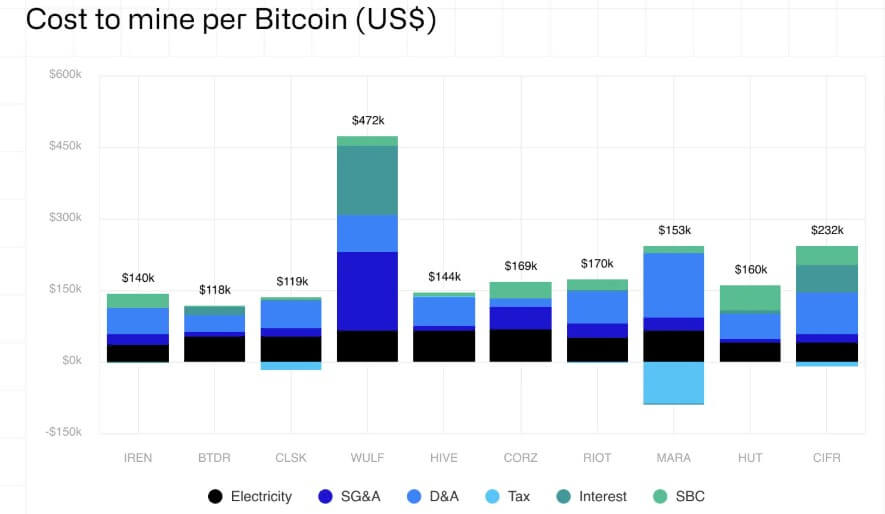
Meanwhile, the revenue side of the equation continues to deteriorate. Hashprice, the metric that tracks expected revenue per unit of computing power, plummeted to between $28 and $30 per petahash per second per day in the first quarter of 2026, which was one of the lowest profitability levels ever.
Because transaction costs remain structurally low at less than 1% of total block rewards, miners are highly dependent on the increase in the spot price.
However, with Bitcoin hovering around $77,000, substantially below the cycle peak of around $126,000 reached in October 2025, miners are caught in a vice.
Mounting debt and massive electricity overheads are squeezing cash flow to the breaking point, forcing executives to look elsewhere for revenue.
Why Wall Street is rewarding the AI pivot
Faced with shrinking margins, pure-play operators are finding boards of directors and institutional investors are aggressively rewarding a move to AI and high-performance computing.
Unlike the volatile, spot market nature of Bitcoin mining, AI data centers offer stable, predictable, multi-year revenue contracts with tech giants like Google, Microsoft and Anthropic.
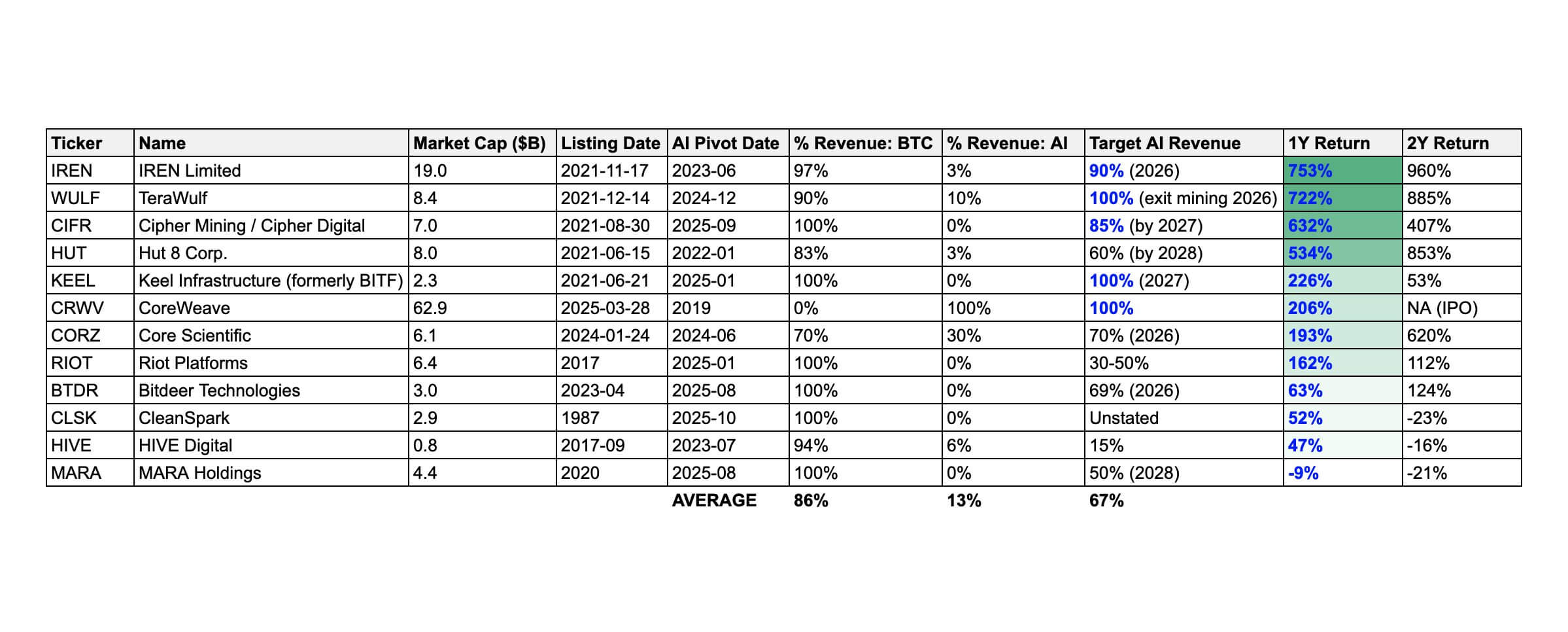
The stock market’s verdict was unequivocal. Mining companies that set AI revenue targets of 80% or higher have seen their stock prices rise by an average of 500% over the past two years, achieving much better market multiples compared to their pure-play mining peers.
Butterfill estimates that public miners could generate up to 70% of their revenue from AI by the end of this year, a steep increase from around 30% now.
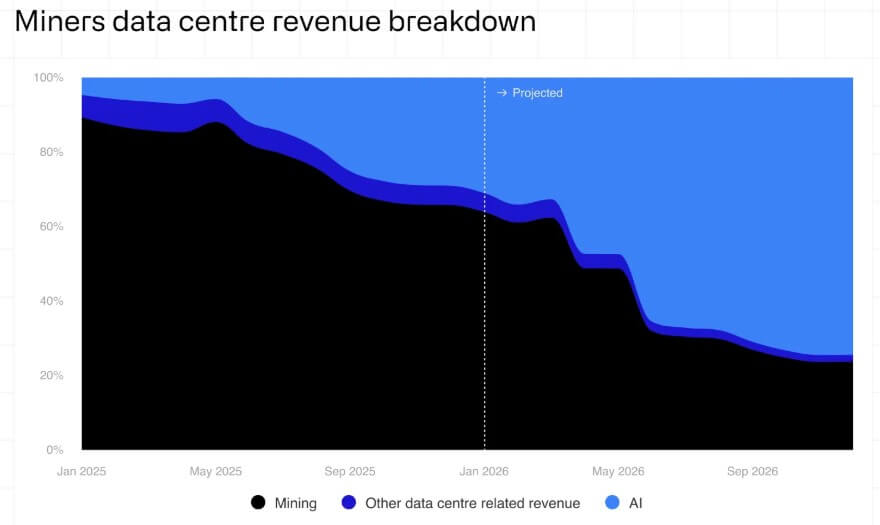
With over $70 billion in cumulative AI and high-performance computing contracts announced in the public mining sector, capital is no longer flowing into next-generation ASIC replacements.
Instead, debt and equity are funneled into a data center-like infrastructure. Operators like TeraWulf, IREN and Cipher have taken on billions in collective debt to finance these expansions, driven by the underlying unit economics.
Although electricity accounts for about 40% of Bitcoin mining revenue, energy costs for AI cloud operators leasing high-performance chips are in the low single digits.
Does Less Bitcoin Mining Investment Mean Less Security?
The large-scale migration of computing infrastructure has sparked a sharp debate about the long-term security of the Bitcoin network.
On the one hand, the bearish thesis holds that if public miners halt reinvestments in mining hardware and dedicate their vast energy capabilities to AI, the network’s security backbone risks eroding at a critical time.
Charles Edwards, founder of Capriole Investments, views the trend with great concern, noting that the average Bitcoin revenue share among major public miners will fall to just 30% within three years.
He noted:
“If these numbers are even half accurate… the energy and commitment to Bitcoin is significantly threatened.”
Bitcoin researcher Paul Sztorc added cultural texture to this shift, noting that the industry is quietly scrubbing its original roots.
According to him, specific mining publications have been rebranded to focus on broader energy themes, and major industry conferences have ditched mining stages for energy-focused platforms, reflecting an industry that is actively moving away from pure crypto workloads.
Yet veterans of the protocol argue that this is exactly how the system is designed to survive.
Blockstream CEO Adam Back countered the alarmism, pointing to Bitcoin’s self-adjusting difficulty mechanism. When computing power is lost, the difficulty of mining decreases, immediately improving profit margins for the remaining operators.
Argued back:
“It’s an arbitrage, with equilibrium when the mining margin is the same as the AI workloads.”
He also described a “positive reflexivity” where higher margins mean surviving miners sell less Bitcoin to cover energy costs.
Meanwhile, James Check, an on-chain analyst at CheckOnchain, said: viewed the transition through the lens of pure capitalism. He noted:
“Huge turnover is literally the intended design of the difficulty adjustment.”
According to him, the AI pivot is a very rational diversification strategy for infrastructure companies that simply “buy power and run computers,” noting that AI serves as a constant baseload, while Bitcoin mining remains an intermittent tool to balance grid loads.
The second half of the halving cycle
As the Bitcoin network moves through the second half of this halving era by surpassing block 945,000 in April 2026, the public mining industry is facing a profound identity crisis.
Hashrate index argued that the next two years, leading up to the 2028 halving, will severely test the protocol’s self-correcting mechanisms against the allure of Wall Street’s AI capital.
The outstanding questions facing the market are now structural rather than cyclical. It remains to be seen whether Bitcoin’s spot price can stage a robust enough recovery to comfortably offset near-record cash production costs, or whether network transaction fees will permanently remain a negligible portion of total revenues.
If the underlying spot economy does not materially improve, the market will be forced to weigh whether the current unprecedented pace of government bond liquidations can be sustained without permanently dampening asset prices.
Furthermore, the industry must determine the basis on which the network’s computing power will finally stabilize once the marginal players leave the ecosystem.
Ultimately, the most pressing tension is existential. By 2027, the publicly traded companies that have driven the industrialization of Bitcoin validation over the past five years may no longer be miners in the traditional sense.
Instead, they are on their way to becoming diversified energy and high-performance computing conglomerates, with only residual, historical exposure to the digital assets from which they originally emerged.