
The Cardano Foundation is becoming less and less dependent on ADA. The latest report shows that Bitcoin and cash now account for a much larger share of reserves, after a year of sharp price differences.
That shift changes how closely the Foundation’s balance sheet tracks the performance of Cardano’s native token.
In its Activity and Financial Insights 2025 Report shared with CryptoSlatethe Foundation said its total assets amounted to 287.5 million Swiss francs, or approximately $361 million. This represents a 45% decline from the $659.1 million in assets it held at the end of 2024.
The decline in face value reflected a difficult year for Cardano’s native token, ADA, but the most notable shift occurred in the makeup of the Foundation’s assets.
Why this is important: The Foundation has historically been one of the largest long-term holders of ADA, so changes to its treasury structure impact the degree of internal alignment between Cardano’s ecosystem and its core institution. A lower ADA concentration reduces direct exposure to the token’s price, but also weakens the feedback loop linking the Foundation’s balance sheet to ADA performance.
A year earlier, the Foundation said 76.7% of its assets were held in ADA, 14.9% in Bitcoin and 8.3% in cash, cash equivalents and financial assets.
However, by the end of 2025, ADA’s share had fallen to around 51.6%, while BTC rose to 25.5% and cash, cash equivalents and financial assets rose to 22.9%.
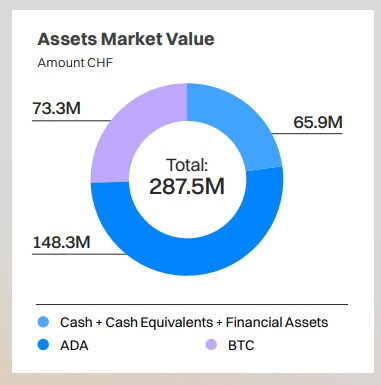
Based on that, the Foundation’s holdings came to approximately $186 million in ADA, $92 million in Bitcoin, and $83 million in cash and financial assets.
This essentially means that the Cardano-focused organization’s assets were no longer as concentrated in ADA as they were a year earlier. Now almost half of the balance sheet was tied to Bitcoin, cash and other financial assets.
How Bitcoin Gained a Foothold in the Cardano Foundation Assets
Bitcoin’s increased role in the portfolio did not result from an increase in the Foundation’s BTC holdings.
In fact, the report shows that the Foundation significantly reduced its BTC holdings last year, by 37% to 656 BTC, compared to 1,054 BTC a year earlier.
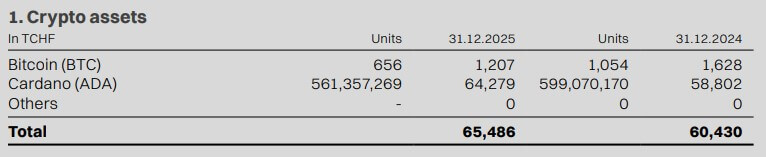
That means BTC’s increased share of the treasury was driven by relative performance and broader reserve reform, rather than an outright accumulation of more BTC.
Market movements help explain the change. Data from CryptoSlate showed that the ADA is down about 63% over the past year, while Bitcoin has shown more resilience, falling about 25%.
That difference meant that BTC did not need to rise in absolute terms to claim a bigger place in the Foundation’s holdings. Instead, the top crypto’s greater resilience during the bear market has allowed it to gain a stronger position.
Meanwhile, the report also suggests that the treasury became more layered, with the Foundation discovering more use cases for BTC and also expanding its cash reserves.
The Foundation said that a portion of its Bitcoin allocation in 2025 was invested in loans and collective investment schemes.
At the same time, financial assets, including third-party loans, investments and shares, rose to 43.9 million Swiss francs (approximately $54.9 million), compared to 14.3 million Swiss francs (equivalent to $17.8 million) a year earlier.
In addition, the organization’s cash and cash equivalents amounted to 20.1 million Swiss francs, or $25.1 million.
Taken together, these numbers show that a reserve base is evolving from a simple ADA-and-bitcoin treasury to something that is more diversified and actively managed.
Spending priorities are shifting
The change in portfolio mix was accompanied by a clearer reset of how the Foundation spent money in 2025.
According to the report, 23.6 million Swiss francs (equivalent to US$29.5 million) was distributed across three strategic pillars, including technology, adoption and governance.
Technology accounted for the largest share at 40.3% or 9.5 million francs. Adoption followed at 39.6%, or 9.3 million francs, while administrative expenditure represented 20.1%, or 4.8 million francs.
That marked a change from 2024, when the foundation grouped its work under adoption, operational resilience and education. The new structure provides a clearer picture of where resources are now being directed and how the Foundation sees the next phase of Cardano.
Technology spend focused on protocol enablement, developer tools, node diversity, interoperability frameworks, oracle infrastructure, and operational resilience.
The Foundation said it has also increased its focus on community initiatives to improve liquidity and adoption in decentralized finance. At the same time, it expanded its Web3 adoption team with a focus on integrations, lists, and real-world asset efforts.
A significant part of the technology and adoption story was tied to digital identity. In 2025, the foundation launched Veridian, a privacy-preserving identity platform designed to help organizations issue and authenticate digital credentials anchored on Cardano.
Meanwhile, adoption spend covered enterprise solutions, identity and traceability systems, regulatory collaboration, education and ecosystem partnerships.
According to the report, the foundation made Originate available as an open-source traceability solution, developed the Reeve platform through internal use and its first enterprise proof of concept, and pushed Veridian toward broader deployment, including a white-label rollout for the United Nations Development Program and the launch of the Veridian Wallet.
The Cardano Academy also expanded through new courses, distribution partnerships and multilingual efforts. The Foundation said the course material was expanded to Binance Academy, which it says reaches more than 44 million students, while also working with the Blockchain Research Institute and Coursera.
Finally, governance took up a smaller portion of the budget than technology and adoption, but it remained central to the Foundation’s 2025 agenda as Cardano deepened its commitment to decentralized decision-making.
The report highlighted support for the largest on-chain budget submitted to date on Cardano, resulting in 38 separate board actions for Treasury withdrawals. It also noted the Foundation’s corporate membership in Intersect and its work on committees related to civics, budget, technical, product, open-source enablement, marketing and oversight.
That participation has led to a range of initiatives, including work on the constitutional process, the Cardano 2030 vision and strategy, the Cardano Summit 2025 proposal and the Cardano 2026 budget process.
The Foundation also said it is supporting tools aimed at increasing participation in governance, including the open-source Cardano Voting Tool, a Proposal Examiner built with Griffin AI, updated governance documentation and special sessions at Cardano Summit 2025.
The foundation’s DRep delegation program distributed 140 million ADA among seven builder DReps, while an additional 220 million ADA allocation for adoption and operational DReps was announced. It also published the cold keys of the Constitutional Commission and expanded the internal frameworks for delegation and elections as the governance transition continued.
In 2026, it will be tested whether the reset works
The next question is whether the Foundation’s repositioning can translate into a stronger operational story for Cardano itself.
Frederik Gregaard, the Foundation’s CEO, said the organization’s focus in 2026 will continue to be on technology, governance and adoption of enterprises and institutions.
He said the group would continue to work to strengthen Cardano’s role in real-world asset infrastructure, support the expansion of stablecoin markets and DeFi liquidity, and build the open-source tools needed for broader adoption.
This is particularly in line with the blockchain network’s recent efforts to integrate the Pyth Network, LayerZero, and Circle’s USDCx stablecoin. All these efforts are aimed at expanding Cardano’s DeFi ecosystem and stablecoin offering to attract institutional support.
That leaves Cardano facing a clearer test in 2026 to determine whether a more diversified balance sheet, combined with heavier spending on infrastructure, governance and adoption, can help stabilize the economics surrounding ADA itself.