

Bitcoin rose along with the rest of the crypto market on Monday after President Donald Trump struck a mixed tone on a possible deal with Iran to reopen the Strait of Hormuz. This led to a relief rally that pushed prices higher but left the broader market structure unresolved.
According to Crypto Slates According to data, the largest cryptocurrency briefly climbed above $70,000 before returning to around $69,500. This had helped push the total crypto market capitalization to $2.5 trillion, an 11-day high.
The move followed two conflicting messages from Trump this weekend. In a Truth Social post, he warned that Iran would “live in hell” if the Strait of Hormuz was not reopened. However, in a subsequent Fox News interview, he said that Iran was “negotiating now” and that there was a “good chance” of a deal within 24 hours.
It was striking that Trump had initially given Iran ten days to reopen the Strait of Hormuz. His latest comments suggested Tehran now has until Tuesday, threatening US strikes on Iranian power plants and bridges if the waterway is not reopened.
At the same time, his comments on the negotiations opened up the possibility, however tentative, that the conflict could shift toward diplomacy rather than immediate escalation.
That was enough to boost sentiment in a market that was skewed toward caution after more than a month of war, rising oil prices and mounting fears of broader economic damage.
Crypto traders responded to that prospect by raising prices across the market, but Monday’s move did not mark a decisive break from the pattern that has defined trading since the conflict began.

Why This Bitcoin Rally Is Still Vulnerable
The latest advance pushed Bitcoin back to the top of the pack that has tamed every major rally and sell-off since the war began. The move was sharp enough to indicate that positioning had become too bearish, but not strong enough to establish a new trend.
Timothy Misir, head of research at BRN, said CryptoSlate that BTC’s price action remained limited as the digital asset remains trapped in the broader range of $60,000 to $70,000.
Fidelity Global Macro Director Jurrien Timmer confirmed this view, while noting that Bitcoin continues to hold the $65,000 to $70,000 range as it tries to establish a base. He explained that the current zone is supported by previous highs, the Bitcoin-to-gold ratio, and the token’s deviation from its power law curve.
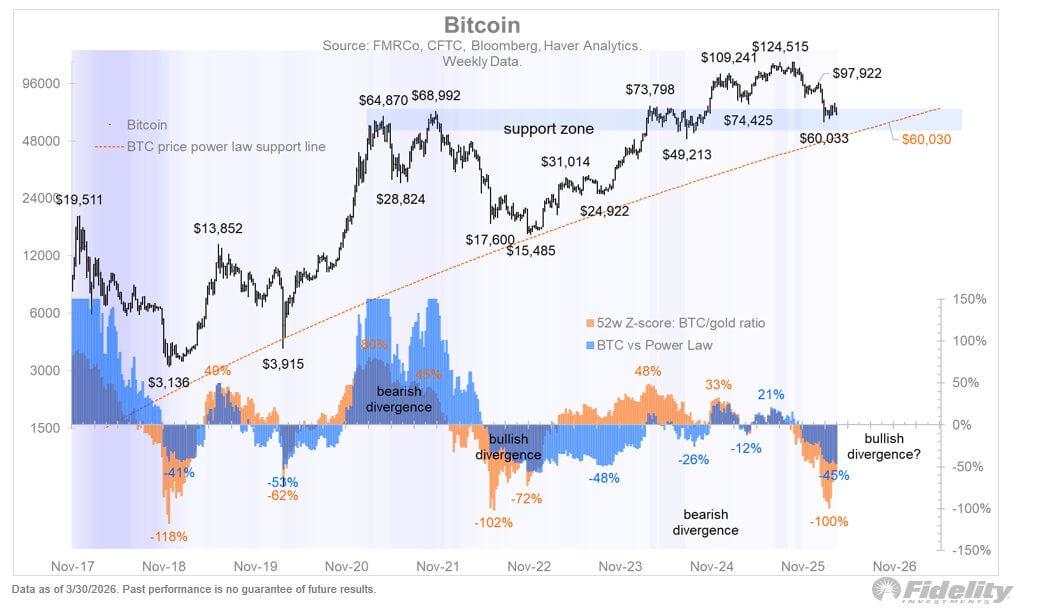
That vision fits the current tape. Bitcoin has recovered at the top of its five-week war period, but the broader structure has not changed. The roughly $65,000 to $73,000 channel that framed the recent price action remains intact, making today’s recovery look more like a range-bound recovery than the start of a clean breakout.
Timmer also pointed to a shift in exchange-traded product flows, which helps explain why Bitcoin reacted quickly once the geopolitical tone softened. When Bitcoin peaked last October, he said, flows left Bitcoin and headed toward gold.
Now that gold is losing some momentum and Bitcoin is regaining its footing, those flows have started to reverse. According to him, gold has started to behave more like Bitcoin, while Bitcoin has started to behave more like gold.

That gives the rally a clearer context. Bitcoin does not move independently of macro conditions, nor does it trade like an asset that has completely escaped the war-induced pressures weighing on the risk markets.
It is responding to the same combination of sentiment, positioning and changing expectations that have shaped oil, equities and broader asset trading since the conflict intensified.
As a result, Monday’s rally was dependent on a shift in headlines rather than a clear change in underlying market strength.
The move was strong enough to unwind the shorts and push Bitcoin back to the top of its range, but not strong enough to dispel doubts about whether the market could sustain these gains if ceasefire talks falter or if oil starts to rise again.
A protracted conflict could still leave $10,000 on the table
Meanwhile, this BTC rebound also hasn’t eliminated the deeper downside that has built up around the top crypto as the war has raged on.
Bloomberg Intelligence analyst Mike McGlone has done just that argued that Bitcoin could still fall to $10,000 in 2026 if macroeconomic conditions deteriorate further.
McGlone said Bitcoin may return to where it was most heavily traded after launching futures in 2017, as it faces a market now saturated with alternative tokens and increasingly dominated by the growth of dollar-backed stablecoins.
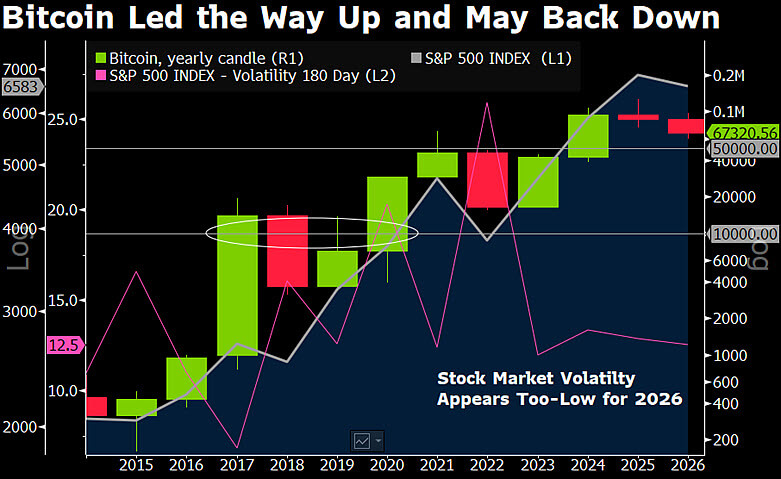
He linked the downside to the risk of a stock market rollover and a new surge in volatility, conditions that would put more pressure on Bitcoin as macro stress increases.
That scenario remains well outside the range implied by Monday’s price action, but it hasn’t been refuted by a single relief rally.
CryptoSlate had previously reported that a prolonged standoff between the US and Iran, a prolonged closure of the Strait of Hormuz, or a broader regional war serious enough to push oil to $150 to $200 per barrel would tighten global liquidity much more sharply and could send stock prices down more than 30%.
Under these circumstances, the $10,000 scenario would no longer look like an extreme outlier, but rather a stress scenario that markets should consider more seriously.

Misir also favors caution, noting that the same market that may rise when headlines indicate negotiations are progressing still remains exposed to the pressures of war, oil and weaker risk appetite.
If the diplomatic opening fades and the energy shock worsens, the support Bitcoin generated early this week will become much harder to defend.
Oil in particular remains central to that calculation. Crude oil climbed back to $112 a barrel on Monday morning as war and disruption around Hormuz fueled supply and inflation concerns. The Kobeissi letter estimated that if these levels continue for another seven weeks, US CPI inflation could rise to around 3.7%.
According to Misir:
“Inflation risk is alive, policy flexibility is limited and growth must absorb the shock.”
Against that backdrop, Misir concluded that BTC’s next move will depend on inflation data and the Federal Reserve.
He explained that the upcoming FOMC meeting and the CPI index would reveal whether policymakers still view post-oil shock inflation as manageable, or whether the war is reinforcing expectations that rate cuts will remain off the table.