



Bitcoin is heading into one of the biggest option expirations of the year at the worst possible time.
CoinGlass data shows approximately $8.07 billion in notional open interest for Deribit’s options expiring on April 24, across 56,300 calls and 49,540 puts. While the ratio itself is bullish, it comes against one of the most uncertain macroeconomic conditions in recent months.
The expiration occurs three days before the Federal Reserve meets for its April 28-29 meeting and four days before the Bureau of Economic Analysis releases both first-quarter GDP and March PCE inflation data on April 30.
That’s the closest macro calendar we’ve seen in a while, and it begins in an environment where Fed officials officially warned last week that oil-fueled inflation could keep borrowing costs high for significantly longer than markets had anticipated.
There is quite a bit of tension in the derivative structure itself.
On Deribit, which now holds about $31 billion in total open interest on options, even surpassing BlackRock’s IBIT, the April 24 contract has heavy call positioning, with about $395 million concentrated on the $75,000 strike. The maximum pain for the contract is near $71,500 to $72,000, about $3,000 to $4,000 below the current Bitcoin price.
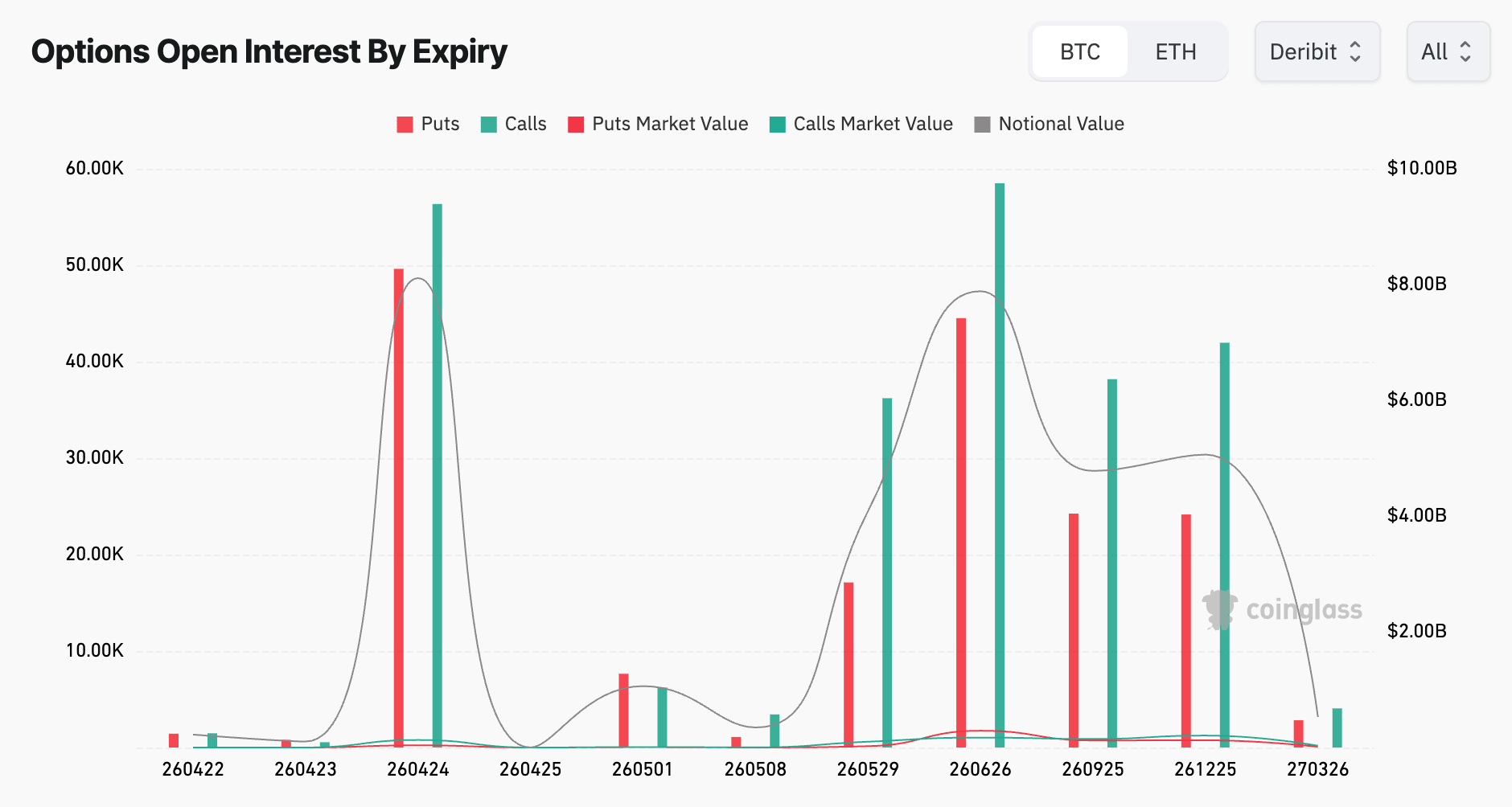
In options markets, max pain is the price level at which the largest number of contracts expire worthless, which favors sellers (in this case large institutions and market makers) over buyers. That gap can create a downward gravity as the settlement approaches.
The Fed has a new problem, and it comes from the Strait
The war that began in late February, when coordinated U.S. and Israeli attacks on Iran led to the closure of the Strait of Hormuz, the narrow waterway through which about 20% of the world’s oil supply flows, pushed Brent crude above $100 a barrel for the first time in years.
The April 17 announcement of Iran’s reopening briefly reversed some of that pressure, with Brent falling about $10 to nearly $89 a barrel and Bitcoin rising toward the $77,000 to $78,000 range.
However, the relief turned out to be short-lived. On Sunday, the US seized an Iranian cargo ship headed to the Strait, seemingly unraveling diplomatic progress made late last week, and Bitcoin opened about 2.5% lower on Monday. The corridor remains more than 95% below pre-war levels in shipping traffic, with major shipping companies still ferrying ships around Africa because insurance companies will not cover the passage, while military ships remain active.
All of this makes everything the Fed does and says in the coming weeks so important, especially for Bitcoin.
St. Louis Fed President Alberto Musalem said last week that the oil shock will likely keep underlying inflation around 3% for the rest of the year, almost a full percentage point above the Fed’s 2% target.
This supports the arguments for keeping interest rates within the current bandwidth of 3.50% to 3.75% “for some time”.
New York Fed President John Williams essentially echoed this: proverb Energy price increases are already being passed on to airline tickets, groceries, fertilizer and other consumer products, and that this process has “already begun.” The CME FedWatch tool estimated a 99.5% probability of a hold heading into the weekend.
The best summary of what’s at stake came from Fed Governor Christopher Waller in a speech on April 17, almost certainly the last substantive communication from the Fed before the pre-meeting blackout closed the window on new guidance.
Waller described the situation as a fork: a quick resolution of the conflict would allow inflation to continue moving towards 2%, leaving room for interest rate cuts later in the year. In contrast, a prolonged conflict would lead to higher inflation becoming embedded in a wide range of goods and services, multiplying supply chain disruptions. The ceasefire is so fragile that both paths really remain alive.
Why Bitcoin Options Expiration is an Amplifier
Expirations of major options almost never drive prices purely in one direction, and the macro sensitivity that has defined crypto markets since late February has made most crypto-native positioning signals less reliable than normal.
The more specific risk of Friday’s settlement is structural: a large expiration concentrated near the top of the recent range creates a hedging dynamic among dealers that could amplify whatever macro signal comes first.
If the situation in Hormuz stabilizes and chances of rate cuts increase, the high-call positioning could translate into a $75,000 squeeze. If a new escalation comes, the same structure is reversed, with a maximum pain of almost $72,000 acting as the level dealers have to defend.
Institutions spent much of this quarter selling upside Bitcoin positions to generate returns and transfer risk to market makers. This created a structural buffer that disappears once the contracts expire, leaving Bitcoin more exposed to macro and geopolitical forces.
Waller’s April 17 speech was the last from a Fed policymaker before officials entered their blackout ahead of the April 28-29 meeting.
The FOMC decision will come without any guidance since mid-April, and markets will read it alongside first-quarter GDP and PCE data, which will show for the first time what a Hormuz shutdown actually costs the US economy.
Bitcoin’s trajectory over the next ten days runs until Friday’s expiration, a Fed decision and a set of numbers that could overhaul the entire interest rate outlook. The derivatives market already has a position on the first event. We now have to see if it holds up through the other two.