
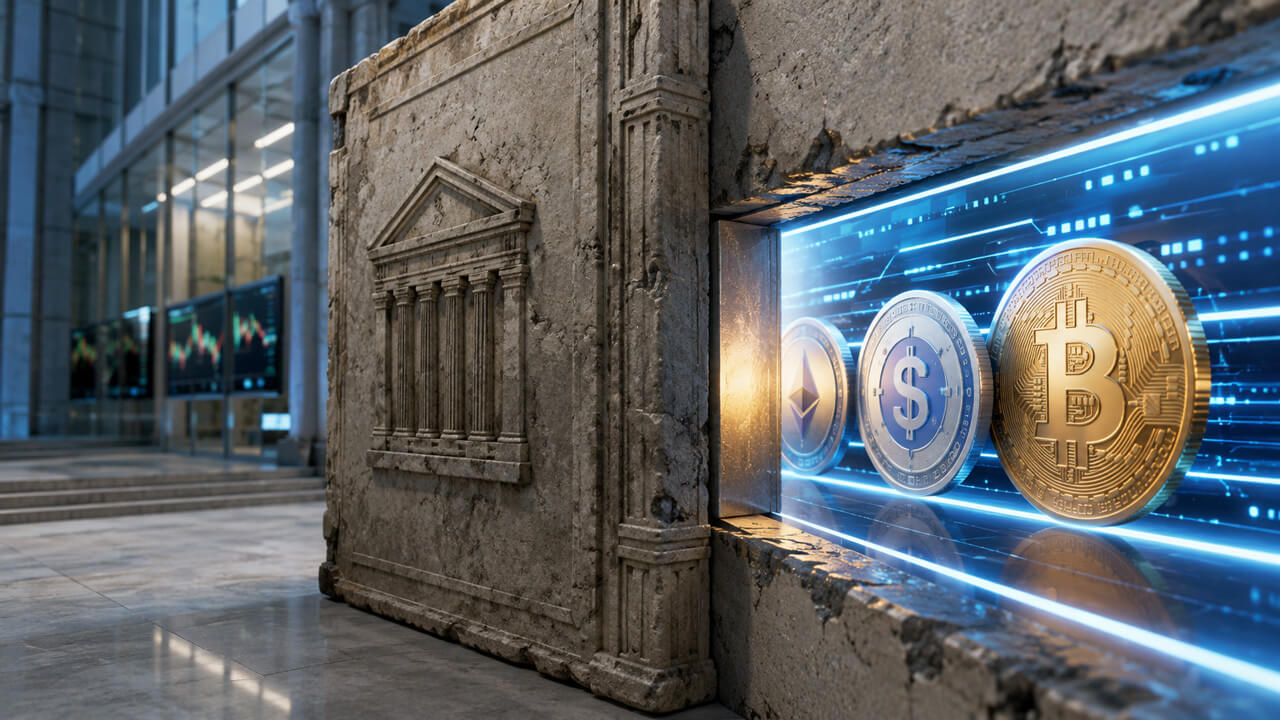
Banks in the US, Britain and Europe finally have a legal path to issuing stablecoins, escrow Bitcoin and clearing tokenized funds, but the capital rulebook that governs it all still treats a Bitcoin position as something close to a guaranteed loss.
According to the Basel Committee’s cryptoasset standard, which has been in force in member states since January 1, 2026, unbacked cryptocurrencies belong to the toughest category of the entire framework, with a risk weight of 1,250%. Once you push that through the Basel minimum of 8%, you get a bank with capital equal to its entire exposure, a dollar of equity set aside for every dollar of Bitcoin on its books.
That gap between permission and capital costs is the part of crypto regulation that almost no one pays attention to, even though it will determine how much digital asset activity actually ends up within regulated banks.
The standard was created at a different time, when regulators mainly tried to keep crypto completely out of the banking system, and was shaped by everything that went wrong at the time: the opacity around stablecoin reserves, the collapse of the stock exchange, the contamination that ran through FTX and Celsius.
The phase that banks are now entering is very different, as tokenized deposits, stablecoin reserve management, custody and on-chain settlement are now part of regulated balance sheets. You can already see it in JPMorgan’s JPMD deposit token, Citi’s Token Services, and the tokenized deposit work underway at HSBC.
The committee itself can conclude that the situation has relaxed. That’s why it began an accelerated review of parts of the standard in November 2025, noted progress in February and May 2026, and promised an update later this year.
The capital math that prices Bitcoin as a certain depreciation
Basel itself does not write laws in any country, but it sets the template that national regulators in the US, EU, UK, Canada, Japan, Singapore and Hong Kong use to decide how much equity a bank should hold against a given asset.
The cryptoasset chapter, known as SCO60, takes everything a bank can touch and sorts it into tiers, and the logic is fairly intuitive. Group 1a is for tokenized versions of traditional assets; Group 1b is for stablecoins that pass strict reserve and redemption tests; and both can be treated more or less as their conventional equivalents. Group 2 captures anything that does not meet these conditions, splitting into Group 2a for assets that are liquid enough to hedge and Group 2b for the rest.
The weight placed on each of these levels is where the business case actually lives or dies. A low capital requirement allows a bank to hold or finance assets cheaply, while a high capital requirement forces it to set aside equity that could work much harder elsewhere. At the very top of the scale, costs become so high that the entire activity no longer makes economic sense.
That’s what the 1,250% figure on Group 2b does in practice, so a $100 million Bitcoin position ends up costing roughly $100 million in capital, and because there’s no netting of long and short exposures, the real bill tends to get even higher when you pile buffers and monitoring add-ons on top.
Furthermore, SCO60 combines an exposure limit that has no real equivalent anywhere else in the Basel framework. That is, a bank’s total Group 2 investments must remain below 1% of its Tier 1 capital, and the moment this exceeds 2%, every single Group 2 position is swept into punitive 2b treatment at once, removing recognition of hedging altogether.
This is what the industry has reacted to most, with bodies such as ISDA and the GFMA telling the committee in August 2025 that entire sections of the standard were too conservative and punitive and calling for a recalibration before it was ever fully adopted.
To be fair to the commission, all that caution made perfect sense at the time they finalized the rules, as regulators were staring at frozen customer funds, weak offshore controls, reserves that no one could actually verify, and tokens that would routinely drop 70% to 80% in a single withdrawal. The entire mandate of Basel is to prevent banks from importing these types of losses into the deposit base.
The push you’re seeing now is that the bucket they labeled as crypto exposure has expanded to include very different things: a tokenized US Treasury fund, a fully reserved payments stablecoin, a escrow customer coin, and a simple Bitcoin transaction have almost nothing in common when you look at the real risk underneath.
We also have the problem of scale, as tokenized real-world assets on public chains have already surpassed $16 billion, with government bonds making up the largest share.
This means that a tokenized Treasury bond on a public blockchain cannot technically meet the conditions of Group 1 and could end up straight into Group 2b, where Basel has filed all purely speculative tokens.
What is the cost of crypto if the capital math is correct?
Probably the best sign that these categories are faltering is that the world’s largest economies simply no longer agree on these categories.
The Trump administration rejected SCO60 outright, with Executive Order 14178 and the July 2025 Digital Assets Report describing that fixed 1,250% weight as anti-innovation and anti-competitive, and US regulators pointing to a risk-based approach tied to how these markets actually behave.
Europe is moving in the other direction and sticking to the cautious line, integrating the Basel treatment into the CRR3 capital rules and the technical standards that the banking authority is still developing.
And because the Basel rules only come into effect through national adoption, you could end up with the same token asset with a heavier capital burden in Frankfurt than in New York, and a global bank having to build separate digital asset products for separate jurisdictions just to handle it.
That fragmentation cuts both ways for a bank trying to figure out where to commit, because loose regulations allow crypto risks to seep into the deposit base, while punitive rules only push activity to companies outside the bank’s perimeter.
What people sometimes miss is that most of what banks actually want here is fee-based and little on the balance sheet, things like custody, fund administration, stablecoin reserve management, tokenized deposit settlement, collateral services and market making in regulated products. The capital treatment determines which of these lines meet an internal return hurdle, as a heavy burden on inventories or financing could shut down the lines that need a balance sheet to function in the first place.
Stablecoins are actually where all this pressure is concentrated, because a fully reserved payment token, a bank’s own tokenized deposit, and a tokenized money market fund each carry different legal claims and appear on the balance sheet in different ways. This means that Basel must price the redemption, reserve, liquidity and enforceability risk for each separately.
The US has already leaned hard into that split, with GENIUS keeping tokenized deposits under regular deposit treatment, while payments stablecoins are subject to a special regime of their own.
When you consider that the stablecoin market is now around $320 billion and is almost entirely denominated in dollars, you begin to understand why this classification carries so much weight. It essentially determines how much of the settlement layer comes to banks themselves and how much continues to flow through non-bank issuers. It is essentially the same concern about deposits that underlies the US banking lobby’s warning about trillions potentially migrating from insured accounts.
And these two paths (a hard capital regime versus a more risk-sensitive regime) lead to two very different markets. If the charge remains punishable, regulated issuers will lean even harder on non-bank infrastructure, tokenized markets will continue to scale outside traditional banking channels, and crypto-native firms will retain a greater share of settlement for themselves.
As treatment becomes more risk-sensitive, tokenized deposits become a credible rival to payments stablecoins, tokenized Treasuries begin to reach investors through bank distribution channels, and much of that activity drifts back to the regulated core, where regulators prefer it.
Typically, crypto regulation reaches people through lawsuits, enforcement actions, and licensing laws. But banks have to adhere to a much slower and tougher regulatory framework, and for them the deciding factor really comes down to the cost of capital, the cold calculation of whether a given industry can still overcome its return hurdle when you set the cost of equity against that.
The Basel revision won’t solve all that in one fell swoop, and that’s happening because the old dividing line between speculative tokens and regulated settlements has been redrawn. Until someone pushes that boundary, the banks best equipped to bring crypto into the regulated system will have every reason to continue operating from the edge.