



In traditional markets the VIX gives traders a way to hedge or trade expected volatility in the stock market instead of having a direct view of the S&P 500. CME Bitcoin Volatility Futures now gives Bitcoin traders a regulated version of that idea: a way to bet on volatility without betting on the price of Bitcoin.
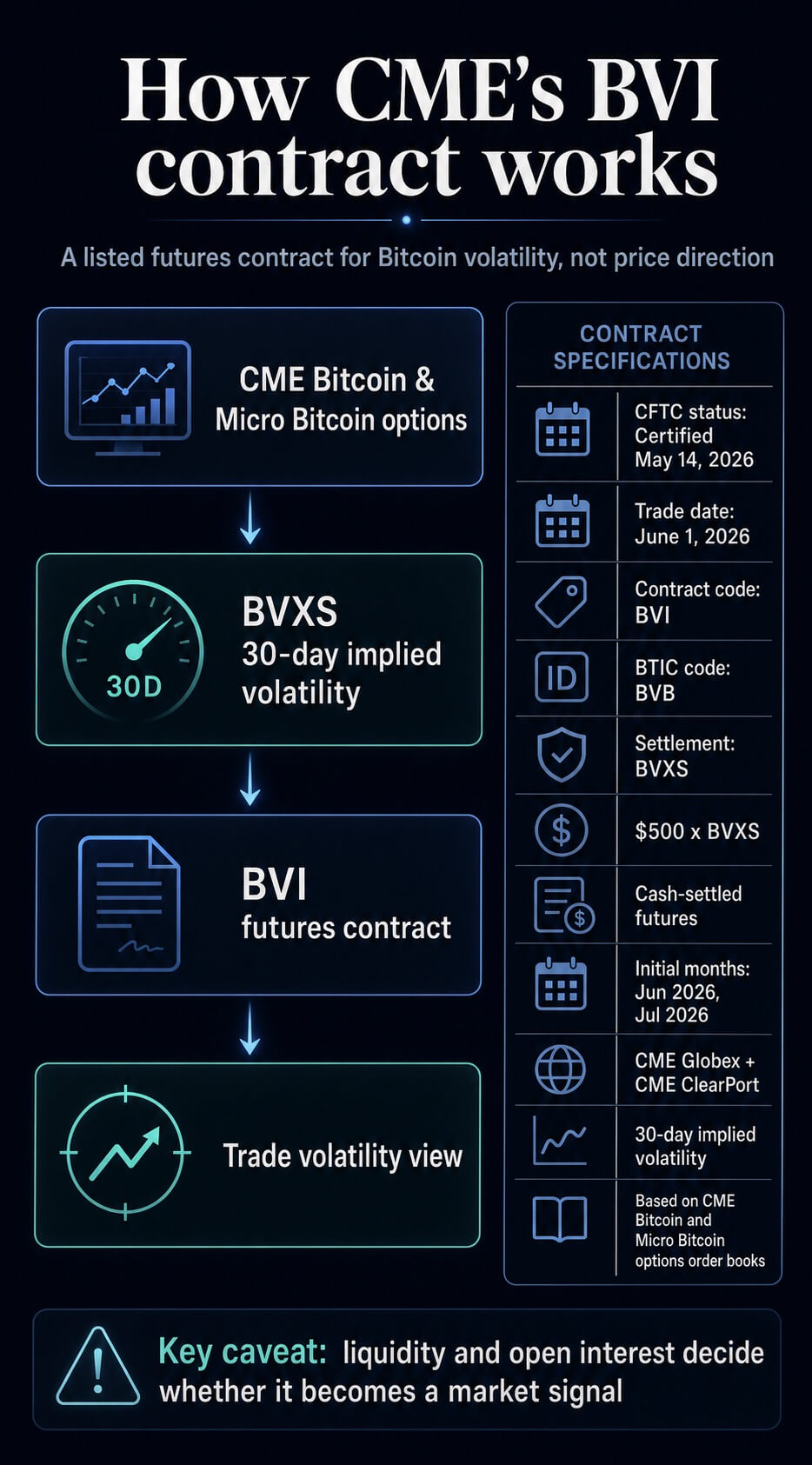
The exchange plans to list Bitcoin Volatility Futures to start trading on June 1, while a May 14 Commodity Futures Trading Commission Product Record lists the contract as certified.
That makes the launch a market structure test: whether Bitcoin is ready for a regulated futures contract tied to the expected turbulence itself.
The contract, ticker BVI, is financially settled according to the CME CF Bitcoin Volatility Index – Settlement, or BVXS. The index is designed to reflect a 30-day outlook of implied volatility taken from CME Bitcoin and Micro Bitcoin option order books.
In practical terms, a trading desk can indicate whether it expects the coming month to be calmer or more volatile for Bitcoin, without using Bitcoin futures, spot ETFs or options to get a direct price picture.
The product has a VIX-like feel, but it doesn’t make BVI a proven Bitcoin fear gauge before trading begins. It places a regulated contract around something traders are already looking at: how much movement the market expects from Bitcoin, regardless of whether the next move is higher or lower.
The VIX became important in traditional finance because it made expected volatility a common risk language. Portfolio managers use it to hedge shocks, options firms use it to address price stress, and analysts use it as shorthand for market fear. BVI is trying to bring a similar layer to Bitcoin, but has yet to prove that traders will use it to any extent.
CME’s new contract shifts trading away from price direction
The certification detail updates CME’s May 5 launch announcement without changing the basic timeline. The contract has been shifted in the announcement from a planned, ongoing regulatory review to a CFTC product record marked Certified.
CME corresponds May 14 submission says the contract will be available on CME Globex and CME ClearPort starting Sunday, May 31, ahead of the June 1 trading session.
The certification marks a milestone for the exchange: CME has certified the contract under the relevant CFTC process, while regulatory approval and future liquidity remain separate questions.
It gives institutional agencies a trusted exchange and clearing framework for a Bitcoin volatility trade.
For most readers, the key terms are simpler: BVI is the futures contract, BVXS is the index it settles on, and each contract is worth $500 times the BVXS level.
The months initially listed are June 2026 and July 2026.
The practical difference is the exposure. Bitcoin futures allow traders to get an idea of where BTC will trade. Bitcoin ETFs give investors spot-linked exposure within investment accounts.
Bitcoin options can express both price and volatility views, but require option execution and option risk management. BVI packages a volatility view into an exchange-traded futures contract that rises or falls with the market expectation for Bitcoin movement rather than just the spot price of Bitcoin.
CMEs product page makes that distinction explicit, saying the contract is intended to hedge Bitcoin exposure against rising or falling volatility and trade on expectations of market turbulence, independent of Bitcoin’s price direction.

BVXS makes option prices the reference point
The futures contract is only as useful as the underlying benchmark. BVXS is the daily settlement version of the CME CF Bitcoin Volatility Index.
CF Benchmarks describes BVXS as a once-a-day benchmark representing a forward-looking, 30-day constant maturity implied volatility measure based on CME Bitcoin and Micro Bitcoin option order books.
In practice, the Bitcoin Volatility Index converts CME option prices into a daily reference point for expected BTC turbulence.
BVXS does not track Bitcoin itself. It tracks what the option prices imply about how much Bitcoin could move over the next 30 days. That makes BVXS a Bitcoin implied volatility benchmark rather than a spot price benchmark.
If option traders price in more uncertainty, the index could rise before Bitcoin makes a big move. If option traders demand less protection or expect calmer trading, the index could decline even if Bitcoin remains directionally active.
That distinction makes the product more than any other access rail. A fund that holds exposure to Bitcoin through spot positions, ETFs, futures or structured products may not want to sell the underlying exposure every time market tension increases.
Instead, it may want a tool that addresses volatility directly. Conversely, a trader can expect turbulence around a macroeconomic push, a regulatory event, a reversal in ETF flow, or a market dislocation, without being sure whether BTC will break higher or lower.
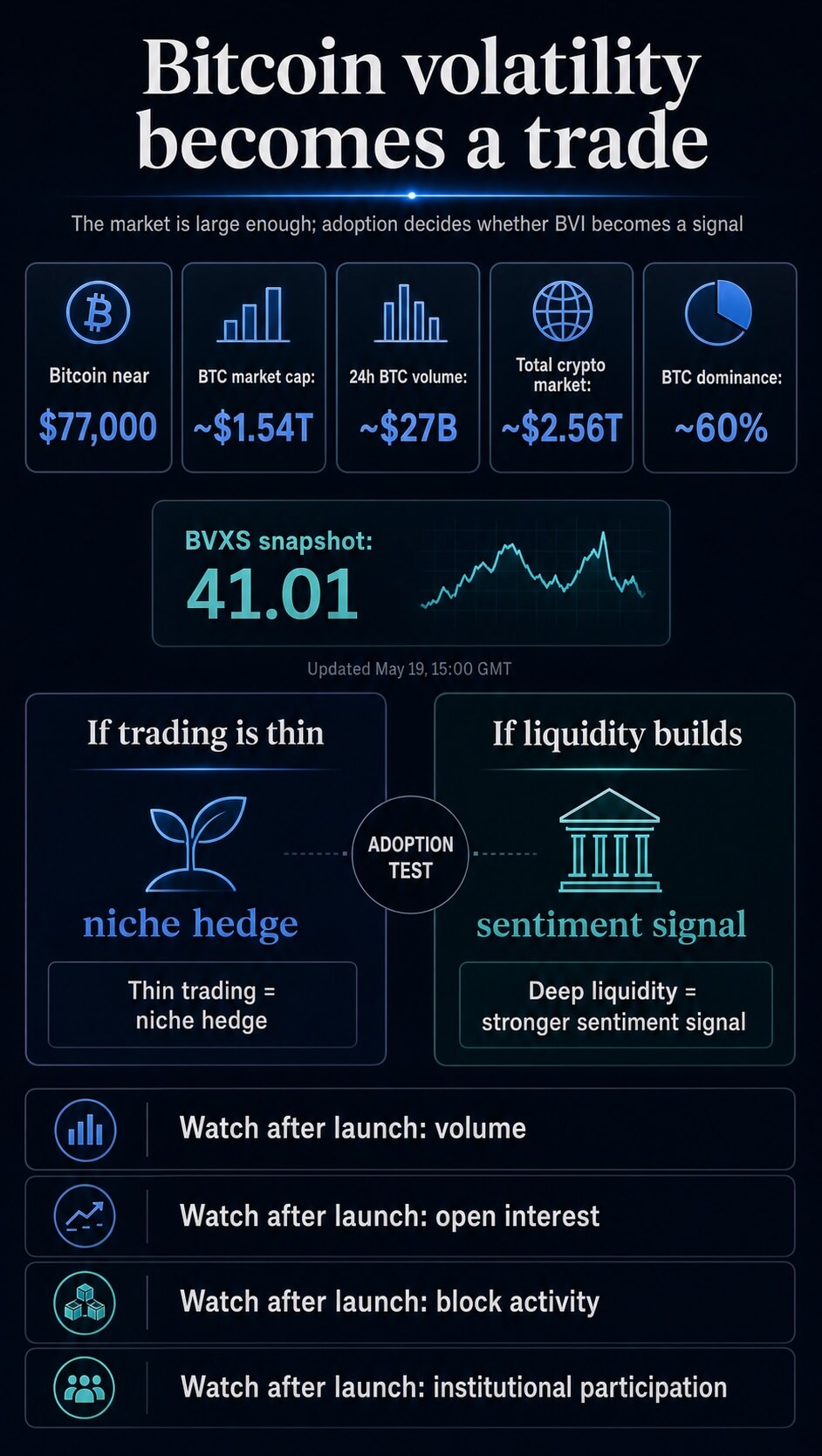
When released on May 20, the latest CF Benchmarks figure available before the session showed a BVXS of 41.01, down 0.99%.
Bitcoin now has a CME-linked benchmark for implied volatility under an exchange-traded futures product.
Why institutions might worry about a Bitcoin fear trade
For institutions, BVI offers an easier way to separate a trade that often mixes Bitcoin futures, options and ETFs together.
With a directional product, the trader is typically exposed to the level of Bitcoin. A long Bitcoin futures position profits when BTC rises and loses when it falls. A spot ETF holder is tied to the direction of the asset.
Options can isolate volatility, but trading is more complex and involves exposure to strike selection, expiration, time decay and position management.
BVI gives agencies a cleaner expression of the question: Will Bitcoin move more or less than the market currently expects?
That can help agencies hedge portfolios, price structured products, manage options books or position themselves around events where the size of the move is more important than the direction.
The timing also fits with broader pressure on CME’s crypto market structure. says CME 24/7 cryptocurrency futures and options trading is scheduled for May 29, shortly before the BVI launch. It also expands CME’s Bitcoin derivatives stack beyond directional futures, options and ETF-adjacent market exposure.
The two developments point in the same direction: regulated crypto derivatives are becoming less of a side session tied to traditional market hours and more of an infrastructure designed around the way crypto is actually traded.

CryptoSlate’s recent Bitcoin coverage has largely followed the direction and entry questions that have dominated the market: ETF flow reversals, inflationary pressures, options liquidity around spot ETF products, institutional accumulation, and the fading economics of some retail ATM models.

CME’s volatility contract moves the discussion to another level. It questions whether Bitcoin risk can become a standalone product.
Bitcoin’s scale makes the question meaningful. CryptoSlate’s market pages showed Bitcoin at nearly $77,000 on May 20, with a market cap of about $1.54 trillion and a 24-hour volume of about $27 billion.
The broader crypto market was approximately $2.56 trillion, with BTC dominance of almost 60%. In that context, a future with regulated volatility is an attempt to make the market expectation of the Bitcoin movement tradable in a more direct form.
The launch test is liquidity, not branding
However, comparing CME BVI futures to the VIX may overstate the product before trading data exists.
VIX futures and options are well-established instruments for trading or hedging volatility risk. BVI has not yet earned that status.
The test after June 1 will be practical: whether the contract attracts volume, open interest, block activity, and enough institutional participation to become a meaningful signal.
According to CME’s filing, trading volumes, open interest levels and pricing information will be published daily. These numbers will outweigh the launch label.
If volume increases, BVI could provide market participants with a cleaner way to hedge Bitcoin exposure when they expect turbulence, or express the view that expected volatility is too high or too low.
It could also give analysts a new signal on market stress, in addition to ETF flows, options positioning, futures basis and spot liquidity.
If business is thin, the product may remain useful to some agencies without becoming a broad sentiment gauge. That outcome would still add a regulated instrument to the Bitcoin derivatives pile, but would fail to convert Bitcoin’s volatility into a widely followed market instrument.
CME has a CFTC-certified Bitcoin Volatility futures contract scheduled for June 1, tied to a 30-day implied volatility benchmark constructed from CME Bitcoin options data.
It gives institutions a way to trade Bitcoin’s expected turbulence without making a direct price bet. Whether it becomes Bitcoin’s fear trade depends on what happens once traders can actually use it.