
Hyperliquid’s HYPE token fell about 6% on Friday after Bloomberg reported that CME Group and Intercontinental Exchange are pressuring US officials to scrutinize the decentralized exchange’s role in offshore oil-related trading.
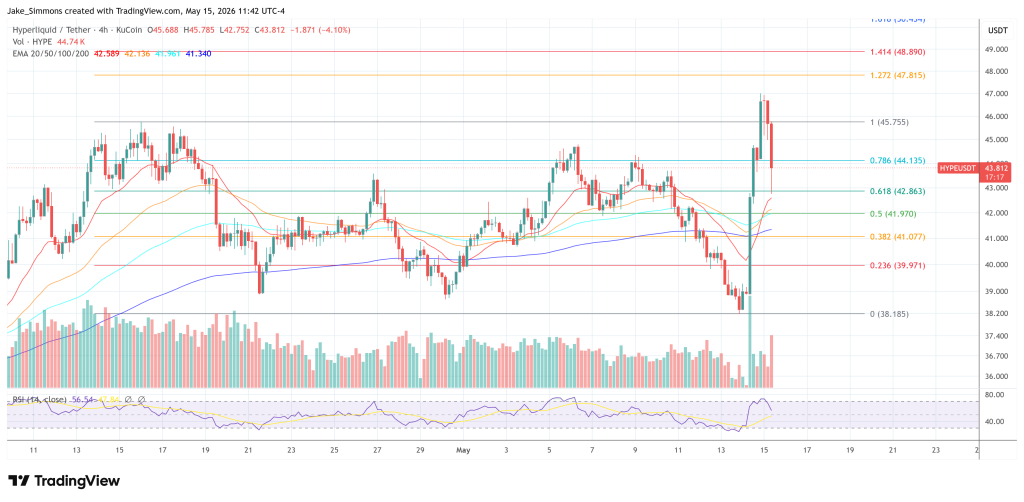
The move puts one of crypto’s fastest-growing derivatives platforms in direct tension with two of the most powerful incumbent players in global commodity markets. HYPE was trading around $43.81 after hitting an intraday high of $46.93, implying a decline of around 6.7% from the session peak. The token’s 24-hour range was from $42.75 to $47.00.
CME and ICE are targeting Hyperliquid’s oil market
According to Bloomberg reporturge Intercontinental Exchange Inc. and CME Group Inc. urged the US to rein in Hyperliquid, which it described as a fast-growing, unregulated crypto platform that could “distort global oil prices” and be used for “price manipulation.”
Related reading
Bloomberg reported that the exchanges have raised concerns with the Commodity Futures Trading Commission and Capitol Hill officials. The core problem is Hyperliquid’s anonymous trading environment, which exchanges say could create openings for insiders to move prices or for state actors to evade sanctions.
That argument comes to a sensitive point for both the crypto market structure and the supervision of the commodity market. Hyperliquid has moved beyond crypto-native perpetuals and into products tied to real assets, including oil. For existing exchanges, the concern is not only that a new location will absorb the speculative flow. It is that a 24-hour, offshore, crypto-native market could begin to influence asset prices that directly contribute to global inflation, energy costs and geopolitical risks.
Oil criminals became a stress test for 24/7 markets
Hyperliquid’s oil market had already attracted attention earlier this year. In March, an oil-linked perpetual contract tracking West Texas Intermediate crude generated more than $1.2 billion in 24-hour volume on Hyperliquid, briefly making it the platform’s second-most traded market after crypto assets. That rise came as traditional oil futures rose more than 30% to nearly $120 a barrel amid escalating tensions in the Middle East.
Related reading
The episode showed why Hyperliquid has become a serious place for risk-taking. Traditional commodity futures still operate within certain market hours, while crypto derivatives trade continuously. During weekends or geopolitical shocks, that difference can turn a crypto venue into one of the few live markets that express rapidly changing views on oil, gold, or other macro-sensitive assets.
For crypto traders, that is the match between the products and the market: always access, leverage and immediate response to global events. For CME and ICE this is the risk case. As liquidity, leverage and anonymity center around synthetic oil exposure outside of traditional regulation, the line between offshore speculation and real commodity pricing becomes more difficult to police.
Featured image created with DALL.E, chart from TradingView.com