



The XRP Ledger (XRPL) is seeing a drastic increase in fraud attempts targeting its users as the network attracts more institutional activity, higher transaction volumes, and renewed attention from XRP traders.
On May 14, David Schwartz, the former Chief Technology Officer at Ripple, said: published a public warning about the increasing scam efforts targeting the XRPL ecosystem.
Schwartz, a highly visible figure within the community, warned users that malicious actors are increasingly deploying fake airdrops and impersonator accounts to drain user funds.
The XRP Ledger Foundation issued a similar alert, stating that scams targeting the XRP community had spiked. The foundation urged users to avoid airdrops, giveaways and fake customer support offers on X, where imitation campaigns often move quickly around trending XRP stories.
The warnings come as XRPL activity, institutional tokenization experiments, and XRP market flows have brought renewed attention to the network.
That attention has also created a wider opening for fraudsters, who are increasingly wrapping old scams in the language of airdrops, board voting, DeFi rewards and institutional adoption.

Scam reports are rising across XRP’s social channels
The most common pattern of these scams involves impersonation accounts pretending to be well-known XRPL developers, executives, influencers, or ecosystem projects.
These accounts often copy profile photos, display names, and recent posts before prompting users to claim a reward, vote on a proposal, or link a wallet to a third-party site.
Once a user has signed the transaction, the wallet can be emptied. In some cases, the malicious prompt is interpreted as a routine board vote or a claim for a free token. In other cases, users are told they are eligible for an NFT reward, but are then asked to approve a transaction that would exchange their XRP for a worthless asset.
Krippenreiter, an XRPL supporter who has tracked several recent scam patterns, said these fraud attempts now include fake NFT rewards, airdrop campaigns linked to
The common thread is urgency: users are forced to take action before checking the account, transaction details or destination address.
Meanwhile, these tactics are not new to XRP holders. Over the years, Ripple has consistently warned about fake XRP giveaways and deepfake promotions, including edited videos that falsely imply support from company executives.
Panos Mekras, co-founder of Anodos Finance, also raised concerns last year about fraudulent projects taking advantage of XRPL’s growing visibility to market vague token offerings and poorly defined products.
The difference now, however, is the scale. The XRP online community has grown and XRPL-based projects have become more visible thanks to the many developments taking place within the network.
As a result, scammers now have more real developments to imitate. This means that a fraudulent post can borrow the language of tokenized assets, lending, governance, airdrops, or validator upgrades and still seem plausible to regular users.
That makes transaction assessment more important. On public ledgers, funds generally cannot be recovered after transfer.
For XRP holders, the basic defense step is still the same: verify the account, inspect the transaction, avoid entering a seed phrase, and don’t link a wallet to an unsolicited link.
Wall Street embraces XRPL’s on-chain infrastructure
The escalation of fraudulent activity is occurring against the backdrop of significant institutional adoption as traditional financial entities increasingly leverage the XRPL for measurable utility.
Facts from digital asset treasury company Evernorth shows that transaction volume on the ledger has grown 65% over the past twelve months, from 43 million to 71 million monthly transactions.
Unlike the speculative outbursts that often occur in the decentralized finance sector, this volume is largely programmatic and linked to real settlements. Key drivers of this activity include cryptocurrency exchange Bitstamp, Ripple’s RLUSD stablecoin, tokenization platform Justoken, and Brazil’s Braza Bank.
It is striking that traditional financial heavyweights are also actively testing the network’s capabilities. In a major milestone for on-chain financing, JPMorgan, Ripple and Mastercard recently completed the first cross-border redemption of a tokenized US Treasury asset on the XRPL.
The transaction was settled within five seconds, a stark contrast to the multi-day settlement windows typical of traditional banking.
Additionally, Guggenheim, a financial services company that manages hundreds of billions in assets, has issued short-term corporate bonds directly on the blockchain. The issue, backed by US government bonds and rated Prime-1 by Moody’s, generated volume of more than $280 million.
In the UK, government-licensed digital asset exchange Archax is migrating institutional products to the
Protocol upgrades focus on institutional compliance
To support this influx of regulated capital, the XRPL network is undergoing significant structural upgrades.
Last week, the XRPL Foundation announced the release of software version 3.1.3, with a “default-yes” change fix that streamlines network upgrades without the need for manual voting by validators.
This foundational update expands the network’s suite of compliance-focused features designed to bridge the gap between decentralized technology and traditional regulatory requirements.
From late 2025, with the introduction of Multi-Purpose Tokens, the network enabled financial institutions to incorporate compliance rules, such as transfer restrictions, freeze controls and know-your-customer requirements, directly into the asset code.
The first half of 2026 saw the rapid deployment of further institutional instruments. In February, the network integrated Permissioned Domains and Token Escrows, allowing banks to set up closed network environments in which only accredited participants could transact.
This was followed by the launch of Permissioned Decentralized Exchanges (DEXs), which essentially functioned as on-chain dark pools that eliminate anonymous counterparty risk.
Most recently, in April 2026, the network developers launched a Native Zero-Knowledge (ZK) Proof Verifier.
This programmable privacy layer allows institutions to settle large transactions on a public blockchain without broadcasting sensitive trading data to competitors, mimicking the confidentiality of traditional clearing systems.
XRP derivatives heat up as whales accumulate
This flurry of development and activity has created significant market momentum around the token.
According to CryptoQuantthe XRP derivatives market on Binance is experiencing a steady return of speculative liquidity.
The company noted that open interest recently rose to $475.4 million, exceeding the 30-day average of $440.7 million. The open interest Z-Score reached 1.65, indicating a significant deviation from historical norms and indicative of increased trading activity and leverage.
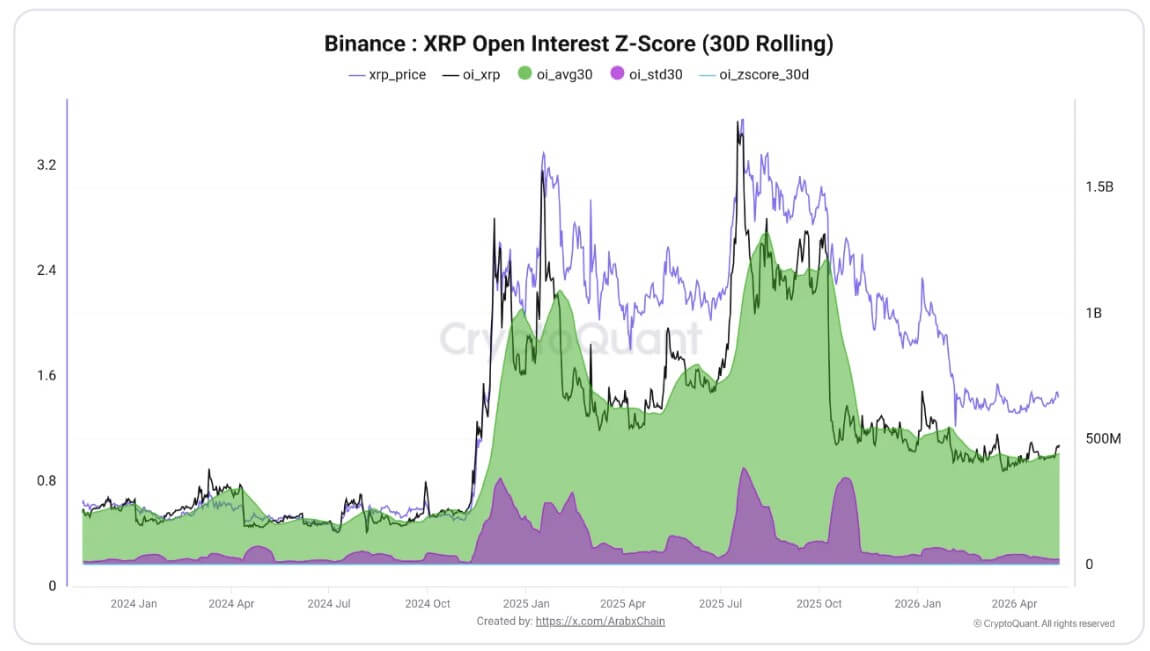
While a rising Z-Score is not an explicitly bullish indicator, it does indicate growing risk exposure that could lead to sharp volatility.
Institutional interest remains high on the spot market. Exchange-traded XRP funds recorded an inflow of $25.8 million on May 11, the largest in a single day since early January, bringing cumulative inflows to $1.36 billion.
This institutional demand is reflected by the behavior of major chain holders.
Facts from blockchain analytics firm Santiment reveals that the number of wallets holding at least 10,000 XRP has reached an all-time high of 332,230.
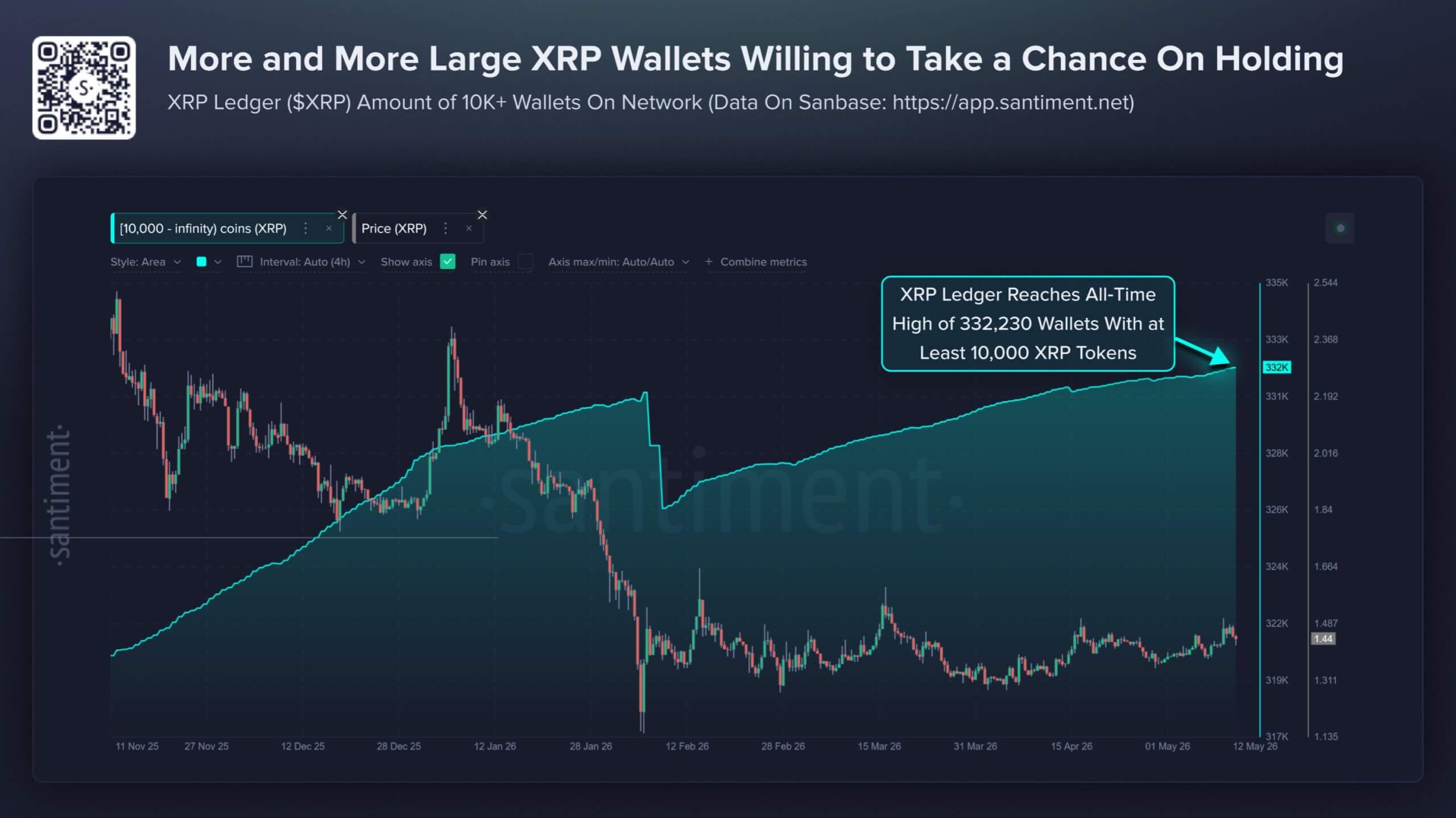
This group of investors has shown consistent accumulation since June 2024, absorbing selling pressure during periods of intense market volatility.
Notably, these large holders quickly resumed their accumulation following a crypto-wide liquidation in early February, indicating a strong long-term belief that the network’s continued structural upgrades will eventually be reflected in asset valuations.
Despite these robust fundamental developments, XRP price action has remained relatively subdued, trading around $1.45 compared to previous levels..