

Bitcoin has failed three attempts to break above the $82,000 area, with short-term holders repeatedly selling off, according to a May 15 market briefing from on-chain analyst Axel Adler Jr.. The setup puts the market in a tight technical and behavioral squeeze, with the 200-day simple moving average acting as resistance while short-term profitability numbers for holders remain stuck near breakeven.
Adler’s latest Bitcoin Morning Short describes the current structure as more than a standard resistance test. The price is caught between the realized cost basis of short-term holders and the 200-day SMA, with each rebound prompting the same response from recent buyers: distribution rather than renewed conviction.
“The price is stuck between short-term holders’ realized cost basis level and the 200D SMA, and every bounce is met with the same reaction: STH uses strength to exit, preventing the market from rising any further,” Adler wrote. “Together, the two charts show not only technical resistance, but also a behavioral trap.”
The key level in Adler’s analysis is $82.1K, identified as the 200-day SMA and the upper limit of the current resistance zone. Bitcoin has approached that level three times since April 2026, but each attempt ended in a pullback. Below, Adler points to the STH 1W-1M realized price of $77.9K as the key support reference, keeping Bitcoin compressed into a corridor around $4,200.
Related reading
That range is important because it combines a widely viewed trend indicator with the cost basis of recent market participants. According to Adler, the lack of abnormal volume spikes during the failed upward attempts suggests that buyers have not shown enough aggression to absorb the supply at the top end of the range.
“As long as the price remains below $82.1K, the resistance structure remains intact,” the letter said. “Confirmation of a regime change would require a confident daily close above the 200D SMA alongside rising volume. Without that, any upswing remains a candidate for selling.”
Bitcoin STH SOPR remains the pressure gauge of the market
The second part of Adler’s argument concerns SOPR for the short-term holder, a measure that tracks whether recently moved coins are issued at a profit or loss. According to the letter, STH SOPR has recovered from the extreme lows of February 2026, but has still not managed to sustainably stay above the 1.0 threshold.
That level is central to the current lecture. When STH SOPR moves towards 1.0 and rolls, it indicates that short-term holders are using rallies to close around breakeven rather than remaining positioned for further upside. Adler said both the seven-day and 30-day moving averages are hovering near that line, reinforcing the idea that supply is reemerging just where a stronger rally would need confirmation.
Related reading
“Every time the price tries to rise, the SOPR briefly moves toward 1.0 and then quickly falls back,” Adler wrote. “This means STH is using rallies to get out of the market rather than holding positions in anticipation of further upside. This pattern is a sign of a market where supply dominates demand at the breakeven zone.”
The interaction between the two graphs is the main point of the assignment. Adler states that the failed breakouts around $82.1K were accompanied by an STH SOPR moving towards 1.0 and then reversing, creating the resistance zone both technically and behaviorally. The 200-day SMA defines the card barrier; short-term sales to holders help enforce this.
“This is not a coincidence, but a mechanism,” Adler wrote. “The resistance at $82.1K is not only maintained technically via the 200D SMA, but also behaviorally – by STH itself, who are using this zone to sell when the market tries to move higher.”
Outbreak conditions remain limited
For Adler, the bullish trigger is clear but unconfirmed. Bitcoin would need a decisive daily close above $82.1K, supported by rising volume, while the STH SOPR’s seven-day moving average should remain above 1.0 for several consecutive days. That combination would indicate not only a technical break from the 200-day SMA, but also a shift in short-term holders’ behavior from selling at breakeven to holding positions in earnings.
Until then, the current regime remains neutral, with a cautious approach. A fourth rejection near the same zone would risk the price moving back toward $77.9K, the support level cited by Adler for short-term holders. If that support does not hold, the letter warns that lower support levels could be in sight again.
In other words, the market doesn’t just wait for the price to clear a line on the chart. We have to wait until recent buyers no longer view this line as an exit.
At the time of writing, BTC was trading at $80,453.
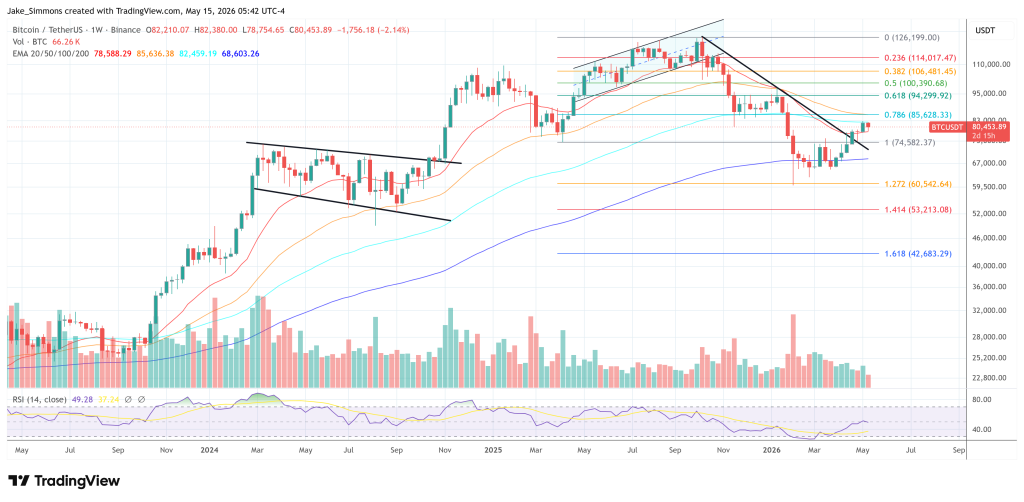
Featured image created with DALL.E, chart from TradingView.com