

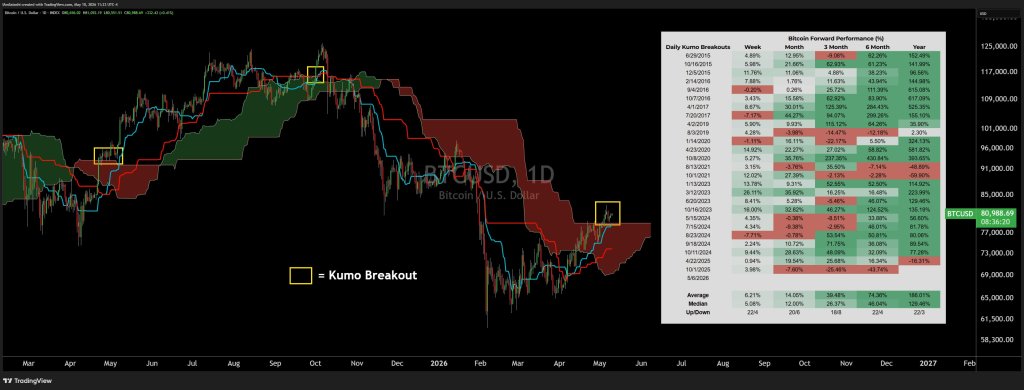
Bitcoin has sparked another daily Kumo breakout, bringing a historically bullish technical signal back into focus. Analyst Josh Olszewicz, who goes by CarpeNoctom, shared a chart where X tracks BTC’s forward performance after each daily Kumo breakout since 2015.
“BTC forward performance of daily Kumo breakouts since 2015”, CarpeNoctom wrotenext to a TradingView chart showing the last breakout on May 6, 2026.
What this means for the Bitcoin price
The historical table attached to the chart shows a notable positive skew between the completed signals. After previous daily Kumo breakouts, Bitcoin was higher 22 out of 26 times a week later, with an average gain of 6.21% and an average gain of 5.08%. A month later, BTC was positive in 20 out of 26 cases, with an average return of 14.05% and a median of 12.00%.
Related reading
The stronger historical profile of the signal appears over longer windows. Three months after the outbreak, Bitcoin was higher in 18 out of 26 cases, with an average gain of 39.48% and a median of 26.37%. Six months later, BTC was positive in 22 out of 26 cases, with an average return of 74.36% and a median of 46.04%. The one-year data is even more striking: across the completed samples, Bitcoin was higher in 22 out of 25 cases, with an average gain of 186.01% and an average gain of 129.46%.
The largest one-year returns were achieved during major bull market phases. Breakouts on September 4, 2016 and October 7, 2016 preceded annual gains of 615.08% and 617.09%, respectively. The April 1, 2017 signal was followed by a 525.35% one-year increase, while the April 23, 2020 breakout led to a 581.82% one-year increase. Another breakout in October 2020 saw a three-month move of 237.35%, a six-month move of 430.84%, and a one-year return of 393.65%.
The graph also shows that the signal is not equally reliable everywhere. Breakouts during weaker or late-cycle conditions produced negative forward returns in several cases. The August 13, 2021 breakout was followed by a 48.89% one-year decline, while the October 1, 2021 signal preceded a 59.90% one-year decline. More recently, the April 22, 2025 breakout showed positive returns over one week, one month, three months and six months, but after one year it fell 16.31%.
Related reading
The most recent completed signal before the May 2026 breakout, dated October 1, 2025, also remains a cautionary data point. Bitcoin rose 3.98% after one week, but fell 7.60% after one month, 25.46% after three months and 43.74% after six months. The one-year return is not yet available in the table.
For traders, the chart views the Kumo breakout less as a standalone prediction and more as a historically asymmetric trend signal. The average returns suggest that the pattern has often produced meaningful upward continuation, but the failed signals cluster around periods when the broader market structure deteriorated post-breakout.
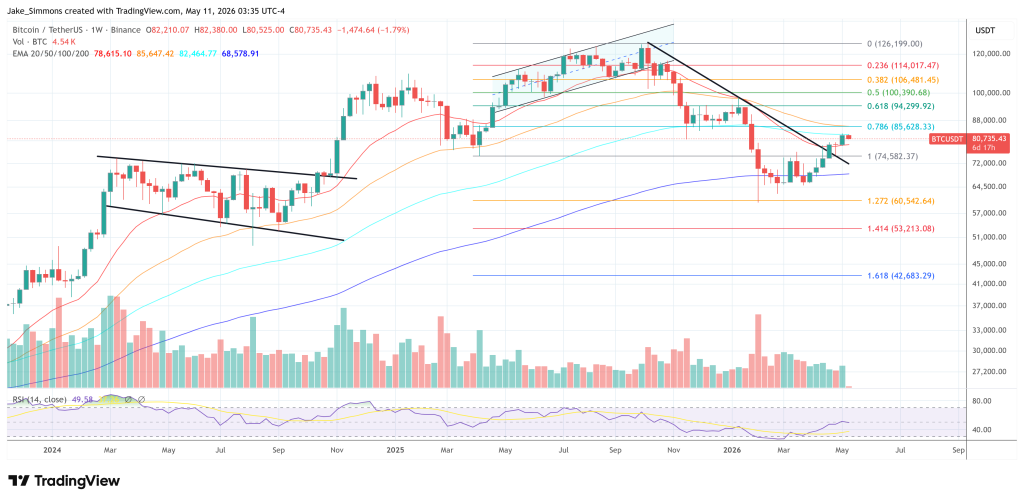
At the time of writing, BTC was trading at $80,735.
Featured image created with DALL.E, chart from TradingView.com