
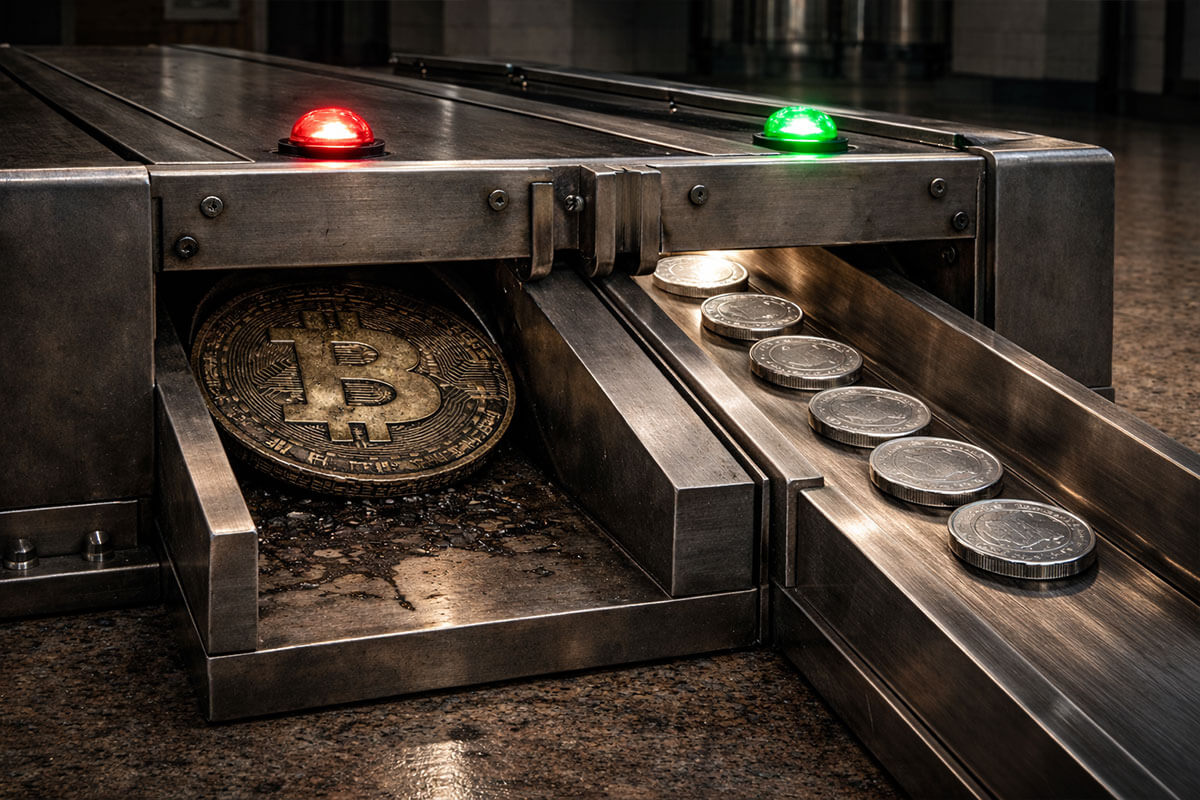
Congress has introduced the Digital Asset PARITY Act, a bipartisan bill introduced by Representatives Steven Horsford and Max Miller, which would rewrite Section 1091 to cover “specified assets.”
The category explicitly includes actively traded digital assets and their derivatives, and distinguishes a limited class of regulated payment stablecoins from the routine recognition of gain or loss.
The depth hits harder on the side of hard action than on the side of help, and that asymmetry gives the proposal its sharpest edge.
For years, crypto traders have exploited a gap that stock investors cannot fill. Under current law, wash-sale rules apply to “shares or securities,” a definition that excludes digital assets.
A trader could sell Bitcoin at a loss, buy it back the next day and still claim the tax deduction, a maneuver the IRS explicitly prohibits in the stock markets.
The draft PARITY Act closes this gap by rewriting Section 1091 to include actively traded digital assets, associated fictitious principal contracts, and related derivatives, including options, futures, futures, and short positions.
The familiar 30 day before and after replacement window applies, and the wash sale changes will take effect as soon as they go into effect.
| Subject | Current law | PARITY bill |
|---|---|---|
| Section 1091 applies to | Shares or securities | “Specified assets” |
| Digital assets covered? | No | Yes, if actively traded |
| Derivatives covered? | Not as crypto assets | Yes: options, forwards, futures, shorts, related contracts |
| Replacement window | 30 days before/after | Same |
| Effective date | Already in effect for shares | After entry into force |
The stablecoin carveout
On the other side of the ledger, it states that sellers recognize no gain or loss on the sale of a ‘Regulated Payment Stablecoin’, provided the transaction remains within the range of $0.99-$1.01 per unit.
When the exception applies, the taxpayer’s basis in the stablecoin is deemed to be $1.00 per unit for purposes of calculating any remaining gain or loss.
The exception does not extend to brokers or traders in securities or commodities, and related party transactions have explicit anti-abuse flags, although these guardrails are subject to technical scrutiny.
A stablecoin must be a payments stablecoin under the GENIUS framework, a permitted issuer must issue it, it must be pegged exclusively to the US dollar, it must trade within 1% of $1.00 on at least 95% of trading days in the previous 12 months, and the taxpayer must acquire it within 1% of $1.00.
The stablecoin section would take effect for fiscal years beginning after December 31, 2025, and the explanatory memorandum to the draft notes that Congress is still working on whether to include a $200 per transaction threshold and an aggregate annual limit in the final text.
That internal candor separates the stablecoin side from the wash-sale side, making the latter read like policies Congress has already decided.
The stablecoin breakdown reflects the policy Congress wants, with Congress expecting the Treasury Department to provide anti-abuse rules for coordinated arrangements, but not yet enshrining these guardrails in the black-letter text.
| Qualification factor | Depth requirement/treatment |
|---|---|
| Item type | Must be one Regulated payment Stablecoin |
| Regulatory status | Must qualify as a payment stablecoin under the NEW framework |
| Publisher | Must be issued by a authorized issuer |
| Pin | Must be secured exclusively on the US dollar |
| Trading Stability Test | Must act indoors 1% of $1.00 at least 95% of trading days in the previous 12 months |
| Acquisition test | The taxpayer must acquire it within 1% of $1.00 |
| Transaction price band | Sales/exchanges must remain indoors $0.99 – $1.01 per unit |
| Tax results are an exception | No gain or loss is recognized for sale |
| Basic treatment | The taxpayer’s basis is deemed to be $1.00 per unit for each residual profit/loss calculation |
| Excluded parties | Do not apply to brokers or dealers in securities or commodities |
| Guardrails against abuse | Related party/coordinated arrangement rules are highlighted but still covered technical editorial review |
| Effective date | Applies to taxable years beginning afterward December 31, 2025 |
| Open problem in concept | Congress is still considering one Threshold of $200 per transaction and a possible one annual total limit |
The policy design
Congress is using the tax code to distinguish between “crypto as payment” and “crypto as commerce.”
The stablecoin market is now around $316 billion, with transaction volume exceeding $34 trillion last year, and a Wharton/WEF analysis found that roughly 99% of stablecoin activity still involves trading digital assets rather than payments.
Congress offers tax credits for the use case it wants to encourage, and writes new fees into the use case it wants to restrict.
The wash-sale rule does not apply when the taxpayer applies mark-to-market accounting to the specified asset, and the design separately creates a mark-to-market choice for dealers and traders in digital assets.
The political loser, more specifically, is the ordinary taxpayer who uses spot crypto for tax loss harvesting.
Advanced trading companies could gain access to a cleaner election framework than the current law provides.
The IRS has finalized reporting rules for brokers for digital asset sales, requiring Form 1099-DA for transactions beginning January 1, 2025, with brokers required to provide taxpayer copies by February 17, 2026.
Most statements for 2025 do not include a cost basis, meaning taxpayers must calculate this themselves. This means that Congress is debating anti-abuse reforms at the exact moment that private crypto holders are experiencing standardized reporting for the first time.
The policy direction also reflects a broader consensus that predates the draft. The 2025 White House Digital Assets Report recommended expanding wash-sale rules to digital assets, while explicitly stating that these rules should not apply to payment stablecoins.
The 2025 Joint Committee on Taxation report identified the current gap in sales and the lack of a de minimis rule for routine spending on digital assets.
With the PARITY Act, Congress is attempting to codify a split that tax policy had already mapped out.
Where it lands
In an optimistic outcome, lawmakers neatly finalize the stablecoin language, align it closely with the GENIUS definitions, and tie the wash-sale crackdown to a clear threshold of $200 per transaction, making small payments truly frictionless.
As a result, the tax law accelerates the adoption of regulated dollars across the chain. Visa data shows that more than 99% of stablecoin offerings are dollar-denominated, and leading issuers earned more than $7 billion in reserve revenue.
If the OCC’s expected issuer base under GENIUS is fully populated, the exception will cover a significant portion of dollar stablecoin volume. Crypto gets a cleaner payment trail and a more equal trading framework at the same time.
In the worst case, the wash sale, short sale and derivatives coverage survive with little dilution, while the stablecoin section gets stuck in technical review and never reaches a final clean text before the legislative calendar tightens.
The mark-to-market election benefits professionals who can navigate an election framework, and retail investors are the quickest to lose the loophole, without offsetting any simplification on the payment side.
Wider crypto legislation had reached a new impasse, with banks and crypto companies still arguing over the stablecoin economics.
The PARITY Act, as a discussion draft with multiple sections explicitly marked for ongoing technical work, is caught in exactly that stalemate. Taxpayers enter the 2026 filing season under new 1099-DA reporting requirements, with Congress pointing to reforms without yet enacting them.
| Scenario | Wash sale rules | Stablecoin carveout | Main winners | Main losers |
|---|---|---|---|---|
| Optimistic | Adopted largely as drafted | Neatly rounded off, possibly with a clear threshold of $200 | Regulated stablecoin users, compliant companies | Tax loss harvesters |
| At worst | The repression survives | Help lingers on technical assessment | Professional traders using MTM elections | Retail crypto holders |
Congress has more certainty about closing the loophole than about the final contours of the stablecoin carveout.
The wash sale rewrite is the harder side of the design because it is concrete, broad in scope and ready to move. The stablecoin relief is the softer edge, presenting itself as directionally clear, mechanically unfinished, and dependent on a framework of regulated issuers that the OCC is still building out.
The version of the bill that actually comes to a vote will reveal which coalition Congress was less uncomfortable about disappointing.