
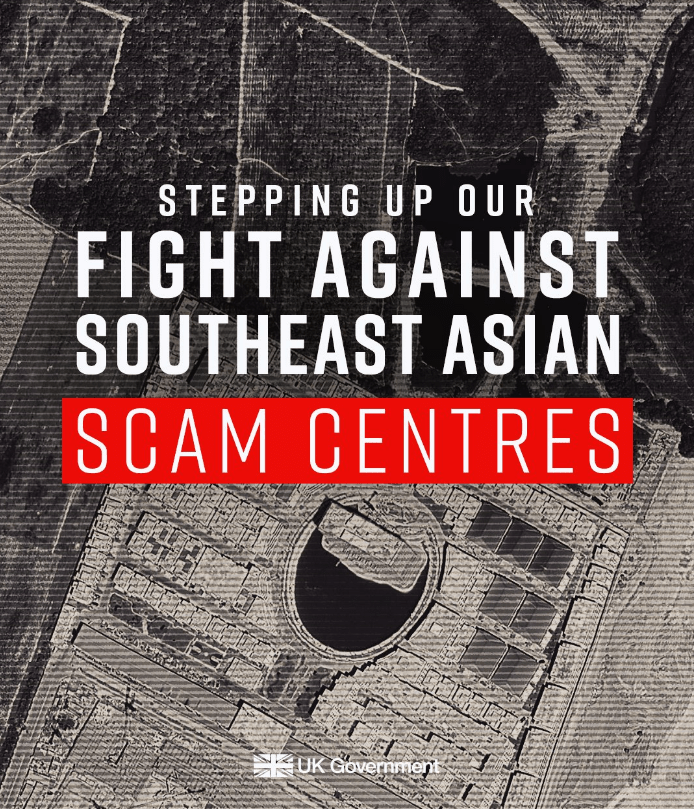
Blockchain analytics firm Chainalysis puts the number at nearly $20 billion – the estimated volume of black money that flowed through Xinbi, a Chinese-language crypto marketplace, between 2021 and 2025. Now the British government wants to close it.
Related reading
Scam Hubs are at the center of it all
The British Foreign, Commonwealth & Development Office announced on Thursday that it has imposed drastic measures sanctions on Xinbi, a platform accused of providing crypto-based services, scam tools and other criminal tools to bad actors in Southeast Asia.
The move will freeze all UK-linked assets linked to the platform and ban UK banks, crypto companies and citizens from doing business with it – financial or otherwise.
Xinbi is not just a payment processor for criminals. Reports indicate that the platform is at the center of a web of interconnected illegal operations, many of which are linked to fraud schemes spanning Southeast Asia – operations that have attracted global attention for using trafficked workers to run large-scale fraud schemes that target victims around the world.
Those who exploit vulnerable people, violate human rights and deceive innocent victims will face serious consequences.
Today we have:
❌ Targeting the largest known scam complex in Cambodia.
❌ An illegal crypto marketplace sanctioned.
❌ Frozen more properties in London. pic.twitter.com/0PFp0h8Uyt— Foreign, Commonwealth and Development Office (@FCDOGovUK) March 26, 2026
Two people were also punished during the action. Thet Li is accused of running the international financial network of the Prince Group, a Cambodia-based company linked to large-scale operations cryptocurrency fraud. Hu Xiaowei is said to have worked within that same financial network and has ties to #8 Park, a fraud company linked to the Prince Group.
Cutting off the money pipeline
Chain analysiswhich provided blockchain data in support of the sanctions, described the move as targeting the on- and off-ramps of the scam ecosystem – the critical routes through which criminal actors can move money in and out of the legitimate financial system.
According to the company, Xinbi acted as a commercial hub, offering payment processing and marketing services to fraudsters who needed a reliable infrastructure to carry out their schemes.
The FCDO said the sanctions are intended to isolate Xinbi from the broader crypto system, disrupting its ability to send and receive transactions. In practice, this means cutting off the platform from the exchanges, wallets and financial services it depends on to function.
Related reading
A line between legal and illegal cryptocurrencies
What was striking about the British government’s statement was the language used. Officials drew a clear line between legitimate crypto activity and criminal misuse of the technology — a distinction that regulators have not always been quick to make publicly.
That framing is important for the sector. For years, critics have pointed to crypto’s role in fraud and money laundering as evidence that the entire sector needs to be reined in. The Financial Action Task Force estimates that between two and five percent of global GDP passes through traditional financial networks as laundered money every year.
Data from Chainalysis shows that illegal crypto transactions make up less than 1% of total on-chain activity – a figure the industry often cites in its defense.
Featured image from Pixabay, chart from TradingView