
Proceeds from Bitcoin sales have paid for healthcare, environmental programs and salaries of government workers in Bhutan – a detail that brings the kingdom’s latest crypto movement into sharper focus.
Related reading
A small nation with a big Bitcoin strategy
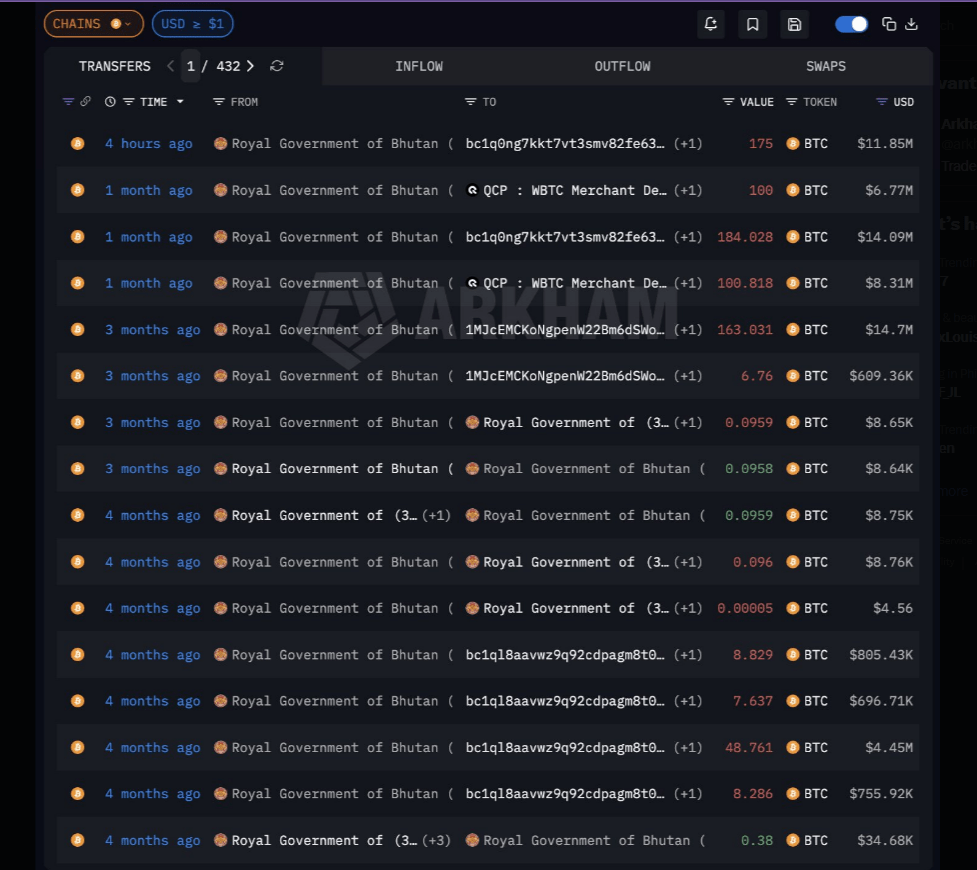
On Monday, blockchain analytics firm Arkham flagged a transfer of 175 Bitcoinworth approximately US$11.85 million, from Bhutan’s main government portfolio.
The money was moved to an address created about a month ago where 184 Bitcoin had already been received from state accounts. As of Tuesday, the coins had not been moved. No sale has been confirmed.
But the transfer fits a pattern that Arkham has been following for months. Data shows that Bhutan tends to sell Bitcoin in batches of $5 million to $10 million at a time. The heaviest sales ever occurred in mid-to-late September 2025.
In February, a similar transfer preceded a $7 million sale to Singapore-based crypto trading firm QCP Capital.
Bhutan just pulled another $11 million worth of Bitcoin from its major holding addresses.
The last time they did this was 1 month ago, and they sold $7 million worth of BTC with QCP Capital.
Bhutan periodically sells off chunks of its Bitcoin at $5-10 million clips, with one particular… pic.twitter.com/tBuz280bBe
— Arkham (@arkham) March 9, 2026
How Bhutan built its stockpile
The kingdom did not buy its Bitcoin on an exchange. It mined it. State-backed operations began in 2019 and were powered almost entirely by hydropower.
During the summer months, Bhutan’s rivers flow quickly and full, creating surpluses for hydroelectric power plants. Instead of wasting that extra electricity, officials focused it on Bitcoin mining.
That strategy roughly delivered 13,000 Bitcoins over several years, making Bhutan one of the largest sovereign wealth holders in the world.
Arkham currently estimates the country’s assets at around 5,400 Bitcoin – a figure that reflects years of periodic sales. Among the countries, Bhutan ranks seventh. The US is in first place by a wide margin, with 328,372 Bitcoins worth almost $22 billion.
The April 2024 halving had a severe impact on the company’s profitability. Mining rewards fell to 3,125 Bitcoin per block, increasing the effective cost of each coin produced.
Since then, Bhutan has increased its sales, and some Bitcoin miners worldwide have shifted their computing power to artificial intelligence and data center work.
Related reading
Druk Holding manages the portfolio
All of Bhutan’s digital assets – including Bitcoin – are controlled by Press Holding and Investments, the country’s sovereign wealth fund. The wallet also contains smaller amounts of Ether and a memecoin called KiboShib, which is reportedly generated by artificial intelligence.
What makes Bhutan’s position unusual is the extent to which its crypto activity is rooted in fundamental government finances. The kingdom does not rely on Bitcoin as a long-term ideological bet. It’s mining when energy is cheap, selling when prices allow, and using the money to keep the lights on.
Featured image from Unsplash, chart from TradingView