

Arthur Hayes has put Zcash at the center of his crypto thesis, saying in an interview with Unchained founder Laura Shin that ZEC is now “probably my largest position outside of Bitcoin.” The BitMEX co-founder described the trade as a bet on rising demand for financial privacy as AI, Big Tech and governments make public chain activity easier to analyze.
Hayes said he views Zcash as the strongest privacy asset in crypto, while acknowledging that the debate between Zcash, Monero and other privacy coins remains unsettled. “I think Zcash is the best,” Hayes said. He added that he is “not a cryptographer” but said his opinion was formed by reading competing arguments and speaking to developers working directly on privacy systems.
His argument was not that Bitcoin should become completely private. Hayes said Bitcoin’s transparent ledger still has accountability benefits, but argued that transparency comes with an increasing trade-off as surveillance tools improve. “With AI, big tech and big governments, it is very trivial to de-anonymize transactions,” he said.
Related reading
According to Hayes, that creates room for a separate privacy item that can build value alongside Bitcoin rather than within it. He described Zcash and Monero as trading at very low relative values to BTC and called the setup asymmetrical as the demand for privacy for investors becomes clearer. The catalyst, as he sees it, is not merely regulatory burden or user preference, but the exponential improvement of AI systems that can link activities from public data sets.
Arthur on why the Zcash and NEAR integration is the quietly building mechanism that turns NEAR from inflationary to deflationary
“With Shielded Zcash you can exchange and send any coin, USDT on Tron, Bitcoin, whatever, and that transaction won’t point back to you. Totally… https://t.co/AOWKNsDRbc pic.twitter.com/tytoAgM5q0
— Laura Shin (@laurashin) May 12, 2026
Hayes connects Zcash and NEAR in latest essay
Hayes expanded on this statement in his latest Crypto Trader Digest essay, “The Butterfly Touch,” dated May 11 on his Substack. In the essay, Hayes argues that rising liquidity in dollars and yuan, driven by spending on AI infrastructure, geopolitical conflicts and renewed credit creation, has reopened the risk window for crypto markets. He said Bitcoin bottomed at $60,000 earlier this year and argued that a move back to $126,000 is a “foregone conclusion” if fiat liquidity continues to increase.
Related reading
The altcoin section of the essay was more explicit. Hayes wrote that it’s “time to shitcoin,” saying that Hyperliquid and Zcash already have enough positions for Maelstrom, while NEAR is his “next favorite” trade. He said his next essay would outline why the “privacy story” combined with Near Intents could create a “positive cash flow situation” for the protocol.
This framing connects Zcash and NEAR under a broader privacy-and-utility thesis. Zcash represents Hayes’ pure-play privacy exposure, while NEAR appears to be the next asset he wants to tie into that theme through intent-based execution and potential protocol-level cash flow. He argued that such a setup could help reverse NEAR’s weak token performance and potentially push it back to older cycle highs.
For Zcash, Hayes’ case is more direct. He said privacy will likely become more valuable as public blockchains become easier to interrogate with increasingly capable AI systems. “People want that privacy,” he said. “And there will be a private alternative.”
At the time of writing, Zcash was trading at $541.75.
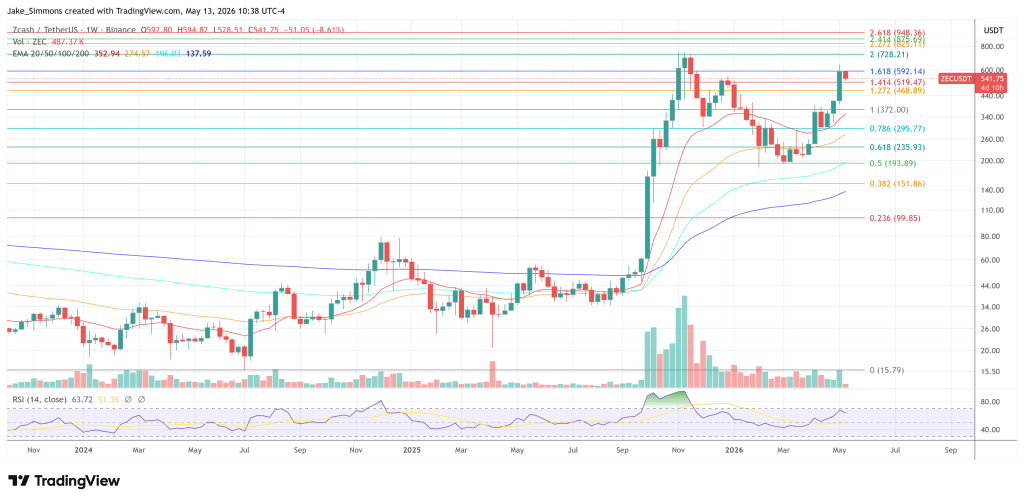
Featured image created with DALL.E, chart from TradingView.com