
New synergy Quantum economic analysis applies Nobel Prize-winning economic principles to explain mass inaction in post-quantum cryptography – while late adopters face ‘crypto delay penalty’ and economic subjugation
NEW DELHI and GENEVA, January 3, 2026 /PRNewswire/ — A groundbreaking economic analysis released today by quantum security firm Synergy Quantum warns that countries face an unprecedented crisis of sovereignty as quantum computers approach the ability to break encryption, potentially exposing $12.4 trillion in global digital assets by 2035.
The report, co-authored by CEO and co-founder Jay Oberai, co-founder Dr. Vipin Rathi and strategic advisor Sudhir Raoreveals that adversaries are already launching ‘Harvest Now, Decrypt Later’ attacks – collecting encrypted data today for future decryption when quantum computers become sufficiently powerful, possibly as early as 2028.
“This is not a future threat – it is a present reality with future consequences,” he warns Jay Oberai, co-founder and CEO from Synergy Quantum. “Every day without quantum-safe encryption is another day of accumulated sovereign risk. The data being stolen today includes military plans, infrastructure blueprints with a 50-year life cycle, and financial data that could destroy economies if exposed.”
The clock is ticking
Recent breakthroughs underline the urgency. Google’s Willow chip achieved subthreshold quantum error correction in December 2024, while IBM expects more than 100,000 qubit systems by 2033. IonQ suggests cryptographically relevant quantum computers by 2028.
“Achieving error corrections below the threshold was the holy grail,” explains Dr. Vipin Rathi, co-founder. “What seemed like a 2040 threat in 2020 is now a 2028 reality.”
Meanwhile, the regulatory burden is increasing. The EU’s Digital Operational Resilience Act (DORA) already requires cryptographic flexibility. The US requires federal migration by 2035, while Britain requires high-priority system migration by 2031.
“We see a perfect storm,” Oberai continues. “Quantum capabilities are increasing, regulations are tightening, yet 86% of financial institutions lack the expertise to even evaluate post-quantum cryptography solutions.”
The Ross Anderson Prophecy
The report is based on Professor Ross Anderson’s framework of security economics and shows that the challenge is not technical, but economic. Anderson showed that those who control protection (banks, governments) are not those who suffer from failures (citizens, customers).
“This liability dumping creates catastrophic incentive structures,” Oberai explains. “Telecommunications companies face equipment cycles of 20 to 30 years. The infrastructure built in the 2010s will still be operational if quantum computers can break its encryption.”
$12.4 billion solution to a trillion dollar problem
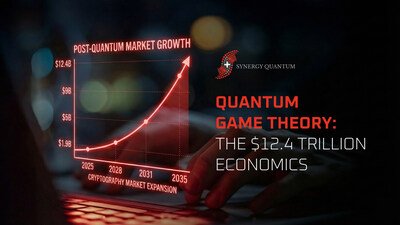
The post-quantum cryptography market will grow from $1.9 billion (2025) to $12.4 billion (2035). Yet this pales in comparison to potential losses.
“A successful quantum attack on SWIFT could freeze $5 trillion in daily transactions,” notes Sudhir Rao, Strategic Advisor. “We’re talking about a 100-to-1 return on security investments, but organizations are hesitant.”
Global preparedness varies dramatically:
- United States: $500 billion defense quantum initiatives
- European Union: DORA creates immediate compliance pressure
- China: Sovereign quantum programs with national standards
- Singapore: The National Quantum-Safe Network has already been implemented
- France: €1.8 billion in sovereign quantum investments
Sovereignty at stake
The report warns that quantum-safe migration is becoming technological colonialism. Countries without sovereign post-quantum capabilities risk permanent dependence on foreign solutions.
“We are witnessing quantum geopolitics,” says Oberai. “Countries that pass this transition will maintain their economic sovereignty and attract quantum-safe investments. Countries that fail will face ‘quantum vassalage’: a permanent dependence on others for digital security.”
The Synergy Quantum solution
Synergy Quantum, with partnerships including Quantinuum, NVIDIA, Thales, Nokia and Bosch, is championing ‘Sovereignty-as-a-Service’ – to help countries build indigenous quantum-safe capabilities.
The company’s Luna SecureOne™ Stack provides sovereign deployment frameworks across critical industries. The SynQ Threat Intelligence Platform quantifies economic impact, enabling informed investment decisions.
“We start by setting economic priorities – which systems generate revenue, protect sovereignty and ensure resilience,” explains Dr. Rathi out. “Technology follows strategy, not the other way around.”
Immediate action required
Sector-specific recommendations share a common urgency:
- Government & Defense: Establishment of national quantum safety authorities by 2026
- Banking: Meet DORA compliance, implement hybrid QKD for high-value transactions
- Telecommunications: Integrate post-quantum security into 5G/6G networks
- Critical infrastructure: Prioritize industrial control systems
The price of delay
Organizations that delay migration face a “crypto delay penalty”: compressed timelines increase costs three to five times and reduce security effectiveness.
“It’s basic game theory,” Oberai notes. “Early movers set standards and conquer markets. The shift to post-quantum cryptography will determine which countries retain sovereignty in the digital age.”
International coordination remains fragmented. The NSA recommends pure post-quantum signatures, while Germany requires hybrid signatures. Different countries endorse different algorithms.
“Organizations that navigate multiple standards gain competitive advantage,” notes Rao. “Those who wait for a single global standard will be paralyzed.”
The quantum dividend
Early movers can:
- Export quantum-safe technologies
- Attract safety-conscious investments
- Establish favorable standards
- Create new financial products
“Post-quantum security is not just defense, it is a competitive advantage,” Oberai emphasizes. “The first quantum-safe financial center will attract trillions of people. The first quantum-safe telecom network will become the backbone of global commerce.”
Looking ahead
The window for cost-effective migration is closing. “The decisions made over the next 24 months will determine digital sovereignty for 50 years,” Oberai concluded. “History will judge harshly those who knew the quantum threat was coming but chose to do nothing.”
Dr. Rathi warns: “Every encrypted communication today is a future vulnerability.”
Rao spells out the end result: “This is $12.4 billion to protect $12.4 trillion in assets. Few economic decisions have been so clear-cut.”
About Synergy Quantum
Synergy Quantum is a sovereign quantum security company that enables countries and critical infrastructure operators to maintain their sovereignty in the quantum age. Synergy Quantum offers comprehensive post-quantum cryptography solutions.
Report authors:
- Jay Oberai, co-founder and CEO
- Dr. Vipin Rathi, co-founder
- Sudhir Rao, strategic advisor and shareholder
Photo: https://web3wire.org/wp-content/uploads/2026/01/New_Synergy_Quantum_Economic_Analysis.jpg-
Logo: https://web3wire.org/wp-content/uploads/2026/01/Synergy_Quantum_LOGO.jpg

View original content to download multimedia:https://www.prnewswire.com/in/news-releases/quantum-game-theory-the-12-4-trillion-economics-crisis-as-nations-rush-to-protect-digital-assets-while-quantum-computers-race-toward-2028-encryption-breaking-capability-302652030.html