
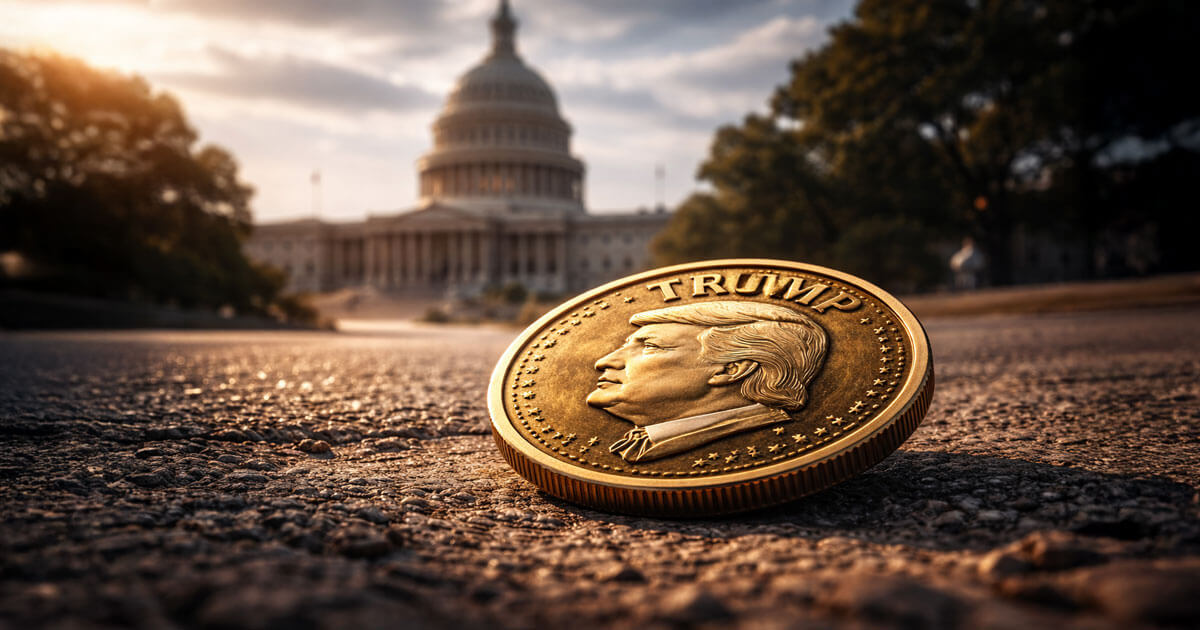

Charles Hoskinson recently argued that the launch of TRUMP, three days before President Donald Trump’s inauguration, derailed a 70-vote Senate majority for the CLARITY Act and turned unified crypto policy into a partisan fight.
In an interview, Hoskinson said that in December 2024, we expected about 70 senators to vote for the CLARITY Act and a supermajority of the House of Representatives, and that the launch of TRUMP before the bill passed turned crypto “from bipartisan to crypto equals Trump equals bad equals corruption.”
He also tied the coin’s launch to the Bitcoin-only rally that defined 2025, arguing that “government interference” and the Trump scandal disrupted flows away from altcoins and tied up capital in BTC.
It’s a compelling story: one bad decision by Trump blew up policy and market structure. The legislative record and market data tell a more complicated story.
TRUMP launched in January 2025 with 200 million tokens sold and 800 million retained by Trump-controlled entities.
Ethics experts and some pro-crypto Republicans immediately labeled it a vehicle for a conflict of interest: a sitting president selling a meme coin while setting crypto policy. The first concrete consequences of the legislation appeared on May 6.
Maxine Waters pulled the plug on a joint House Financial Services and Agriculture hearing on crypto market structure rules, explicitly citing Trump’s memecoin and World Liberty Financial as abuses of power.
Hoskinson is right when he says TRUMP has made the legislative path more difficult. But a few details complicate the picture. First of all, crypto had already entered Trumpworld before the coin.
Trump campaigned as “the crypto president,” raising significant amounts of money from the industry and inking a lucrative deal with World Liberty Financial, where his family claims a large share of the token and fee revenue.
Ethical concerns about that deal and the USD1 stablecoin surfaced long before Waters ended that hearing in May. Second, the legislative saga did not end with the canceled hearing.
Despite the drama, Republicans in the House of Representatives and some Democrats have still introduced core bills.
In mid-2025, the House of Representatives passed the GENIUS Act for stablecoins and the Digital Asset Market Structure CLARITY Act with bipartisan votes, although far from unanimously.
The reporting highlighted that “many Democrats strongly oppose” the package, seeing it as too friendly to industry and too intertwined with Trump’s personal businesses, even as others crossed the aisle to vote yes.
That coalition looks different from the cakewalk of 70 senators that Hoskinson described. It’s the GOP that’s nearly united, along with a minority of Democrats, as a vocal progressive faction and ethics hawks push back.
Third, Waters’ objection focused on self-dealing and abuse of office, not partisan hostility toward crypto. She argued that she couldn’t participate in a hearing on “crypto market structure” while the sitting president was running a memecoin and stablecoin empire that could personally benefit from whatever regime they wrote.
The distinction is important: it wasn’t that Democrats suddenly decided that “crypto equals Trump.” It used to be that Trump’s projects made questions about conflicts of interest inevitable.
Voting and the timeline
There is no public count showing that seventy votes were cast in favor of CLARITY in the Senate in December 2024. The data shows that congressional committees have introduced bills with bipartisan votes, but Democrats are increasingly divided between centrists and progressives.
Stories about World Freedom and TRUMP hardened opposition among Democrats who might otherwise have been persuasive. At least one major hearing was canceled because of these Trump-linked projects, Waters said in her statement.
There was a two-pronged path for crypto, but it was fragile and conditional on the White House not turning regulations into a vehicle for presidential enrichment.
TRUMP exposed a conflict of interest problem that many Democrats were already nervous about, instead of creating partisan opposition from the start.
Even after TRUMP’s response, Congress still managed to pass GENIUS and remove CLARITY from the House, suggesting the memecoin didn’t kill the legislation outright.
The Bitcoin-only rally was already baked in
Hoskinson also linked the Bitcoin-only rally and lagging alts to “government interference” and the memecoin saga. The market data points to several factors.
Several independent reports from 2025 addressed the same themes. An institutional and retail flow shock into spot Bitcoin ETFs, with research showing new ETF buyers overwhelmingly focused on BTC, a pattern that was “pulling capital away from the broader altcoin market.”
A maturing, more cautious market, with CoinGlass and other derivatives shops flagging “continued weakness in ETH and the broader altcoin market,” coupled with reduced risk appetite, tougher competition and a lack of new killer apps, not just politics.
Bitcoin’s dominance rose until mid-2025, with market commentary repeatedly pointing to BTC’s share of total crypto market capitalization reaching 70% in the mid-1960s, while altcoins lagged behind even during upswings.
A June analysis explicitly linked this to ETF-driven demand being “treated the same as gold,” with buying dips and persistent pumping, while altcoin liquidity remained scarce.
When we zoom in on coins like XRP or SOL, we see a story driven by product and regulatory issues: ETF approvals and pauses, uncertainty around which assets the SEC will tolerate in exchange-traded packaging, and uneven institutional custody support.
When the SEC greenlighted and subsequently paused a Bitwise altcoin index ETF conversion, XRP and other majors suffered the consequences of regulatory uncertainty, not TRUMP drama.
Trump’s memecoin and World Liberty scandals increased headline risk and made some institutions more cautious about crypto exposure, while ethical questions remained unresolved.
The main reasons why this cycle resembles “Bitcoin first, maybe alts later” are structural. ETFs and government bonds made BTC the cleanest institutional trade. The regulations are clearer for BTC and, to a lesser extent, ETH than for most altcoins. Risk appetite and innovation are lower outside a handful of L1 ecosystems.
None of this required TRUMP to exist.
Still, Hoskinson is right about the optics. Launching a presidential memecoin before a major bill was always going to complicate politics.
Waters May’s statement makes that concrete: she could not negotiate the market structure while the president was making money from his office through the same instruments they were trying to regulate.
However, the broader causal claims end up in the data. As of December 2024, no 70-vote Senate coalition was documented. There was a fragile bipartisan opening that made Trump’s crypto empire, first World Liberty and then TRUMP, politically more difficult for Democrats who feared endorsing self-dealing.