

Journalist
Posted:
The California Public Employees’ Retirement System (CalPERS), the largest public pension fund in the United States, has suffered a painful blow to its investment in MicroStrategy (MSTR).
CalPERS is experiencing heavy losses due to MSTR
A recent SEC submit revealed that CalPERS acquired 448,157 shares of MicroStrategy (MSTR) during the third quarter and invested more than $144 million in the position.
However, after a sharp sell-off in shares, the value of this stock has fallen to around $80 million within just a few months.
While the decline represents a steep percentage loss, the impact remains structurally manageable for CalPERS. The fund oversees more than $550 billion in assets for more than 2 million public sector employees and retirees, meaning MSTR stock is only a small but highly volatile part of its massive portfolio.
The 45% drop in MSTR’s share price this quarter is closely tied to Bitcoin’s decline. The broader risk-off sentiment has further pressured high-beta technology and cryptocurrency-related assets, widening losses.
Looking ahead, the biggest structural risk for MicroStrategy may not just be price volatility.
Instead, the company faces the possibility of exclusion from major stock benchmarks, including the MSCI USA Index and the Nasdaq 100, which could have a significant impact on investor demand.
JPMorgan signals the same threat
JPMorgan has identified a significant risk for MicroStrategy (MSTR) due to its heavy dependence on Bitcoin [BTC]. This reliance would violate index rules intended to distinguish operating companies from pure investment vehicles.
The stakes are high because passive funds track these benchmarks and currently hold nearly $9 billion worth of MSTR stock. An exclusion from the indices would therefore have significant consequences.
According to JPMorgan, removal from the MSCI USA Index alone could lead to an outflow of $2.8 billion. If other index providers follow suit, the impact could be as much as $8.8 billion.
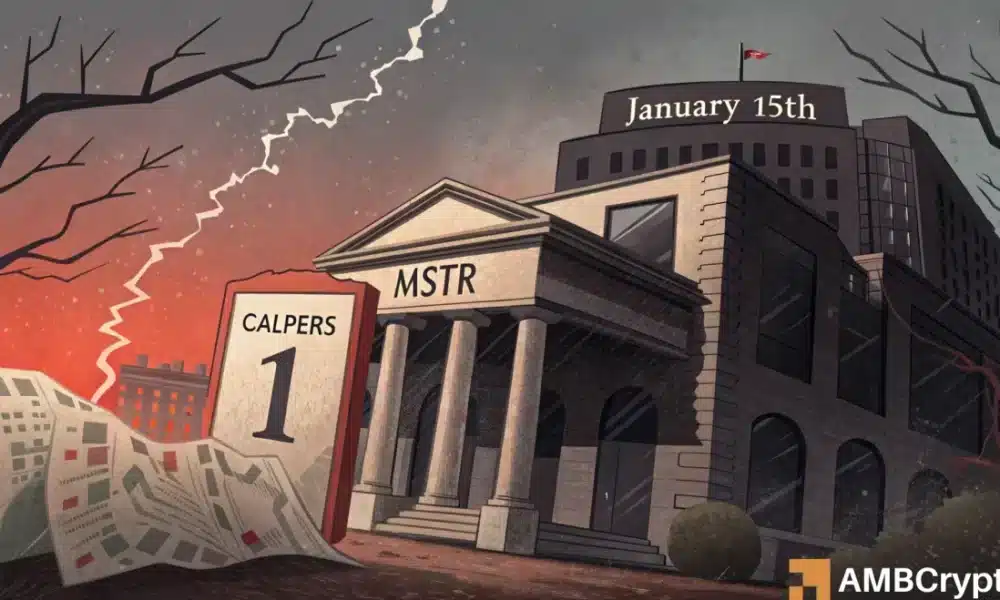
MSCI is scheduled to announce its decision on January 15. Should MSTR be removed, passive funds would be forced to liquidate their positions.
MicroStrategy’s growth strategy was based on issuing shares to buy Bitcoin and using rallies to raise additional capital. This approach has pushed MSTR’s market value far above the true value of its Bitcoin holdings, increasing both its exposure and vulnerability.
What’s more?
MSCI considers MSTR a passive fund, a classification strongly disputed by CEO Michael Saylor, who cites the company’s $500 million software business and its active efforts to raise capital.
Investment bank TD Cowen also predicts that a foreclosure could trigger up to $8 billion in foreclosures.
While MSTR assures that its assets will cover its debts by a ratio of 5.9x even if Bitcoin falls to $74,000, market skepticism remains about its shrinking multiple-to-net asset value (mNAV).
Final thoughts
- MSTR’s 45% stock decline is directly related to Bitcoin’s volatility and overall sense of risk.
- The main threat is the exclusion from the MSCI index, which risks up to $8.8 billion in passive fund sales.