

Bitcoin suffered a sudden and deep decline in November, losing almost a quarter of its value and wiping out more than $1 trillion in the crypto market.
Related reading
Whales trim their position before the crash
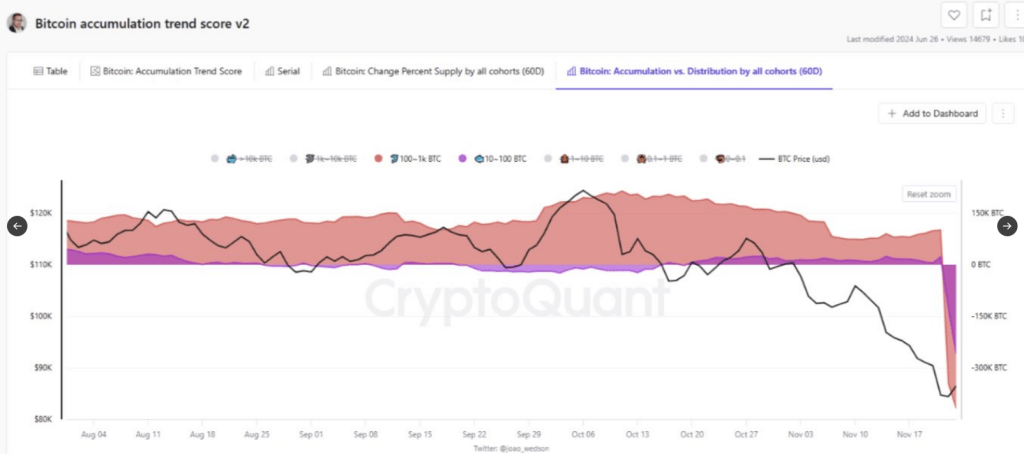
According to on-chain data from CryptoQuantmajor holders played a central role. Portfolios holding between 1,000 and 10,000 BTC scaled back their stakes in the weeks leading up to the fall.
These big sellers took profits after the October rally, and in many cases selling was steady rather than panicking. When major players withdraw in this way, market depth can quickly disappear.
A quick overview of Bitcoin’s price decline shows that prices fell from record highs above $126,000 in October to around $81,000 at the low, before registering a partial jump to $87,000. Traders and funds were taken aback by the speed of the move.
At the time of writing it is Bitcoin was trading at $87,086, up 1.5% in the past 24 hours.
Retail sales increased the pressure
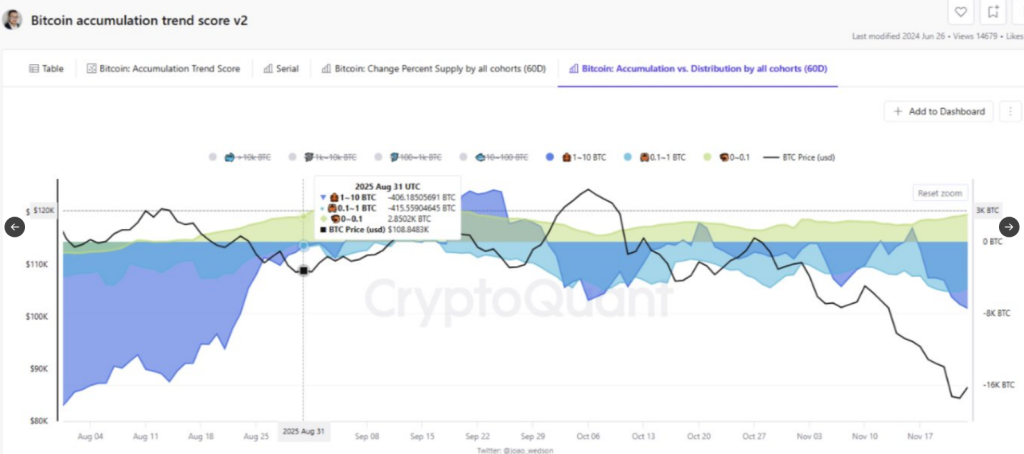
Based on reports, small wallets also lean towards security. Holders under 10 BTC and groups up to 1,000 BTC reduced their positions, removing another layer of potential buyers.
Has Bitcoin found its bottom? Cohorts tell the whole story
“BTC may have formed a local bottom, supported by a strong rebound and accumulation of:
100–1k BTC holders.
>10k BTC holders.
However, the crucial 1k-10k BTC cohort is still spreading, causing an entire… pic.twitter.com/dGU4CBD1Bw
— CryptoQuant.com (@cryptoquant_com) November 25, 2025
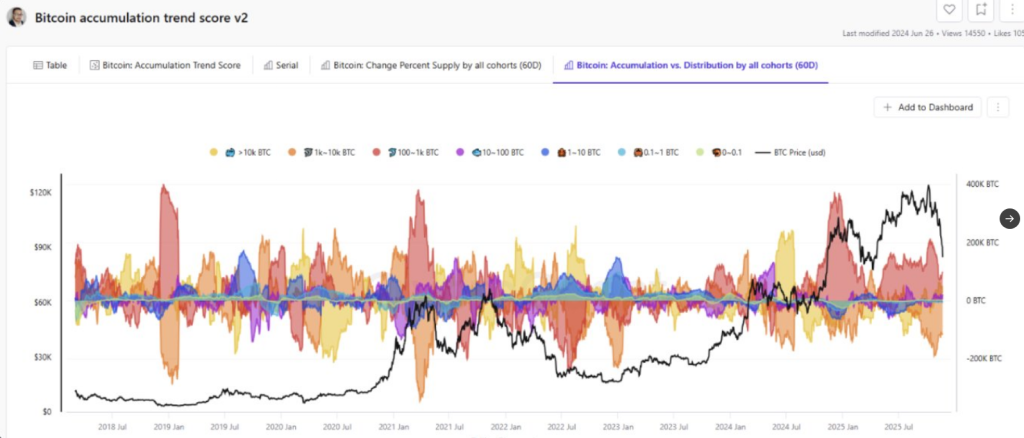
Buying interest from ordinary investors was weaker than expected. Medium holders – those with 10-100 and 100-1,000 BTC – bought during the correction, and their activity helped slow the decline. Yet their purchasing power was not sufficient to absorb the large outflow.
Futures liquidations amplified the decline
Reports indicate that dynamics in the futures markets have turned a correction into a crash. Long positions were forcefully closed over a period of thirteen days.
That cascade removed bids and created a chain reaction of selling that pushed Bitcoin from about $105,000 to $81,000. The liquidations were heavy and the selling pressure increased as the foreclosures moved on to the next.
A careful recovery shows life
After hitting lows, Bitcoin climbed back to around $87,500. This recovery is being interpreted by some as a sign that a local bottom may be forming.
However, according to CryptoQuant, the recovery cannot be considered safe as the 1,000 to 10,000 BTC group continues to reduce its holdings. The health of the market was tested by who chose to sell and who chose to buy.
Bottom status depends on whale activity
Market watchers say a real turnaround must stop selling from deep pockets. If these whales take a break, mid-market buyers could build a firmer bottom and confidence could return.
If the sale goes through, lower levels can be explored again. The coming sessions will be closely watched by traders looking to see if major holders change course or continue to cash out.
Related reading
For now, the situation is simple and at the same time tense: prices have recovered slightly, but the structural weakness that allowed a 25% decline has been exposed.
Bitcoin could face further losses after the recent crash, if CryptoQuant data is to be believed. Large holders have taken profits, while retail investors have also sold, leaving fewer buyers to support the market.
Analysts say the next step will depend on whether these large holders will continue to sell or whether mid-market buyers will step in to stabilize prices.
Featured image from Vecteezy, chart from TradingView