
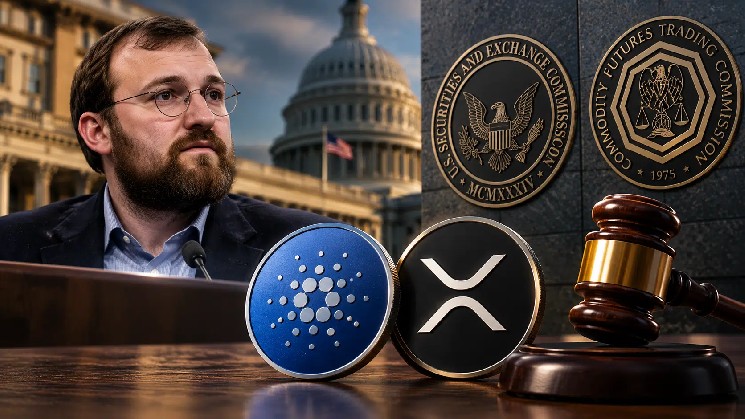
Cardano founder Charles Hoskinson believes that ADA and XRP should be considered genuine commodities under U.S. crypto regulation.
Hoskinson recently discussed why the CLARITY Act did not progress in the U.S. Senate, highlighting what he perceives as a key flaw in the proposed legislation’s approach to categorizing and overseeing digital assets.
Hoskinson Challenges Broad Commodity Classification
He pointed out that one of the main issues was the attempt to classify a wide range of digital assets as commodities and entrust the regulation of these assets to the Commodity Futures Trading Commission (CFTC).
Hoskinson argued that securities and commodities possess distinct characteristics that necessitate different regulatory strategies. He emphasized that the Securities and Exchange Commission (SEC) has a larger workforce and more extensive tools for market oversight, while the CFTC traditionally functions as a principles-based commodities regulator.
However, Hoskinson’s critique does not oppose the use of commodity regulation for crypto assets in general. Instead, he advocates for lawmakers to first determine which digital assets genuinely qualify as commodities and which should be classified as digital securities.
Hoskinson Affirms Cardano and XRP as Legitimate Commodities
He specifically mentioned Bitcoin, Cardano, and XRP as examples of crypto assets that he believes are truly commodities.
Hoskinson’s statements align with a significant regulatory development in the U.S., where the SEC and CFTC jointly issued an interpretation outlining the classification of various crypto assets, including digital commodities, digital securities, and stablecoins. Interestingly, Cardano and XRP were categorized as digital commodities.
XRP’s Legal Status Enhances Its Distinction
XRP has a unique legal history that influences its regulatory classification. In July 2023, the U.S. District Court for the Southern District of New York differentiated between XRP itself and how Ripple marketed the token.
The court did not deem XRP inherently a security but identified certain institutional sales of XRP as securities transactions, while Ripple’s programmatic sales on secondary markets did not qualify as unregistered securities sales under the circumstances.
This distinction separates the underlying crypto asset from specific transactions involving it.
Changes in Cardano’s Regulatory Landscape
Previously, Cardano was among the crypto assets involved in SEC enforcement actions against major cryptocurrency exchanges.
However, the regulatory environment has evolved. For instance, the SEC dropped its civil enforcement case against Coinbase in February 2025.
The SEC’s March 2026 interpretation established a broader framework for distinguishing digital commodities from other types of crypto assets.
Hoskinson Advocates for Global Regulatory Cooperation
Hoskinson emphasized the importance of international cooperation in cryptocurrency regulation.
Given that digital assets transcend borders, regulatory decisions in one jurisdiction can impact participants and businesses in other regions. As a result, Hoskinson suggested that the U.S. should seek mutual agreements with other jurisdictions to ensure that diverse regulatory frameworks can collaborate effectively.
His overarching argument revolves around establishing clear distinctions between digital commodities and digital securities while coordinating these regulations across different jurisdictions.