

Crypto analyst Will Taylor, founder of CryptoinsightUK, says XRP may be approaching a defining market setup as US regulatory clarity, Ripple’s infrastructure build-out and broader macro liquidity pressures converge.
In the week 195 edition of The Weekly Insight, Taylor argued that the market may be underestimating the significance of the recent progress around the Clarity Act, particularly for assets related to institutional settlement and financial infrastructure. The newsletter described XRP as one of the clearest expressions of that thesis, noting that the view represents personal opinion rather than financial advice.
XRP thesis is about regulation and ripple
Taylor’s XRP case rests on a simple premise: If U.S. crypto law ultimately removes the regulatory uncertainty that has kept institutions cautious, the market will have to reassess whether Ripple’s long-term utility thesis can finally be tested on a large scale.
“Looking specifically at XRP, I honestly believe that Ripple has spent years building a complete financial solution,” Taylor wrote. “That includes a prime brokerage, a stablecoin company, a stablecoin itself, custody infrastructure, clearing solutions, treasury integrations, and systems designed to move and settle value on the XRP ledger, while also holding a significant portion of XRP itself.”
The analyst acknowledged widespread criticism that Ripple has used XRP sales to fund neighboring businesses. But he argued that clearer legislation would force a more decisive judgment from the market.
Related reading
“At that point, the excuse that institutions cannot engage due to unclear regulations disappears,” Taylor wrote. “The legislation will be there, the infrastructure will be there, and then we will finally see if the benefit is real or if it was all just speculation.”
Tying the XRP setup to broader developments in Washington, Taylor said the passage of the Clarity Act through the Senate Banking Committee increases the likelihood that crypto market structure legislation could eventually become law. According to the newsletter, the bill still requires broader congressional approval and a presidential signature.
“This is why we are here. This is why many of us got involved in the first place,” he wrote. “If this legislation passes, I think it will fundamentally change the way the world views crypto. We will move from pure speculation about utility to actually starting to see integration in real time.”
He added that markets often revise their prices before full utility is achieved, based on the expectation that integration is coming. In the case of XRP, this would mean that the price could start to react before any large-scale institutional use becomes visible on-chain.
Taylor also pointed out XRP’s liquidity conditions, saying that liquidity on the daily time frame continues to rise above the current price level. He said this signals more short positions entering the market, potentially creating “extra fuel” if the price starts to rise.
Macro background is added to the installation
The XRP argument was placed within a broader macro framework. Taylor said the week had been important for risk assets, citing positive rhetoric from a meeting between Donald Trump and Xi Jinping in China, progress on crypto legislation and the confirmation process for Kevin Warsh.
Related reading
At the same time, he warned that pressure on global bond markets remains a key risk. US 10-year yields were described at around 4.5%, while UK government bonds rose to their highest level since 2007. Taylor said markets appear to be divided between a bullish camp expecting policy support and a bearish camp expecting a bigger financial event.
His own view leans towards intervention. He suggested that policymakers could try to stabilize bond markets through liquidity measures, reassurance or a new backstop, rather than allowing systemic stress to increase.
For crypto, Taylor sees that as potentially powerful. If policymakers extend the cycle and support risky assets as crypto regulation progresses, assets with institutional narratives could benefit the most.
Taylor said he believes there is a scenario where $10 trillion to $100 trillion moves up the chain over the next five to 10 years, with the illiquidity of supply potentially amplifying price effects as assets become harder to accumulate.
“But now we are reaching the stage where many of the things people have speculated about for years are potentially beginning to become reality,” Taylor wrote. “And the next phase from now on is to find out whether the investment thesis was actually correct.”
At the time of writing, XRP was trading at $1.38.
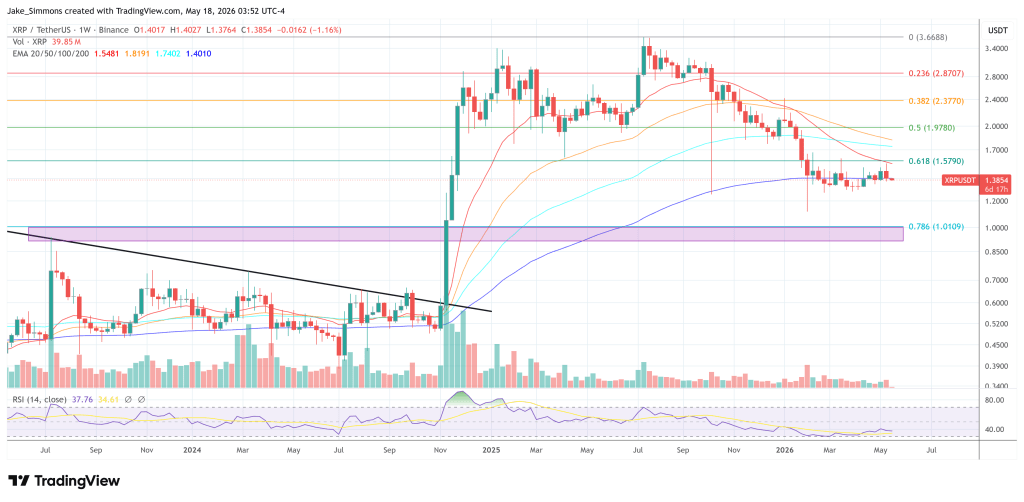
Featured image created with DALL.E, chart from TradingView.com