

The SEC floated the crypto market structure on April 13 without waiting for action from Congress.
The agency’s Trade and Markets Division published a staff statement on covered user interfaces, such as websites, browser extensions, wallet-linked apps and mobile applications that help users in self-custody setups prepare crypto asset transactions.
The staff said it will not object to these providers operating without broker-dealer registration under Exchange Act Section 15, provided they remain within a strict set of conduct and disclosure barriers.
This wording of the conditional, limited, and purposefully provisional reflects that the SEC is far enough into its own regulatory program to outline the operating conditions for an on-chain securities stack, yet still dependent on Congress for whatever lasts.
What the statement actually does
A Covered User Interface Provider qualifies if it allows users to customize transaction parameters, avoids requesting specific transactions, relies on pre-disclosed and independently verifiable routing logic, and presents execution options based on objective factors such as price or speed, among others.
The statement explicitly includes distributed ledger trading systems, such as automated market maker (AMM) liquidity pools and liquidity aggregators, as locations to which these interfaces can connect.
That marks the first time the SEC has described, with any operational specificity, how a self-protective interface layer for crypto assets could function while remaining outside broker status.
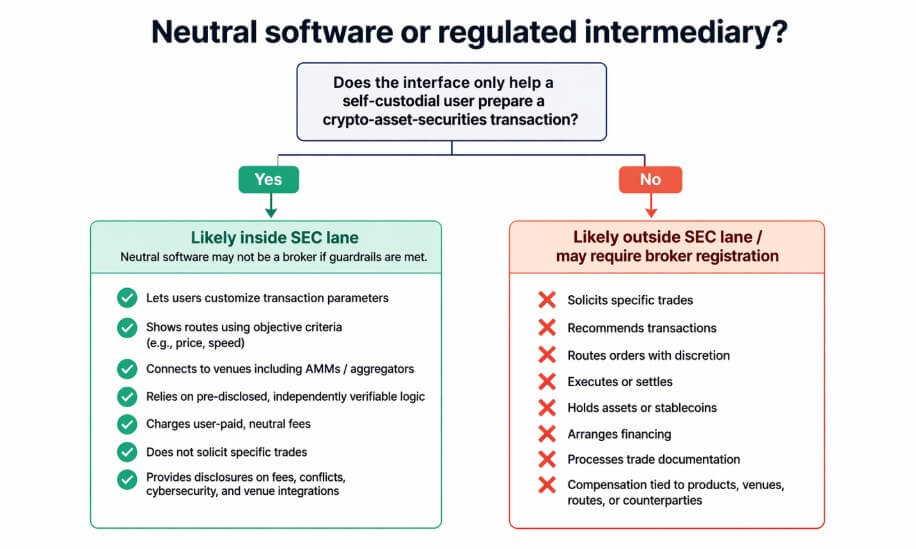
For tokenized security builders, the operational picture that emerges is a deliberately thin stack consisting of software that helps users express preferences, inspect routes, compare prices and gas costs, and sign via a self-custodial wallet.
The document draws the outer edge of anything resembling mediation, such as no recommendations, no discretionary order routing, no execution, no custody of funds or stablecoins, no settlement, no funding arrangements, and no requests for specific transactions.
Where the lane ends
Any interface that negotiates transaction terms, manages user assets, executes or settles transactions, arranges financing, performs independent valuations, or processes trade documentation is outside the scope of the statement.
Compensation related to specific products, locations, routes or counterparties also disqualifies a provider.
The SEC’s permitted zone includes objective route display and user-driven parameter settings. Anything related to execution, routing discretion, or custody requalifies a provider as a broker.
The statement explicitly pointed out that an intermediary business model requires registration of brokers regardless of whether the wallet is self-custodial. Its scope ends at the interface layer, leaving full-service DeFi products completely out of coverage.
Protocols that hold assets in smart contracts, perform swaps on behalf of users, or bundle routing with custody are intermediaries in a different category of regulation.
The relief is specific to a product form, with the broader on-chain trading economics falling outside the scope of the statement.
A three-part SEC campaign
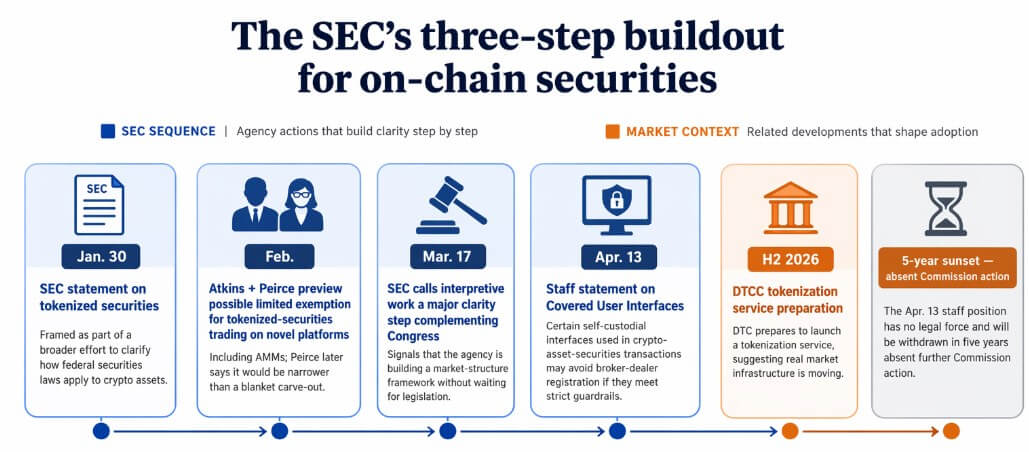
The April 13 statement is the third in a deliberate series. On January 30, the SEC published a statement on tokenized securities, framing it as part of a broader effort to clarify how federal securities laws apply to crypto assets.
On March 17, the agency described its interpretive work on cryptoasset law as an important step toward clarity, complementing Congress’ market structure work.
Commissioner Hester Peirce and Director of Trading and Markets Jamie Selway both described the April 13 release as an incremental infrastructure for tokenized securities and crypto market structure.
In February, chairman Paul Atkins and Peirce said staff were working on an exemption for restricted trading of certain tokenized securities on new platforms, including AMMs. Peirce later said that the exemption in question would be limited.
The markets affected by these rules already have real volume. RWA.xyz currently shows $29.3 billion in real-world distributed assets, over $1 billion in tokenized public equities and ETFs, and $13.4 billion in tokenized U.S. Treasury securities.
DTCC has said that DTC is preparing a tokenization service for the second half of 2026. The SEC is outlining rules for a market that already has users and transfer activities.
Two futures for product design
The bull case runs through the more limited relief that arrives before the legislative window closes.
If the SEC follows the April 13 neutral interface statement with a capped AMM pilot that restricts, lists, and regulates on-chain tokenized securities trading along the lines described by Atkins, on-chain tokenized securities trading will become operational within a capped regulatory framework.
Builders who designed their interfaces around the neutral software standard would have an infrastructure in place if the exemption were to apply. The payout is an on-chain securities stack that is functional, if limited, before Congress finalizes a broader statute.
The bear case is product paralysis at the product edge. Because the declaration has no legal force, does not create enforceable rights and will expire in five years if the Commission does not intervene, counsel for cautious organizations may see the April 13 road as too fragile for anything ambitious. Interfaces remain informational or routing.
Serious trading in tokenized securities is concentrated in incumbent-led permissioned pilots such as DTCC’s tokenization service, major bank programs, and similar structures built around registered entities, while the product architectures that the declaration aims to enable are indefinitely postponed.
The Congress Variable
The disclaimer of the document itself merely reflects the vulnerability as the contributors see it, without legal force or effect, and without the Commission’s action that would give it permanence.
Senate Banking announced a crypto market structure increase in January and postponed it as talks between the two sides continued. As of April 15, no new public markup date will appear in committee materials.
Treasury Secretary Scott Bessent urged Congress to pass the CLARITY Act on April 9.
All three data points come to the same conclusion: Only a statute can keep an SEC-created job open.
Galaxy Research and the Blockchain Association urged the SEC on April 14 for conditional AMM relief, while SIFMA argued that new on-chain trading structures should take place under sustainable regulations with similar investor protection standards.
That dichotomy between agency staff, the crypto-native industry, and the established financial infrastructure is precisely the configuration that makes a Congressional resolution necessary and politically difficult.
| Interested party | What they want | Why it matters |
|---|---|---|
| SEC staff | Narrow operating room under existing authority | Let parts of the market move now without waiting for Congress |
| Crypto-native industry | Conditional AMM relief and workable tokenized securities rails | Want real product implementation before legislation is ready |
| Established Financial Infrastructure / SIFMA | Sustainable regulation and comparable standards for investor protection | Insists on sustainability, predictability and traditional safeguards |
| Congress | A legal market structure framework | The only path to lasting, non-reversible clarity |
Chairman Atkins has consistently framed Project Crypto as a complement to legislative work. The April 13 statement is the clearest expression of that attitude, because it is real enough to build now, and contingent enough to require something more lasting.