
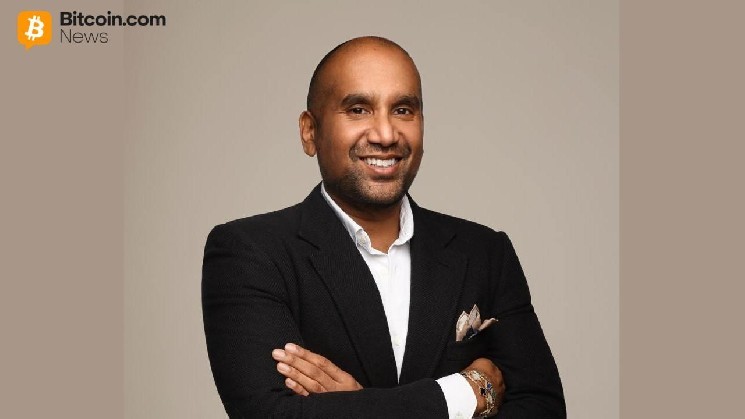
Lux Thiagarajah argues that decentralized technology will not displace banks, but ‘re-platform’ them. According to him, regulated entities will remain essential because governments will not outsource prudential supervision to unauthorized systems.
From revolution to infrastructure
For years, the promise of blockchain in the financial world was cloaked in the language of revolution. The world was repeatedly told that “crypto invoicing” would upend the global supply chain. But as the dust settles in early 2026, the reality of institutional adoption appears to be more pragmatic – and arguably more powerful.
In a discussion about the structural shift away from digital assets, Lux Thiagarajah, chief commercial officer (CCO) at Openpayd and a veteran of JPMorgan Chase and HSBC, sheds light on where the ‘smart money’ actually ends up. His judgment? The revolution isn’t happening in the front-end billing office; it happens in the pipes.
The backdrop to this shift is a transformed regulatory landscape. With the full implementation of the European Union’s Markets in Crypto-Assets (MiCA) regulations and the enactment of the US GENIUS Act in 2025, stablecoins have officially transitioned from experimental “wallet-based” tokens to regulated “account-based” production tools.
“The strongest institutional buy-in remains in the on-ramp and off-ramp space,” Thiagarajah explains. “While these rails are often described as simple infrastructure, they provide the crucial bridge between traditional fiat systems and blockchain networks.”
While the industry once dreamed of a world where every invoice was a programmable non-fungible token (NFT), institutions are currently focusing on settlement speed. By integrating stablecoins into their backend operations, companies reduce settlement times from days to seconds. However, the ‘last mile’ – the ability to convert that digital value back into fiat – remains the most sought-after capability.
The replatforming of giants
When asked whether decentralized technology is intended to replace older systems, Thiagarajah was clear: this is an evolutionary layer, not a replacement. He points to the behavior of the world’s largest financial institutions – from JPMorgan’s Kinexys to Blackrock’s BUIDL fund – as evidence of a ‘re-platforming’ rather than a displacement.
“This is not decentralization displacing the banks,” Thiagarajah noted. “It is the banks that are integrating decentralized technology into their existing models. KYC, AML and prudential supervision are not optional, and governments will not outsource these responsibilities to completely permissionless systems.”
However, a new challenge has emerged: regulatory divergence. While the EU’s MiCA framework emphasizes strict, state-driven supervisory control, the US GENIUS Act focuses on federal legal protections and the separation of banking and commerce.
This raises a crucial question for global treasurers: will companies be forced to maintain separate, isolated on-chain stacks for each jurisdiction? Thiagarajah believes the answer lies in architecture.
“The underlying technology is not fragmented,” he argued. “Blockchains, wallets, and smart contract logic remain aligned. If the infrastructure is built around a single core ledger, with compliance logic applied at the asset layer rather than the chain layer, we can avoid creating multiple siled environments.”
The real risk, he warns, is not the rules themselves, but a lack of interoperability. If Eurozone liquidity is tied up in MiCA-compatible tokens, while U.S. liquidity is in GENIUS-compatible tokens, the cost of moving money cross-border could remain high despite the technological leap.
The end of the ‘batch-based’ era
The outlook for the next decade suggests that while banks will continue to exist as regulated entities, the “legacy structures” that define them – batch-based settlement and multi-day processes – will disappear.
As CCO of Openpayd, Thiagarajah’s role is to position the company as the architect of this bridge phase. By providing the universal infrastructure that connects domestic fiat trails to blockchain networks, Openpayd enables institutions to scale their digital asset strategies without waiting for a total global overhaul of corporate accounting.
Meanwhile, Thiagarajah shared his thoughts on MiCA’s strict transaction limits on US dollar-denominated stablecoins within the European Economic Area. Although intended to protect the euro, such a requirement risks causing significant friction for European businesses, Thiagarajah argues. He said companies may have to “go the long way” to settle transactions, while forced conversions of euro-backed tokens into the dollars needed for international goods and services could lead to higher currency costs.
The CCO argues that unless there is a massive structural shift in the dollar’s role as a global reserve currency, the market will remain fundamentally dollar-denominated for the foreseeable future.
Thiagarajah rejects the idea that regulation inherently stifles growth. Instead, he argues that regulatory transparency is the missing ingredient that ultimately justifies Level 1 institutional flows. For banks and funds, ‘unclear’ is synonymous with ‘non-investable’. That’s why laws like MiCA and the GENIUS Act provide the formal permission these institutions need to move from pilots to large-scale liquidity deployment.
Frequently asked questions ❓
- What is the current state of blockchain adoption in the financial world? The adoption is more pragmatic and focused on the backend infrastructure rather than a front-end revolution.
- How will new regulations affect stablecoins? Regulations such as the EU’s MiCA and the US GENIUS Act have transformed stablecoins into regulated production tools.
- What role do banks play in integrating decentralized technology? Banks are not being replaced, but are evolving by integrating decentralized technology into their existing systems.
- What challenges does differing regulations pose for global companies? It could require companies to maintain separate systems for different jurisdictions, risking increasing transaction costs.