
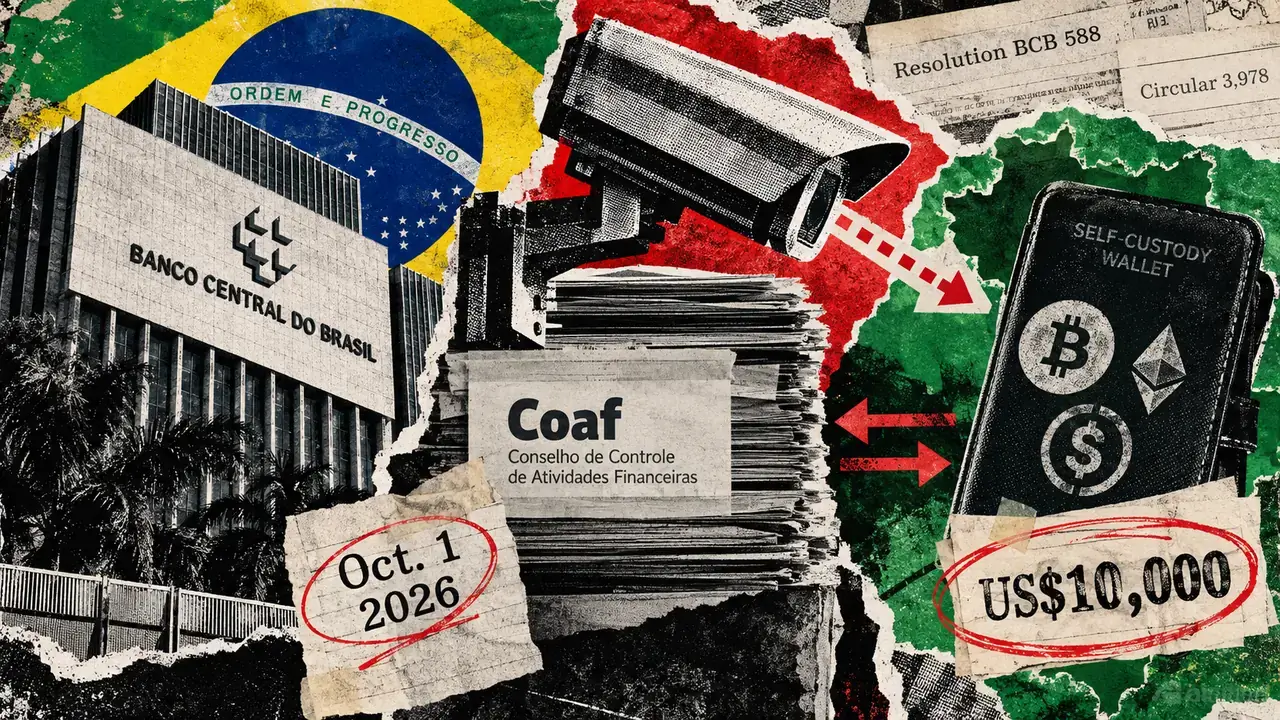
Brazil is set to implement new regulations requiring financial institutions to report large cryptocurrency transfers involving self-custody wallets starting from October 1st. Under Resolution BCB 588, institutions authorized by the Banco Central do Brasil will need to notify the Financial Activities Control Council (Coaf) whenever they send or receive virtual assets worth at least $10,000 to or from a self-custody wallet.
This requirement applies to both deposits from and withdrawals to wallets controlled directly by users. The filing obligation falls on the institution processing the transfer, with qualifying transactions reported to Coaf by the next business day in accordance with Brazil’s existing anti-money-laundering framework. The threshold operates automatically, meaning institutions do not need to determine whether a transaction is suspicious before filing a report.
The new provision adds another layer of oversight by providing authorities with visibility into large movements between regulated platforms and self-custody wallets, even in the absence of suspicious activity. This measure precedes tighter controls on some outbound crypto transfers, as outlined in Resolution BCB 584 set to take effect on January 1, 2027. This resolution establishes a precautionary holding procedure for certain virtual-asset transfers leaving regulated institutions, allowing for additional checks to be conducted before the transactions are finalized.
These regulations aim to increase scrutiny at the entry and exit points of Brazil’s regulated financial system. Exchanges, banks, and other covered providers will need to identify self-custody counterparties, calculate transaction values, and integrate automatic Coaf reporting into their monitoring systems before the October deadline. By January, some institutions will also need processes in place to hold outbound transfers for further review.
These rules come at a time when Brazil’s crypto market is expanding rapidly. The country accounted for $252.5 billion of crypto activity according to Chainalysis, making it the largest market in Latin America and ranking first in the firm’s 2026 global crypto adoption index. Despite a slight contraction in the measured crypto economy, the regulatory expansion is a significant step towards ensuring transparency and compliance within the sector.