
The Impact of Rising Government Bond Yields on Global Markets
Government bond yields are on the rise globally, leading to a divergence in market dynamics. This trend has been exacerbated by the ongoing conflict in the Middle East, which has pushed oil and diesel prices higher. As a result, the inflation outlook is becoming more complex, prompting questions about the need for further policy tightening by central banks. In the United States, the 10-year Treasury yield briefly reached 5.2% before retreating to 5.163%.
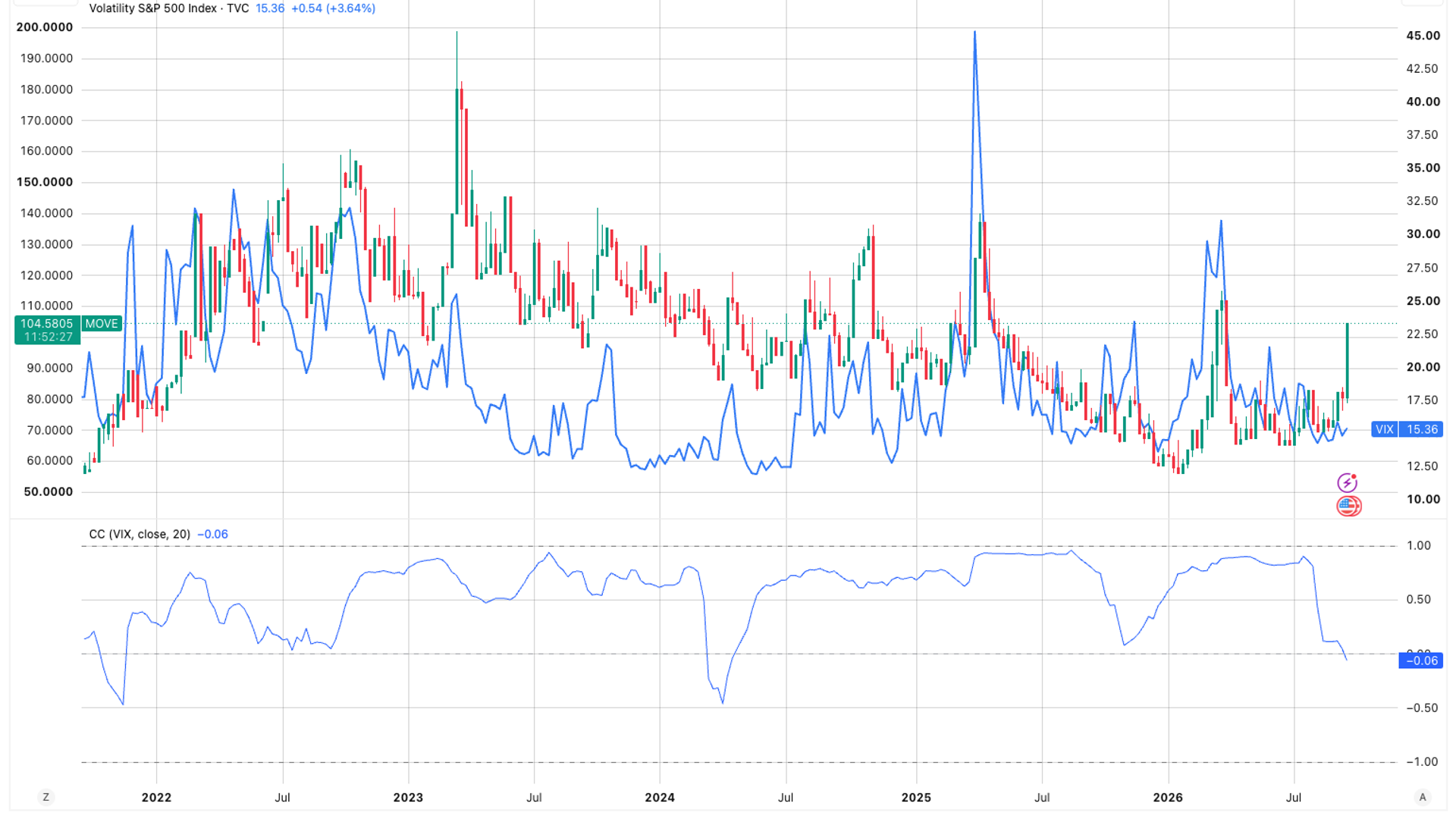
Comparing the current situation to March, when the MOVE index was last at a similar level, the S&P 500 index has seen a significant increase from 6,350 to 7,704, representing a rise of approximately 21%. However, bond traders are now willing to pay more for protection against interest rate fluctuations.
Interestingly, the correlation between the VIX (Volatility Index) and MOVE has turned negative, standing at -0.06 over a 20-day period. This marks the first time this correlation has been negative since April 2024, albeit close to zero. Similarly, the correlation between BVIV (Bitcoin Volatility Index) and MOVE is notably negative at -0.37, one of the lowest readings in recent years. Despite the spike in bond volatility, bitcoin’s expected volatility has remained relatively stable at its yearly low.
It is worth noting that while rising yields have had an impact on market dynamics, there has been little consistent relationship between bond yields and bitcoin’s returns, as reported by CoinDesk this week.
Overall, the increasing government bond yields are reshaping global markets and raising concerns about inflation and monetary policy. Investors are closely monitoring these developments to navigate the shifting landscape of the financial markets.