



Bitcoin’s return above $80,000 has raised a question that traders haven’t faced on a large scale since 2020: How does the world’s largest digital asset behave when a health risk, rather than interest rates, regulation or crypto-native leverage, becomes the market’s dominant risk headline?
The immediate cause is an outbreak of the hantavirus on board the MV Hondius, a luxury cruise ship on its way to the Canary Islands.
On May 6, the World Health Organization (WHO) confirmed a cluster of severe respiratory illnesses on board, including two confirmed cases, five suspected infections and three deaths on May 4.
This comes as the key digital asset traded as high as $82,752 earlier this week, continuing a recovery that has restored confidence after months of volatile macro trading.
Still, the timing of the hantavirus headlines has complicated this move, as BTC now faces concerns about whether it can absorb a shock that would once have sparked a broad rush for cash.
The hantavirus health scare is hitting a busy trade
According to the WHOhantaviruses are typically transmitted through contact with infected rodents, including exposure to urine, feces, or saliva. Most species do not spread easily between people.
The strain linked to the MV Hondius cluster is believed to be the Andes virus, a South American variant that has raised concerns because it is one of the few hantaviruses associated with human-to-human transmission among close contacts.
The disease can be serious. Hantavirus cardiopulmonary syndrome has led to death rates of up to 40% in parts of America, making any suspected cluster difficult for public health officials and markets to ignore.
Still, WHO officials have characterized the global risk as extremely low and largely confined to the ship environment.
That distinction is important. A cruise ship cluster with intensive contact tracing is very different from a respiratory virus spreading through major population centers.
However, the market’s concerns stem from the uncertainty window. Hantavirus infections can have a long incubation period, complicating contact tracing and causing traders to react to official briefings, passenger movements and new cases before the full picture is known.
That’s the kind of information gap that markets often price poorly. Bitcoin’s rise above $80,000 had already led to leveraged longs and profit-taking pressure. A new external shock gives short-term traders a reason to reduce exposure, even if the underlying health risk remains limited.
Why March 2020 still matters
The memory traders keep returning to is March 2020, when the WHO declaration on the COVID-19 pandemic helped trigger one of the most violent liquidity events in modern market history.
Bitcoin entered that period with a growing reputation as a hedge against monetary disorder. In the first phase of the COVID shock, that argument failed the market test. The token fell more than 50% in about 48 hours and briefly traded below $4,000 as investors sold liquid assets to raise cash.
That episode showed that during the earliest phase of a systemic shock, liquidity can be more important than an investment thesis. Assets like BTC, which are traded 24 hours a day, can be sold quickly and often become ATMs for investors facing margin calls elsewhere.
However, the fear of hantavirus is much smaller than that of COVID in March 2020. There is no evidence yet of sustained community spread, no comparable risk of an economic shutdown, and no signal that governments are preparing restrictions for the pandemic era.
But traders don’t need a formal pandemic declaration to respond defensively. A market that has already recovered strongly can sell based on headlines alone, especially if the reference point is a previous crash that still shapes crypto risk management.
That’s why the current episode is less a repeat of 2020 than a test of whether Bitcoin’s investor base has changed enough to prevent a health headline from becoming a liquidity event.
The market has deeper support than in 2020
Bitcoin’s biggest defense today is that the market around it looks very different from the one that broke down during the coronavirus situation.
In 2020, crypto liquidity was more fragmented, leverage was more concentrated offshore, and institutional access remained limited. The market was still strongly driven by retail flows, derivatives positioning and currency stress.
Today, spot Bitcoin ETFs have created a regulated channel for large investors. Corporate bonds have added an additional demand base. Market makers, custodians and institutional agencies are now giving Bitcoin a clearer connection to traditional portfolio flows.
This shows that BTC traders have more signals to separate a sustainable collapse from regular profit-taking.
For context: SoSoValue facts show that Bitcoin ETFs in the US have attracted net inflows of more than $1.6 billion since early May, indicating that institutional demand has remained intact despite the health outlook.
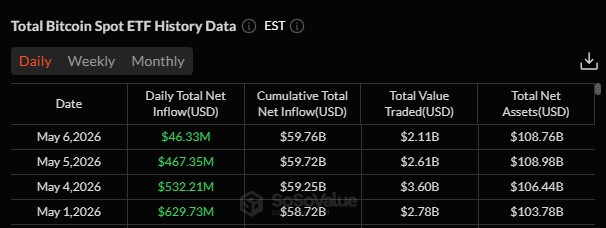
These continued ETF purchases would make it harder to argue that Bitcoin is repeating its 2020 behavior as a pure liquidity source.
Moreover, the political background has also changed. The White House’s support for a strategic Bitcoin reserve has given Bitcoin a sovereign-level policy narrative that did not exist during the COVID crash.
While that doesn’t create a guaranteed price floor, it does change the way investors frame price declines.
This means that Bitcoin is no longer a speculative asset trade outside the traditional system. It is now linked to listed company balance sheets, ETF portfolios and government-level reserve discussions.
That evolution is the core difference between this fear and the pandemic crash of six years ago.
Prediction markets show caution and not panic
Prediction markets also suggest traders are on alert without anticipating a full global health shock.
On Polymarket, a contract asking whether a “Hantavirus pandemic” would happen in 2026 recently showed a nearly 9% chance. Kalshi, a regulated US prediction market platform, showed a higher probability, almost 35.7%, that the WHO would explicitly characterize the outbreak as a pandemic.
The gap reflects different contract language, market structure and trading bases. It also shows that the fear trade remains uneven.
Crypto-native speculators appear to estimate a low probability of a real pandemic, while a broader event-risk market places more weight on the official WHO language.
However, the more speculative corners of crypto are already moving faster than the underlying risk.
Several hantavirus-themed tokens have appeared on decentralized exchanges An reaching a market value of approximately $3.5 million within hours.
That reaction says less about the disease than about the attention economy of crypto. When a global news event emerges, the memecoin markets are often the first to fund it, regardless of whether the underlying event is of lasting market significance.
What will determine Bitcoin’s next move?
The next test for Bitcoin is whether the $80,000 area will hold as support or become another failed breakout.
The first variable is public health language. As long as WHO officials continue to describe the risk as low and tied to the cruise ship cluster, the macro impact should remain limited.
However, any confirmed evidence of continued spread beyond close contacts would quickly change that calculation.
The second is the demand for ETFs. Positive or neutral flows during a deteriorating economic cycle could indicate that institutional buyers are viewing fear as noise rather than a reason to exit the market. But a sharp reversal in ETF outflows could indicate the market is becoming more defensive.
The third is confirmation from traditional markets. A true pandemic-style risk shock would likely manifest itself in a stronger dollar, lower government bond yields, higher volatility indicators and pressure on equities.
Without these moves, a Bitcoin pullback would look more like local profit-taking after a strong rally than the start of a broader liquidity squeeze.
For now, the hantavirus outbreak is not a repeat of COVID. It’s a reminder that Bitcoin’s institutional maturity will be most clearly assessed when the catalyst comes from outside the crypto space.
The $80,000 recovery can survive a contained health crisis, but will have to prove that fear is no longer traveling through the market with the same force it did in March 2020.