

Bitcoin is struggling to maintain the USD 90,000 level after a sharp rejection from the USD 94,000 resistance zone, leaving market sentiment sharply divided. While some analysts argue that BTC is entering a deeper corrective phase, others believe that the pullback is a necessary reset before another upward attempt. The current price action reflects this uncertainty, with volatility increasing as buyers and sellers battle for short-term control.
Related reading
According to an analysis shared by Axel Adler, Bitcoin’s risk structure remains vulnerable in the short term. His short-term risk chart puts BTC below the Short-Term Holder (STH) Cost Basis, which is currently valued at around $100,200. The price is also trading below all major moving averages, including the 128-day, 200-day and 365-day SMAs, reinforcing the view that the broader structure is still bearish. At current levels around $91,000, Bitcoin is in a moderate risk zone, positioned between the STH cost basis and the -15% downside limit.
This positioning suggests that the recent upswings should be treated with caution. Until BTC regains the STH cost basis, upward moves are more likely to represent technical jumps within a downtrend than a confirmed reversal.
Conversely, a breakdown below the moderate risk line would indicate increasing downside risk and could increase selling pressure. As a result, the $90,000 – $100,000 range remains a crucial battleground for Bitcoin’s next price move.
STH losses continue to limit Bitcoin’s upside
Adlers analysis also highlights a second crucial framework: the chart that tracks Bitcoin’s record highs alongside euphoria zones and the Short-Term Holder Market Value to Realized Value (STH MVRV) indicator. This metric measures the ratio of Bitcoin’s current market price to the average realized price of coins held by short-term investors, providing direct insight into the profitability (and behavior) of this highly reactive cohort.

Currently, the STH MVRV is around 0.92, well below the historical average of roughly 1.09 and decisively below the neutral level of 1.0. In practice, this means that the average short-term investor has an unrealized loss of about 8%.
Historically, periods when the STH MVRV has remained below 1.0 have often coincided with capitulation phases or longer stretches of consolidation, rather than sustained bullish expansions. The last clear euphoria zone on this chart appeared during the all-time high update in October 2025, underscoring how far current conditions are from a speculative extreme.
As long as STH MVRV remains below breakeven, short-term holders are incentivized to sell into rallies as the price approaches their cost basis. This behavior creates a persistent overhead supply and strengthens structural resistance around the STH cost base, near the $100,000 level. Consequently, reclaiming that zone is not just a psychological milestone, but a necessary condition for any meaningful regime shift back to a bullish market structure.
Related reading
Bitcoin’s price action on the daily chart reflects a market still stuck in a fragile recovery attempt after a sharp rejection from higher levels. After the failed breakout above the $94,000-$95,000 area, BTC experienced a decisive sell-off that pushed the price back to the $85,000 zone, where buyers intervened aggressively. This reaction marked a short-term trough, but the subsequent recovery has so far lacked structural strength.
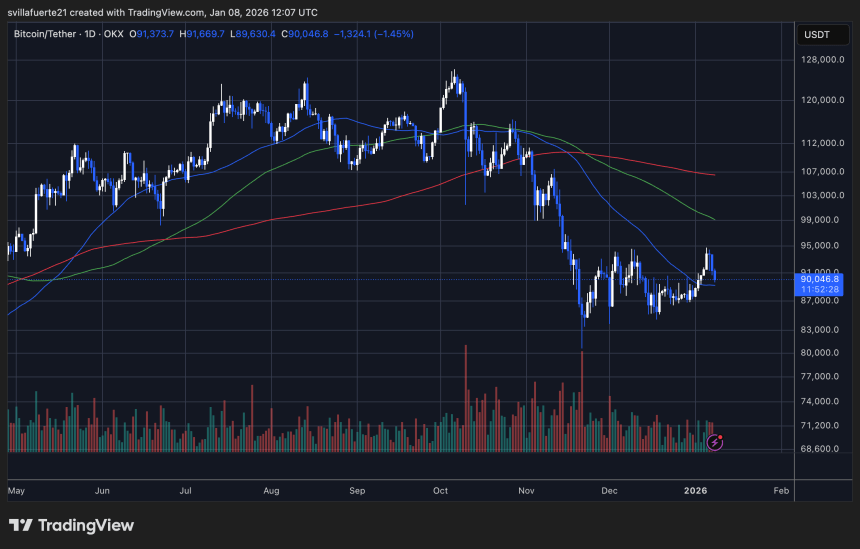
Currently, Bitcoin is trading near the $90,000-$91,000 region, a former support that has now become a major pivot. The price remains below the 200 and 365 day moving averages, both of which are sloping downward and act as dynamic resistance. The 128-day moving average has also limited recent upward attempts, reinforcing the idea that the broader trend remains corrective rather than impulsively bullish.
Related reading
From a structure perspective, the chart shows a series of lower highs since the October peak, indicating that sellers continue to control the macro trend. Volume grew particularly during the November to December sell-off, while the current upswing is unfolding thanks to relatively lighter participation. This divergence means that the increase may be more a result of short covering than strong demand on the spot market.
Unless Bitcoin can reclaim and hold the $94,000-$95,000 resistance zone with increasing volume, the risk of another rejection remains high. If this doesn’t happen, the path to the $85,000 support could reopen, forcing the market to once again prove its underlying strength.
Featured image of ChatGPT, chart from TradingView.com