

Bitcoin continues to struggle to regain the $65,000 level as continued selling pressure and weakening sentiment keep the market in a vulnerable state. Price action has remained subdued in recent weeks, with volatility high and risk appetite limited by tightening liquidity conditions and macro uncertainty. The inability to secure sustainable adoption above this psychological threshold has heightened caution among traders, leaving Bitcoin in a defensive phase rather than an early recovery environment.
Related reading
According to top analyst Axel Adler, recent data about the chain support this interpretation. Realized capitalization – which measures Bitcoin’s total value based on the last price each coin moved – has fallen for the second month in a row. At the same time, the cohort of 3- to 6-month holders has expanded significantly as coins acquired near cycle highs enter that category. These dynamics typically reflect post-peak positioning rather than new accumulation.

The realized 30-day net position change is currently around -2.26%, indicating continued capital outflows from the network. Realized Cap peaked at nearly $1.127 trillion at the end of November 2025 and has since shrunk to approximately $1.094 trillion, representing a compression of approximately $33 billion. Until this measure definitively returns to positive territory, evidence of renewed accumulation demand remains limited.
HODL waves emphasize defensive market structure
Adler notes that the latest HODL Waves data reinforces the view that Bitcoin is in a defensive phase rather than active accumulation. The chart shows a sharp expansion in the 3-6 month coin cohort, which has risen to approximately 25.9% of the circulating supply. This reflects a growing number of coins that last moved between August and November 2025 – a period that closely aligns with purchases around the market peak.

HODL Waves track Bitcoin supply distribution based on how long coins have remained inactive. Expansion of older cohorts generally indicates reduced transactional activity. In this case, however, the data does not indicate an accumulation of confidence, but rather a ‘costly investment’ environment, with many investors holding underwater positions.
The 3 to 6 month cohort has increased from about 19% in early February, while the 6 to 12 month group has also grown to about 20.2%. Meanwhile, short-term coins of less than a month together only account for about 9.3%, suggesting limited new demand entering the market.
Combined with declining realized capitalization, the data points to an aging supply without corresponding capital inflows. Until newer buying activity emerges and the 3-6 month cohort migrates to longer-term holdings without selling pressure, Bitcoin’s broader market structure will likely remain defensive rather than decisively bullish.
Related reading
Bitcoin’s three-day chart reflects a clear structural deterioration as the price accelerates lower towards the $63,000 region. After failing to reclaim the $90,000-$95,000 supply zone earlier this year, BTC formed a distribution range before breaking decisively below its 50 and 100 period moving averages. That collapse caused a sharp decline, confirming a shift from consolidation to trend continuation in this time frame.
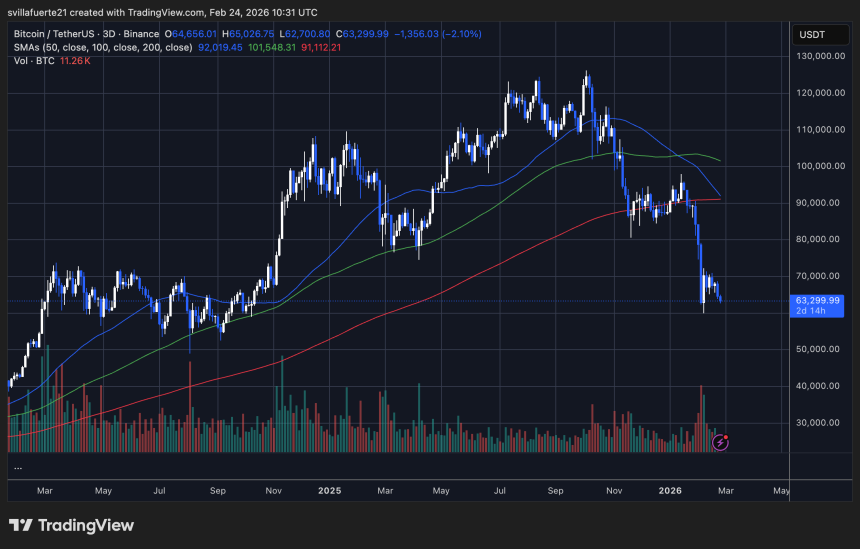
Currently, the price is trading well below the 50 SMA (~$92,000) and the 100 SMA (~$101,500), both of which have rolled over and are now acting as overhead resistance. The 200 SMA near the low $90,000 region also remains well above current price, reinforcing the broader bearish bias. The alignment of these moving averages – where the shorter-term averages are below the longer-term averages – confirms negative momentum and continued downward pressure.
Related reading
Volume increased during the recent sell-off, indicating active distribution rather than passive drift. The sharp rejection from the mid-$90,000s, followed by impulsive downside candles, suggests sellers remain in control.
From a structural perspective, the $60,000-$62,000 zone will be the next critical support region. A sustained break below could open the way to deeper retracement levels. To stabilize, Bitcoin would need to at least reclaim the $75,000 to $80,000 area and rebuild higher highs – a scenario not yet supported by current momentum.
Featured image of ChatGPT, chart from TradingView.com