

Capriole Investments founder Charles Edwards says Bitcoin could be positioned for a sharp upward repricing if the network shows tangible progress in post-quantum security. Speaking on the Bitcoin Suisse AG podcast with Dominic Weibel and Luca Gnos, Edwards argued that Bitcoin’s recent underperformance, weak sentiment and institutional hesitation suggest that quantum risk is already partly reflected in the market.
Edwards framed the current setup as one of the strongest Bitcoin opportunity zones in months, but with a major caveat. According to him, Bitcoin has “completely flipped the script” after a nine-month downtrend, showing relative strength against stocks and gold even as geopolitical risk, oil market concerns and macro uncertainty remain high.
“Bitcoin, which has been in a huge downtrend for the last nine months, has completely flipped the script in the last two, three weeks,” Edwards said. “These are very strong signals that in my experience you usually only get every few years.”
Quantum risk is now central to Bitcoin
The central variable, according to Edwards, is no longer the traditional four-year cycle, miner supply or even short-term macro volatility. At issue is whether Bitcoin can demonstrate credible movement toward quantum-resistant signatures before the perceived threat window further shrinks.
Related reading
Edwards said he remains constructive on Bitcoin as an investment because the asset is already heavily discounted. But he was blunt about the longer-term risk if Bitcoin Core contributors and the broader ecosystem continue to treat quantum security as a distant issue.
“From an investor perspective, I’m constructive and optimistic because we were at such a big discount,” he said. “Today the risk is fully priced in, and more. To me, that means this is a good opportunity in the short term.”
However, that chance is conditional. Edwards said his concern is that Bitcoin’s current cryptographic assumptions could become a live market issue before the network completes the long process of developing, agreeing and rolling out post-quantum upgrades.
“If we do nothing for two years, I’ll probably run out of Bitcoin,” Edwards said. “Some things have a time limit.”
Edwards criticized what he sees as complacency among parts of the Bitcoin development community. While he acknowledged that some preliminary work has been done, including references to BIP 360, he argued that Bitcoin still lacks a concrete migration path for post-quantum signatures and for coins that may remain exposed.
“Some of the largest core developers recently said these aren’t even our top 100 priorities,” Edwards said. “And I just think: how? For me, this is the only priority that Bitcoin should have. Nothing else matters.”
Related reading
He said the technical problem is solvable, but not trivial. Post-quantum signature systems could be larger, raising questions about block space, throughput, wallet migration, and the treatment of dormant coins. Edwards also highlighted the unresolved problem of lost coins, including older outputs that could become vulnerable if sufficiently powerful quantum computers arrive before a network-wide transition.
His base case is not that Bitcoin fails. Instead, he expects growing pressure from institutions, Ethereum’s quantum preparedness work, and Bitcoin-focused companies to eventually force progress. He described every clear signal from key Bitcoin Core contributors that quantum resistance is becoming a serious priority as a potential catalyst.
“Once there is some incentive to implement code to improve Bitcoin, I think we will increase the price and this risk will disappear,” Edwards said. “If we get a handle on quantum, we can get to a new all-time record very quickly, I think. If we don’t, we might not get one.”
Bitcoin statistics signal value
In addition to quantum, Edwards said several Capriole metrics point to Bitcoin trading in a deep value zone. He cited Capriole’s energy value model, which he said placed Bitcoin’s fair value at around $115,000, implying a discount of around 43% at the time of the discussion. He also pointed out discounted values for metrics such as dynamic range NVT, metric, MVRV Z-score and miner-related indicators.
Still, Edwards emphasized that mining statistics matter less than they used to. In his framework, institutional demand from ETFs and government bonds has become the dominant supply-demand force. He said institutional buying recently turned positive again, while supply from long-term holders started to rise after a long period of selling.
That combination, he argued, is tantamount to seller exhaustion. It also helps explain why Bitcoin has held strong despite weak sentiment.
For the short term, Edwards pointed to $71,000 as a key level and said Bitcoin could move towards $80,000 to $82,000 if current strength continues. A weekly or monthly close below $71,000, he said, would test that setup.
At the time of writing, BTC was trading at $77,629.
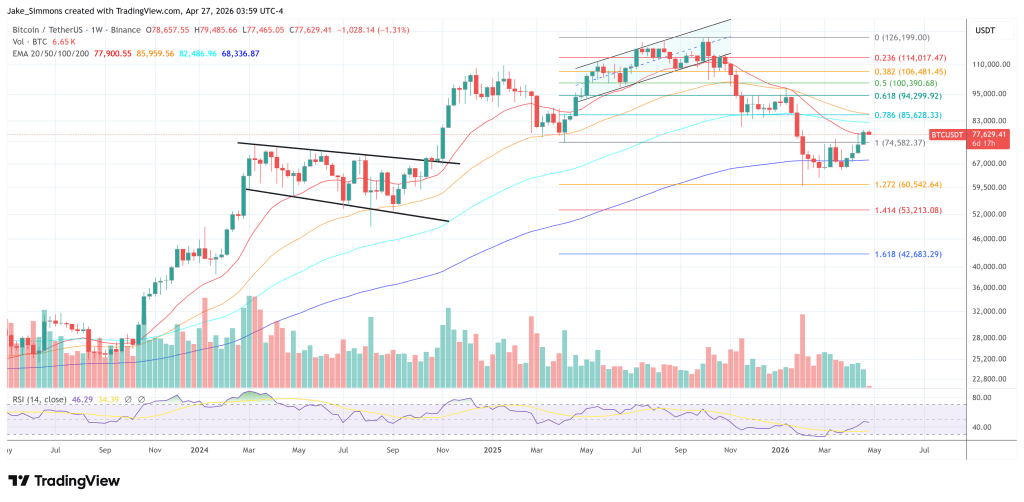
Featured image created with DALL.E, chart from TradingView.com