
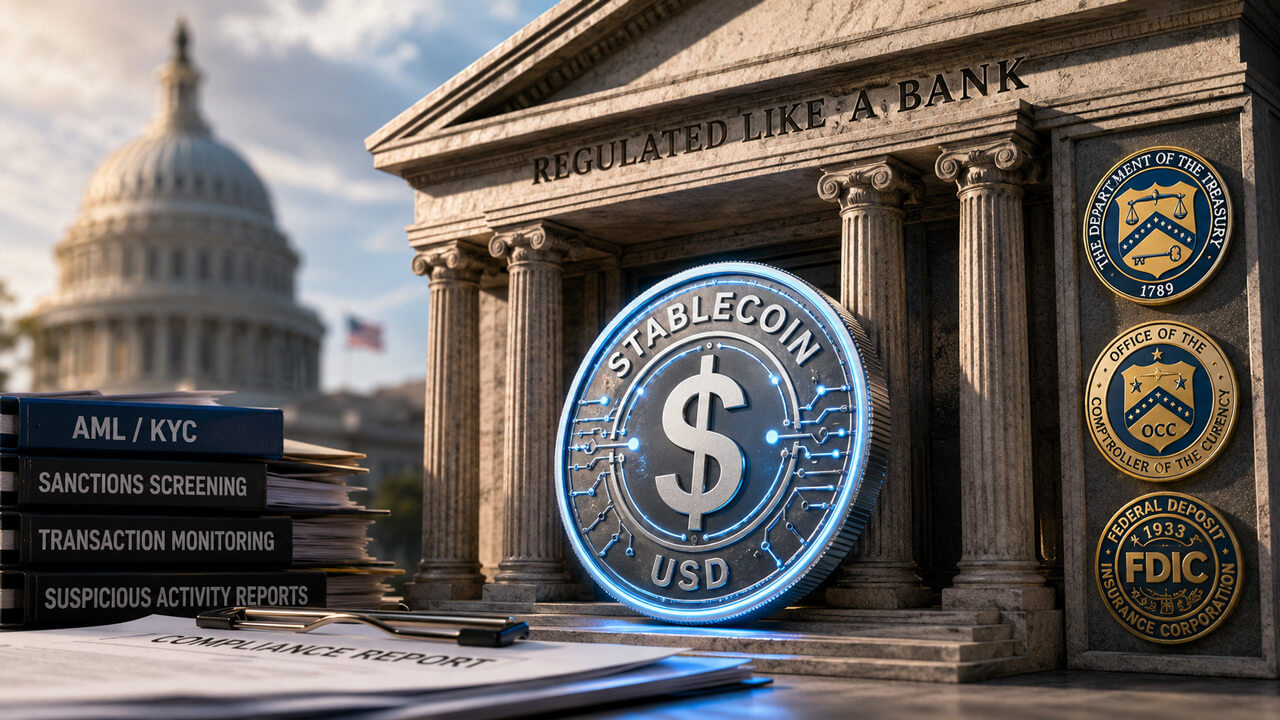
Three federal agencies have proposed rules that would let stablecoin issuers operate like banks. The Treasury Department wants them to implement anti-money laundering programs and sanctions.
The Office of the Comptroller of the Currency (OCC) wants a weekly confidential report and a quarterly financial report from each, and the Federal Deposit Insurance Corporation (FDIC) wants Bank Secrecy Act requirements applied to the issuers it oversees.
If passed, these proposals will turn the issuance of a dollar-pegged token into a task that requires customer screening, transaction monitoring, suspicious activity reporting, reserve disclosure, and a steady flow of data to a primary regulator.
The next phase of stablecoin regulation is therefore less about the permission to issue a token and more about whether an issuer can bear the costs of supervision like a financial institution.
Much of this formalizes what major issuers are already doing. But for smaller companies, the burden of compliance will become the biggest barrier to entering a market that is now worth about $320 billion. The legal clarity that the industry has fought for for years has come with operational costs that determine who can realistically compete.
The GENIUS Act, which was signed into law in July 2025, is the federal framework for payments stablecoins, the dollar-pegged tokens designed to maintain a stable value and facilitate payments and settlement. It allows a company to issue these tokens only as a “permitted payment stablecoin issuer,” or PPSI, which means payment stablecoin issuers must be approved by regulators under the federal regime.
The Treasury opened the regulations that fill in the details at the end of 2025, and the proposals coming in until 2026 are where that consent will become a working compliance regime.
Stablecoin issuers are turning into compliance companies
A stablecoin issuer’s product looks simple, as the idea is for one token to equal one dollar, but the regulated version has a long operational tail.
Stablecoin compliance now means teams and systems must identify customers, monitor transactions, screen wallets and counterparties against sanctions lists, flag suspicious behavior, and document it all for an investigator. The work moves from the edge of a crypto company to the center of the company.
That change in requirements took shape in April 2026, when Treasury Department FinCEN and OFAC issued a joint proposed rule which would treat permitted issuers as financial institutions under the Bank Secrecy Act and require it for the first time a category of U.S. persons to maintain an effective sanctions compliance program.
The FDIC followed suit on May 22 with a parallel rule for the issuers it oversees, those that operate as subsidiaries of non-member state banks and state savings associations.
All this changes the cost structure of the company. The competitive advantage is moving toward compliance capacity, so that issuers who can afford lawyers, transaction monitoring providers, reporting systems, and sustainable banking relationships have an advantage over new entrants who build the same machine from scratch.
The supervisory side became concrete in June 2026, when the OCC published draft reporting forms for issuers under its jurisdiction. Each issuer would file a weekly confidential report on each stablecoin it issues, covering issuance, redemptions, trading volume and reserves, plus a quarterly financial conditions report much like the call reports national banks file.
Issuers with more than $50 billion outstanding would also prepare audited annual financial reports, and the OCC would examine each at least once every twelve months. Weekly data gives regulators early insight into reserve problems or repayment stress, turning a symbolic project into a continuously monitored financial company.
The market is becoming smaller and more institutional
The same framework limits how regulated issuers can compete for users. The GENIUS Act prohibits issuers from paying holders any interest or returns on the token, and the OCC proposal incorporates that prohibition into the rules, reserving control for affiliate schemes intended to circumvent it.
Yield has been one of crypto’s strongest tools for winning users, so issuers that can’t afford it directly will instead compete on liquidity, integrations, payment tools, and institutional access.
Add these costs together and the result will likely be consolidation. Large issuers can absorb the costs of compliance, setting up reporting systems, hiring former regulators and retaining their banking partners, while smaller issuers may struggle to justify the costs unless they serve a particular niche or partner with a larger regulated platform.
A state-chartered non-bank issuer with more than $10 billion in circulation would typically have to transition to a federal license so that scale would attract issuers to federal supervision. The FDIC estimates that five to 30 of the institutions it oversees could receive approval to issue through subsidiaries in the first few years of the framework.
That smaller field entails a trade-off between credibility and flexibility. A regulated stablecoin will be more attractive to banks, brokers, payment companies and government bonds because it has clear rules and a trusted regulator. The same oversight makes the token more akin to a tokenized layer of the existing banking system than the open financial infrastructure that early proponents described.
The companies that will benefit from this are those who already understand how supervised institutions work, which is part of why Tether switched to a compliant US product called USAT, while Circle leaned further into his regimented position.
The GENIUS Act stablecoin rules were created as a game changer for the industry, and they remain so. The implementation phase shows that legal clarity comes with a supervisory regime, and that the next phase of growth will depend less on issuing a token and more on proving that an issuer can survive within the financial system.
The companies that manage this could become critical dollar infrastructure for banks and corporations, while those that can’t bear the burden could be taken out of the race before the framework comes into full effect in 2027.