

Blockchain analytics platform Chainalysis has reported that wallets interacting with Coinbase’s x402 protocol have generated more than 100 million transactions on Base since the payment standard’s launch, which is one of the clearest signs yet that machine-to-machine payments are starting to gain traction on public blockchains.
Built to allow software agents to automatically pay for online resources, x402 allows a stablecoin payment to be completed as part of a web request. Under this model, an AI agent accessing an API, data feed, or digital service can process payment directly without requiring a user to manually approve each transaction.
Much of the protocol’s early activity came from PING, a memecoin project that required users to make a payment via x402 to earn tokens. According to Chainalysis, the token launch attracted significant user participation and saw a sharp increase in the number of transactions within the network.
While activity cooled after interest in PING waned, Chainalysis said usage levels remained well above pre-launch levels. The report notes that transaction volumes have stabilized over time, even as transfers of larger amounts account for an increasing share of activity.
Data cited by Chainalysis shows that payments above $1 represented approximately 49% of the value transferred via x402 in early 2025.
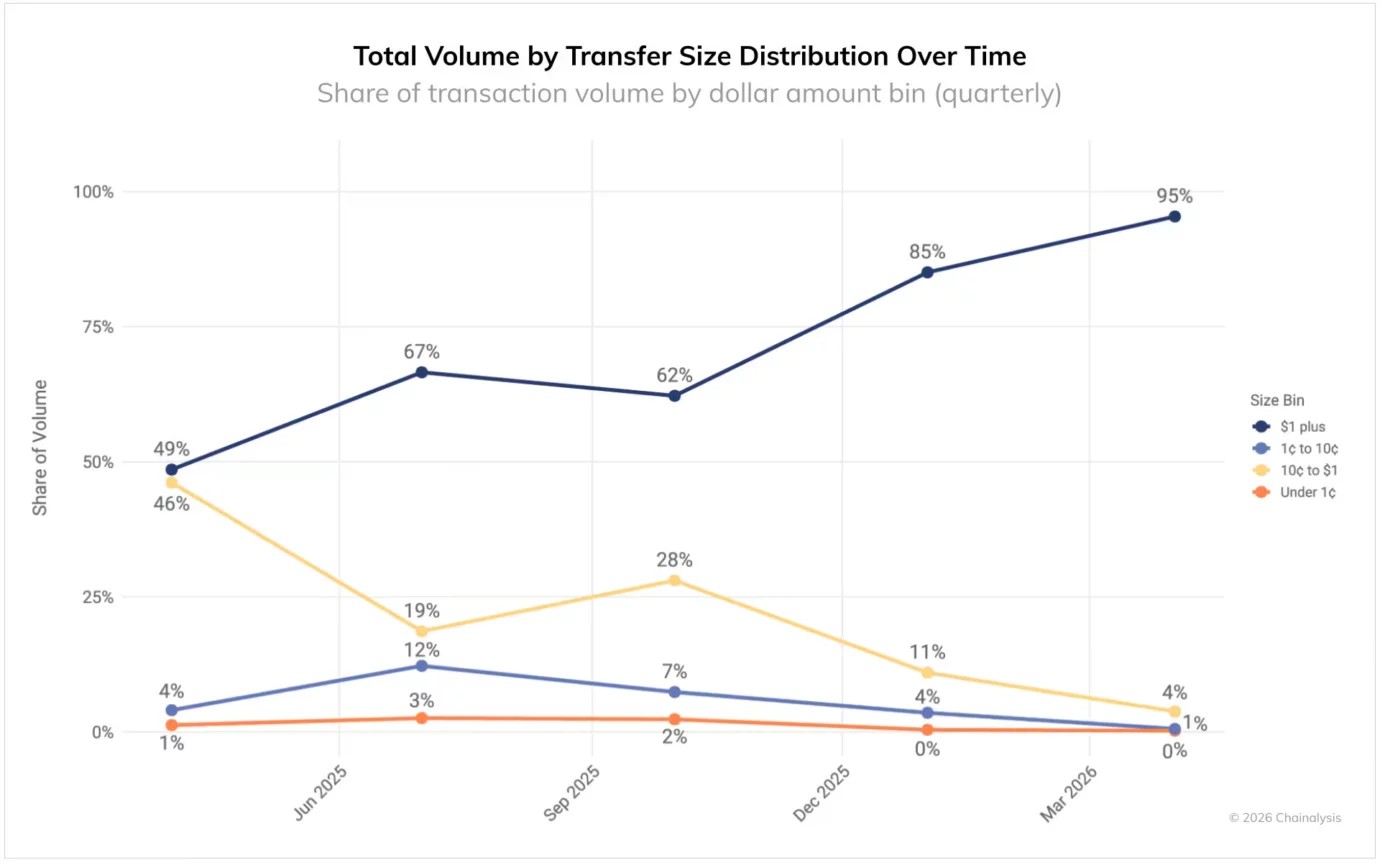
By early 2026, these transactions accounted for about 95% of the value moved through the protocol, a change that the blockchain analytics firm says suggests its use extends beyond small experimental payments.
Coinbase is expanding its infrastructure for AI-powered transactions
Recent developments in the Coinbase ecosystem have placed x402 at the center of several projects focused on AI-driven payments and automation.
In May, Coinbase-backed Base introduced Base MCP, a framework that connects Base Accounts to AI assistants such as ChatGPT, Claude, Codex and Cursor via the Model Context Protocol. Base said the system allows users to manage transfers, swaps, balance checks, transaction reviews and x402 payments through conversational interfaces, while final approval remains with the account holder.
At the same time, Base integrated a range of decentralized finance applications, including Moonwell, Morpho, Uniswap, Avantis, Aerodrome and Virtuals, allowing AI agents to assist users with lending, liquidity management, token swaps and derivatives activities. According to Base, each transaction still requires confirmation from the user through a separate approval window.
Coinbase has also built supporting infrastructure around x402 through Agentic.market, a platform designed to help autonomous agents discover and purchase services using $USDC. Previous figures cited by Base showed that x402 activity had already reached approximately 165 million completed transactions, involving more than 480,000 agents.
Outside of the Coinbase ecosystem, interest in automated payments continues to spread. Amazon Web Services has added support for Coinbase’s x402 standard through Amazon Bedrock AgentCore Payments, allowing AI agents to purchase services using $USDC. Stripe has also introduced x402 support on Base, while AllUnity has adopted the standard for its own agentic payment layer.
The growing attention to these systems comes as industry executives increasingly argue that AI agents could become key users of blockchain networks.
Coinbase Chief Executive Officer Brian Armstrong has said that AI agents could account for a significant portion of future onchain activity, while Circle Chief Executive Officer Jeremy Allaire has made similar comments about autonomous payments. Former Binance Chief Executive Officer Changpeng Zhao has described cryptocurrency as the “native currency” of AI agents.
Separate research has also indicated growing commercial interest in the sector. A Forrester report identified Stripe’s Machine Payments Protocol as a potential catalyst for AI-driven micropayments, while Bernstein analysts highlighted Coinbase’s x402 protocol and argued that the increasing use of AI agents could support demand for stablecoins due to their suitability for frequent, low-value transactions.
This trend has emerged alongside rapid growth predictions for agentic AI. According to Fortune Business Insights, the agentic AI market could reach $139.19 billion by 2034, while MarketsandMarkets estimated that agentic AI software services could grow at a compound annual growth rate of 46.8% through 2032.