

CryptoQuant CEO Ki Young Ju says Bitcoin’s current distribution phase may be less a sign of structural weakness than a large transfer of supply from legacy market participants to US financial institutions, ETFs and new long-term holders.
In one series of messages on According to him, the most important question is not only how much supply is sold, but also who ultimately absorbs it.
“I believe the selling by Bitcoin OGs and legacy miners is part of a major shift in ownership, moving to traditional US financial institutions, investors and ETFs,” Ki wrote. “So I don’t agree with the claim that Bitcoin won’t do well once the shift is complete and liquidity stops coming in.”
Bitcoin’s ownership base is changing
Ki’s dissertation is on the composition of Bitcoin holders. He said that for any asset, the long-term market design is highly dependent on the capital base behind it. If the new owners are institutions capable of attracting larger amounts of liquidity over time, he argued, the transition could ultimately support a new upward cycle.
“For any asset, it ultimately matters who owns it,” he wrote. “If the people who own it now are entities that can raise even more liquidity in the future, then I think we can look forward to the next rally at any time.”
The argument marks a remarkable framework for the current market. Bitcoin has faced intense selling pressure even as large institutional buyers have continued to absorb supply. Ki described the current phase of distribution as “a huge change of hands,” pointing to a market where legacy holders are distributing, while ETFs, Strategy and newer cohorts are taking the other side.
Related reading
According to Ki, the average cost basis of Bitcoin investors is around $53,000. Historically, he said, bear markets only ended after the price fell below the realized price. He previously thought this level would be difficult to revise due to institutional inflows and Strategy’s limited sales. But he said the recent price action indicates “unusually strong selling pressure.”
The scale of absorption is central to his concern. Since January 2023, Strategy has bought 711,206 BTC and sold only 32 BTC, removing a net 711,174 BTC from circulation, according to Ki. Since March 2024, when Bitcoin was also around $63,000, ETFs have absorbed 509,102 BTC, while Strategy bought another 650,706 BTC. Together that amounts to 1,240,808 BTC absorbed, but the price has returned to the same level.
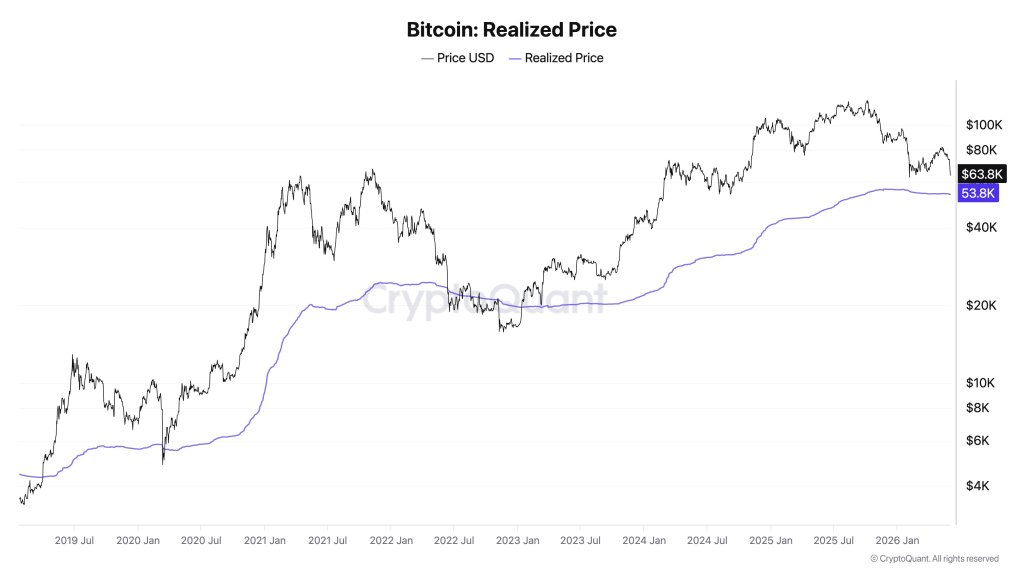
For context, Ki noted that foreign exchange reserves are around 2.7 million BTC, while Satoshi Nakamoto is estimated to hold around 1 million BTC. In other words, more Bitcoin has been absorbed than Satoshi’s estimated pile, and almost half of the foreign exchange reserves, without seeing a sustainable price increase.
Short-term buyers are maturing
Ki also pointed to a major shift within the realized capitalization structure. Bitcoin is about the same price as it was two years ago, he said, but the holder base looks materially different. The six-month-to-two-year cohort, which represents investors who entered during this cycle, now accounts for 53% of the realized cap, up from 15% two years ago.
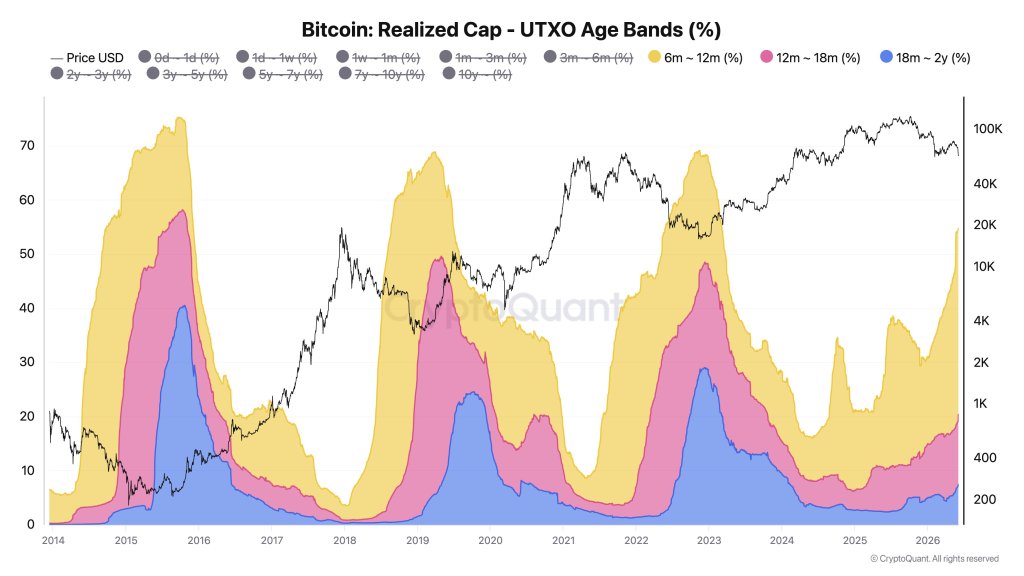
This is important because, according to Ki, short-term holders are gradually becoming long-term holders. He compared the current figure to the previous cycle, when Bitcoin hit a low after the same cohort reached 68% of the realized limit. “Short-term holders are evolving into long-term holders,” he wrote.
Related reading
The setup is not without risk. Ki posted a separate observation from Julio Moreno stating that total demand for Bitcoin, including speculative and spot demand, is shrinking at a monthly rate of 232,000 BTC. Moreno argued that the current correction is directly related to Bitcoin demand conditions, and not to stock, oil or macro indicators. He noted that shares are at an all-time high as manufacturing activity improves.
Ki’s messages therefore present a divided picture. On the one hand, current demand is shrinking and selling pressure remains strong, despite historical institutional absorption. On the other hand, Bitcoin’s ownership base is migrating towards institutions and maturing newer cohorts that could provide a deeper demand base in the future.
Ki acknowledged that this transition comes with cultural costs. “Frankly, in terms of rising asset values, I think investors in traditional financial institutions could provide an even stronger demand base than Bitcoin OGs,” he wrote. “Of course, in that process, some of the cypherpunk values may be diluted. I really regret that too.”
For the markets, the debate now turns to whether Wall Street’s growing share of Bitcoin ownership can offset the supply that is leaving older holders and miners behind. Ki’s conclusion remains constructive, but conditional on that transfer becoming a source of future liquidity rather than a ceiling on upside potential.
“Still, I believe there will definitely be another upward cycle for Bitcoin,” he wrote. “As an investor, I still believe in Bitcoin and think it is worth waiting a little longer.”
At the time of writing, BTC was trading at $62,696.
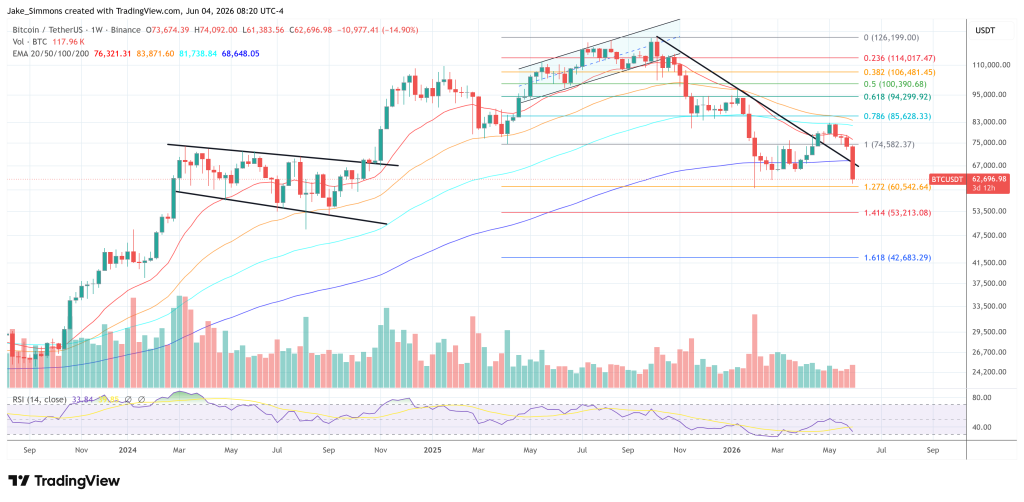
Featured image created with DALL.E, chart from TradingView.com