

Binance CEO Richard Teng said tokenization is approaching a major turning point as regulation, institutional access, adoption and market infrastructure converge. He said the next 12 to 18 months could define tokenized finance.
Key Takeaways:
- Binance’s Richard Teng said tokenization is heading to a major market inflection point.
- Clearer rules can help institutions connect blockchain systems to regulated capital markets.
- Settlement, custody and transfer systems could shape the next phase of tokenized finance.
Tokenization Outlook Centers for Regulation and Access
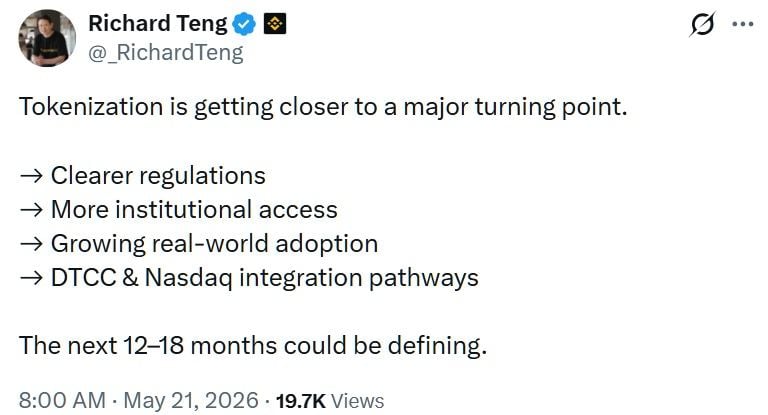
Binance CEO Richard Teng shared on May 21 on X that tokenization is approaching a “major turning point.” Teng cited clearer regulations, greater institutional access, increasing real-world adoption and integration paths from Depository Trust & Clearing Corporation (DTCC) and Nasdaq. He said the next 12 to 18 months could define tokenized finance.
“Tokenization is moving closer to a major turning point,” Teng wrote. Regulatory frameworks are moving towards operational rules for tokenized finance by 2026. In the US, the CLARITY Act cleared the Senate Banking Committee on May 14 as a central proposal for the structure of the digital asset market. The bill aims to clarify which digital assets fall under the supervision of the Securities and Exchange Commission (SEC) and which fall under the supervision of the Commodity Futures Trading Commission (CFTC). Tokenized stocks, bonds, and funds remain securities when they represent securities on the blockchain infrastructure.
Institutional access is expanding as banks, custodians, ETF issuers and exchanges connect tokenization to capital market systems. Blackrock’s BUIDL tokenized Treasury fund, Franklin Templeton’s blockchain-based fund management, and JPMorgan’s Kinexys platform demonstrate this shift. Goldman Sachs and BNY Mellon are building a tokenized money market infrastructure. Securitize’s partnership with Computershare links tokenized securities to traditional transfer agent systems. Spot bitcoin and ethereum exchange-traded funds (ETFs) have also broadened institutional access through brokerage, pension and portfolio platforms.
Adoption in the real world takes place in the market infrastructure
Real world adoption in 2026 is focused on tokenized money, collateral, government bonds and settlement infrastructure. Bank of Montreal on March 24 introduced plans for tokenized cash capabilities using CME Group’s authorized network on Google Cloud Universal Ledger. JPMorgan expands tokenized collateral transfers and tokenized repo operations. Citi develops tokenized deposit systems. HSBC has expanded tokenized gold and tokenized deposit pilots in Hong Kong.
DTCC and Nasdaq pathways connect tokenization to the core infrastructure of the financial market. Nasdaq recently received approval from the SEC for a rule change that would allow securities to be traded in token form under defined conditions. DTCC develops a DTC Tokenization Service infrastructure for real-world assets in a controlled and regulated environment. Intercontinental Exchange is working with Citigroup, BNY Mellon and other institutions on tokenized deposit systems linked to clearinghouses.
Teng stated:
“The next twelve to eighteen months could be decisive.”
The four points in Teng’s post outline a tokenization market that moves through regulation, institutional infrastructure, real-world usage, and settlement integration. The short-term model points towards authorized blockchain settlement associated with regulated banking, exchange, custody, clearing and transfer systems. That structure places tokenized assets alongside the existing securities infrastructure in the global capital markets. It also defines tokenization as an operational market infrastructure, with banks and exchanges using blockchain rails for collateral mobility, settlement speed, transparency and compliance controls.