
Solana’s AI story is gaining new support from crypto investors who argue that SOL can be positioned as a key financial infrastructure asset in an agent-driven economy. Parker White, COO of DeFiDevCorp, and Tom Shaughnessy, founder of Delphi Ventures, both pointed to Solana’s speed, liquidity and developer ecosystem as reasons why the market may be underpricing the asset.
Solana’s AI thesis is becoming increasingly popular
White, known on X as @TheOtherParker_, said on May 9 that he remains bullish on SOL because Solana combines “s-tier technology, user acceptance and liquidity.” He pushed back on the general argument that Ethereum’s greater DeFi liquidity and TVL base gives it an unassailable lead, arguing that the equation will look different once the traditional financial sector enters the market.
“Some people will respond with, ‘Yes, but ETH has such a huge DeFi liquidity/TVL edge.’ However, huge is relative and compared to TradFi liquidity, all DeFi liquidity is a drop in the ocean,” White wrote. “So when TradFi capital allocators enter the space, SOL and ETH are effectively on the same, level playing field. In this environment, technology/UX plays a huge role in adoption and SOL wins hands down.”
Related reading
White also argued that SOL’s relative valuation leaves room for greater price repricing if investors start treating Solana as a serious competitor to Ethereum. “Couple all this with the five times relative value difference, and it’s really hard not to be bullish,” he wrote. “If SOL just overtakes ETH, SOL will be at around $500 without ETH even moving. Good chances for a good outcome.”
The more novel part of White’s thesis is not simply that Solana can compete with Ethereum in terms of throughput or user experience. It’s that AI could make Solana more strategically relevant, not less. According to him, many software companies are facing uncertainty as AI compresses margins or disrupts established cash flow models. Solana, on the other hand, could benefit if autonomous agents require fast, cheap, and globally accessible financial rails.
“As future software cash flows continue to be repriced with increasing uncertainty, investors will look to diversify because diversification is the best way to combat uncertainty,” White wrote. “As this diversification occurs, investors will view SOL as a financial software infrastructure with a ‘high degree of positive AI convexity.’”
White’s argument rests on the assumption that agentic activity requires low-cost, high-frequency settlement. He described Solana as “unparalleled” in the field of micropayments and said that token-token value transfer between non-human agents “makes sense on SOL, but nowhere else.” Other networks, he argued, are either too expensive or lack the infrastructure and liquidity needed for that use case.
He also said that Solana’s network effects would be strengthened rather than weakened by the use of AI. “Second, the network effects and liquidity cannot be replicated by a new AI-built system,” White wrote. “More AI use actually strengthens network effects and liquidity, not weakens it. This is where the positive convexity comes in.” He added that crypto networks are “global, permissionless and composable,” making them a natural operating environment for agents who need to communicate, collaborate, pay and build across borders.
Related reading
Shaughnessy, to write separately on X, made a similar case. He said his SOL thesis is that it is “the best chain for AI,” citing cheap and fast infrastructure in addition to what he called the strongest technical foundation. He also argued that AI will make it easier to build new crypto applications, potentially accelerating industry formation through “easy capital formation,” global communities and rapid app creation.
In a follow-up post, Shaughnessy Solana contrasted Bitcoin in the context of AI agents. “I don’t think AI and agents work directly with BTC because it is not a programmable chain on which they can communicate,” he wrote. “I really think BTC is a huge beneficiary of AI because AGI wants to own assets that humans can’t manipulate and print money en masse to address BTC’s AGI benefits.”
For Solana, Shaughnessy summarized the thesis as “legitimate ownership of the AI sector,” faster on-chain performance through Alpenglow, underownership after investors sold SOL for other assets, and the potential for pre-IPO shares to trade around the clock.
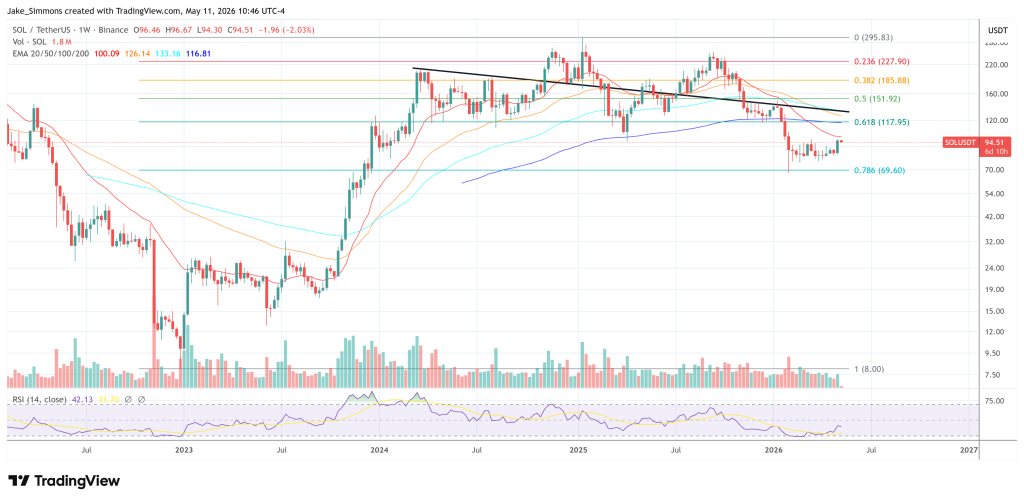
At the time of writing, SOL was trading at $94.51.
Featured image created with DALL.E, chart from TradingView.com