



A high-stakes tug-of-war is unfolding in the digital asset markets as Bitcoin grapples with the critical $80,000 threshold.
While long-term holders are taking advantage of the recent surge to reap huge gains, a relentless wave of institutional capital flowing into exchange-traded funds is absorbing the sell-off, leaving hopes of a near-term rally toward $90,000 firmly intact.
The world’s largest cryptocurrency is currently in a crucial transition phase. After months of volatile, largely sideways trading, the market is showing classic signs of renewed bullish momentum.
However, the path to the upside is heavily contested by experienced investors who are actively allocating their holdings across the newly generated liquidity.

The Bitcoin wealth transfer for $80,000
As Bitcoin rose from $78,000 to a psychologically significant $80,000 this weekend, on-chain analytics revealed a dramatic increase in distribution from seasoned investors.
According to data from Glassnode, the group of holders who built their positions two to three years ago have accelerated profit-taking to as much as $209 million per hour. These investors are currently realizing profits ranging from 60% to 100%.
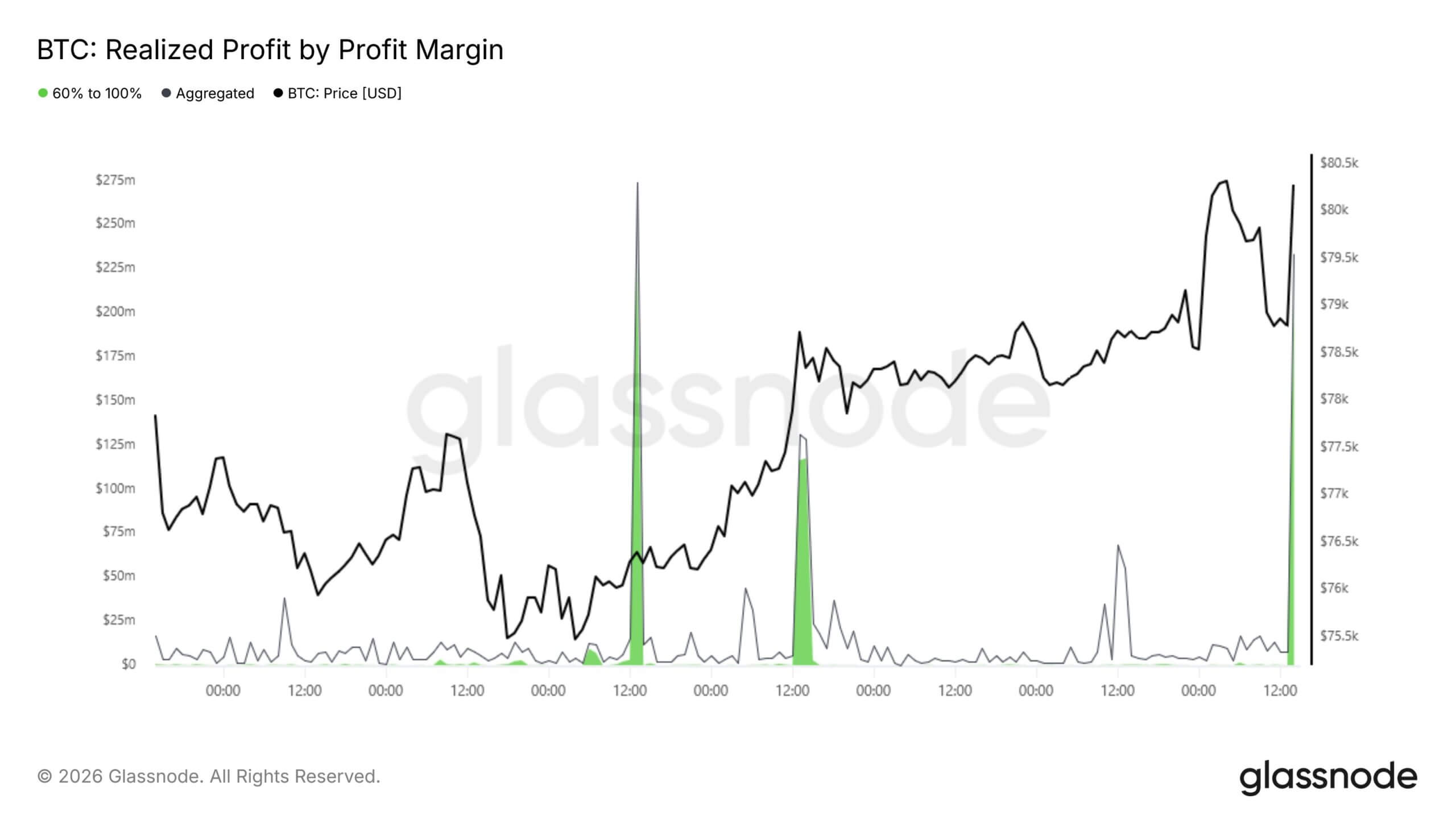
This change in behavior is confirmed by statistics from CryptoQuant, which show that the net realized profit and loss across the network has increased to approximately $1.12 billion. This represents the highest level of realized gains since last December.
Reaching a threshold of this magnitude indicates that traders who built up during the depths of the bear market are now on comfortable cushions, prompting them to rebalance their portfolios and actually secure cash.
While massive sell-offs in traditional stocks often raise alarm bells, this is very different in the crypto world.
Typically, market experts interpret this magnitude of profit-taking against the backdrop of rising prices as a sign of underlying market health.
Analysis agency Santiment explained that this phenomenon acts as a real-time stress test for the asset. The fact that hundreds of millions of dollars of supply were dumped onto the market while the price still exceeded the $80,000 level demonstrates formidable underlying demand.
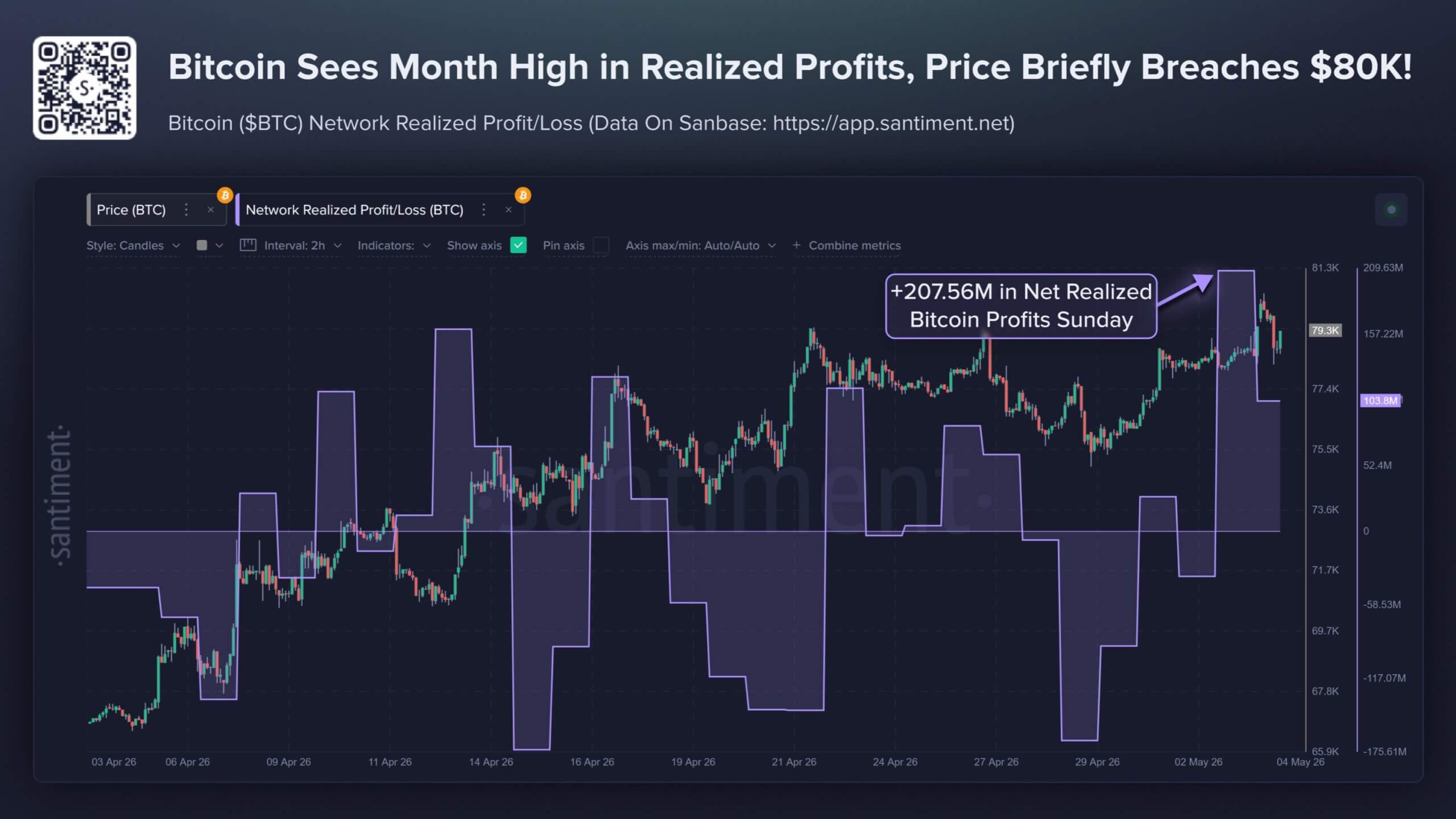
Moreover, this distribution cycle serves a structural purpose: it essentially resets the cost base of the market. As older, highly profitable coins are sold, they are absorbed by new entrants who initiate positions around $80,000.
These new buyers are statistically less likely to panic and sell on small dips to $79,000, putting a much stronger structural floor under the current price action.
Short-term holders, who are currently holding at higher costs, are exhibiting unusually quiet behavior, with weekly currency inflows on platforms like Binance hovering around the lows of the cycle.
This indicates a growing expectation of further upward trend rather than a push to capitulate prematurely.
ETFs and institutional demand are shifting the opportunities
The main driver behind this robust absorption is the continued success of Bitcoin Exchange Traded Funds (ETFs).
After a period of declining interest earlier this year, interest in these regulated investment vehicles is picking up again, demonstrating a resilience that is reshaping the fundamental architecture of the market.
Data collected by SoSoValue shows that spot Bitcoin ETFs have already attracted more than $1.1 billion in fresh capital in the first two trading days of May. BlackRock’s iShares Bitcoin Trust (IBIT) led the charge, accounting for more than $600 million of these inflows alone.
Industry observers note that the nature of these flows is shifting in a decidedly bullish direction. Outflow flows become noticeably shorter and less severe, while periods of sustained inflow last longer.
This persistence is crucial; Bitcoin doesn’t necessarily need explosive, multi-billion dollar daily infusions to appreciate. Rather, it requires the constant, day-in, day-out bidding that continuous ETF buying provides.
As a result, the institutional footprint radically changes the supply-and-demand calculus. Charles Edwards, founder of Capriole Investments, highlighted that institutional buyers are currently absorbing more than 500% of the newly produced Bitcoin supply generated by miners every day.
“Every time the price has been this high, the price has shot up over the next week,” Edwards said in an X message.
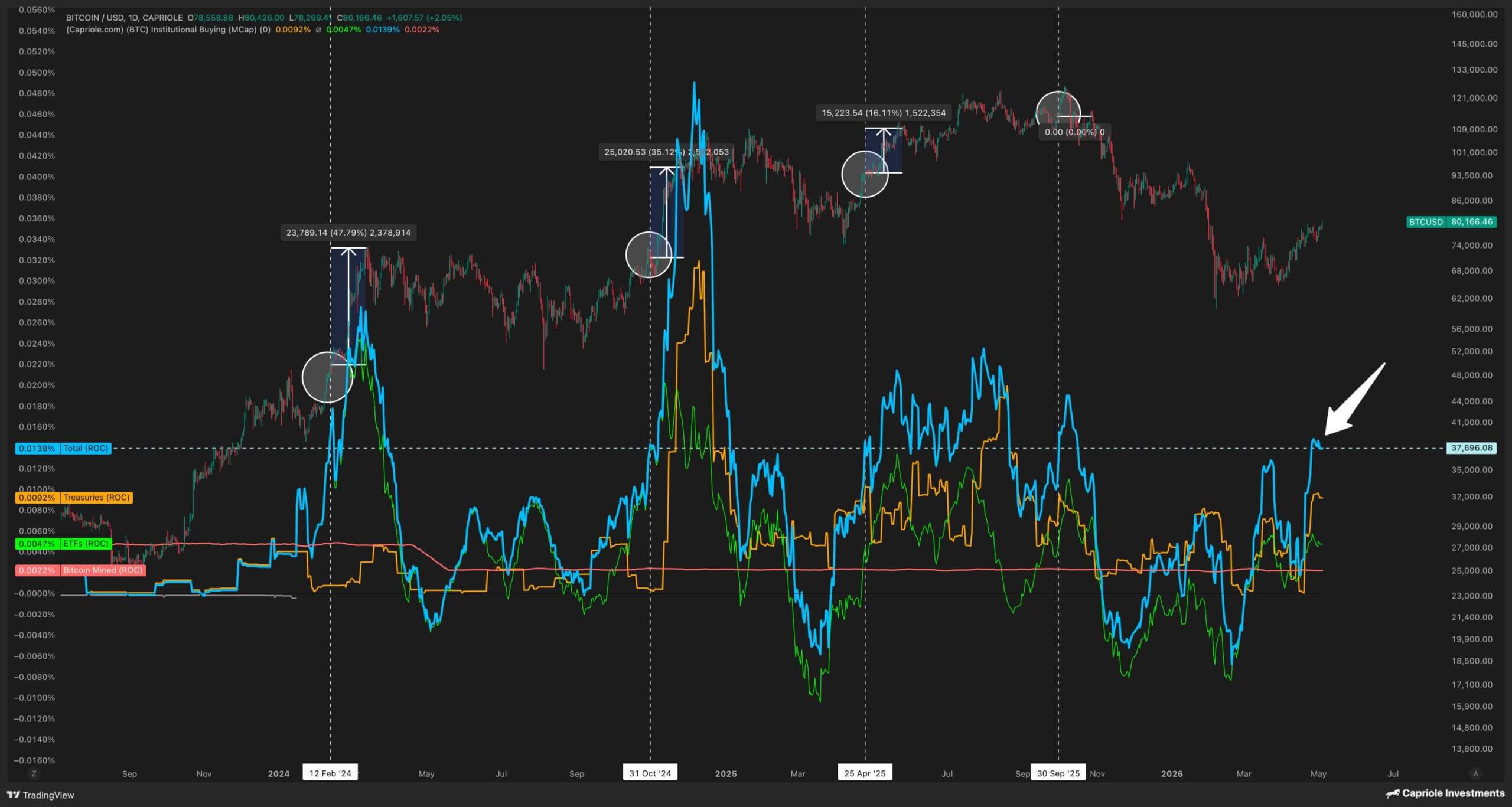
He pointed out that historical precedents for this level of supply absorption have seen an average return of 24% the following month. Should history rhyme, such a trajectory would push Bitcoin toward the $96,000 mark by June.
Bitcoin short sellers are caught in the squeeze
While spot accumulation provides a steady tailwind, the derivatives market adds explosive upside potential.
Traders who bet against the rally have been subjected to a brutal series of liquidations, with their underwater positions turned into rocket fuel for upward price spikes.
That’s what an independent Bitcoin analyst says Axel Adlerbearish traders have faced $7.88 billion in forced liquidations since early February.
Despite repeated punitive measures, short sellers continue to take new positions near the $80,000 resistance level, only to be forcibly closed by the market.
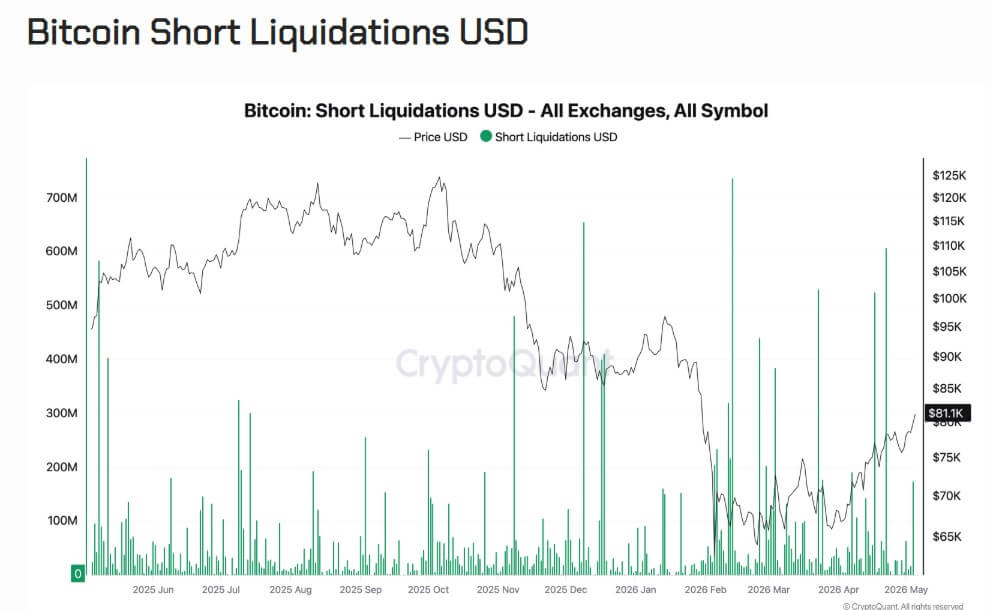
This dynamic has played out in three distinct waves in recent months, with forced closures routinely eclipsing half a billion dollars in a single day. After a period of relative calm in late April, liquidation volumes suddenly rose to $175 million on May 4.
This localized spike during an otherwise quiet trading week underlines a critical vulnerability: Short interest continues to build strongly just below the $80,000 mark.
If Bitcoin can definitively capture and hold this territory, market mechanisms dictate that the next wave of liquidations could become completely self-reinforcing.
The asymmetric design is not lost on speculative markets. Bettors on decentralized prediction platform Polymarket currently estimate a 62% chance that Bitcoin will clear $85,000 before the end of the month, with a one in four chance of hitting $90,000.
Macro crosswinds and the legislative ‘spring’
Despite its bullish on-chain architecture and institutional appetite, Bitcoin remains inextricably linked to broader macroeconomic forces and the escalating geopolitical landscape.
The assets have recently proven their worth by absorbing a gauntlet of macroeconomic headwinds, including the Federal Reserve’s latest policy decisions and swings in crude oil prices, all without breaking the overarching uptrend.
Market maker Wintermute noted that Bitcoin’s ability to close near the top of its range for the third week in a row despite these external pressures is a strong signal of strength.
However, significant technical hurdles remain. Bitcoin has consistently failed to close above its 200-day moving average since late 2025, which currently hovers around $82,000. A decisive break above this line would be the first unmistakable trend reversal signal of the year.
Trading firm QCP echoed this sentiment, arguing that the real litmus test for the bull case is a clean weekly close above the CME futures gap between $82,000 and $83,000.
Until this becomes a reality, erratic, choppy price action is the most likely outcome.
Moreover, Washington’s geopolitics and policies will largely determine whether that outbreak occurs. Recent White House announcements on the Strait of Hormuz have temporarily injected confidence into risky assets, and falling implied volatility suggests that markets are currently pricing in a de-escalation of tensions in the Middle East.
If macroeconomic stability holds and energy shocks are averted, the runway is clear for digital assets to soar higher along with stocks.
Adding to the optimism is the impending legislative progress in the United States. The digital asset industry is keeping a close eye on the CLARITY Act, a landmark market structure bill that is headed for a bipartisan markup in May. The prospect of regulatory certainty is already dispelling institutional hesitation.
Tom Lee, Chairman of BitMine, said:
“The crypto spring has begun, in our view, and as in previous cycles, investor sentiment and conviction are muted and bearish even as crypto prices rise. We believe the potential passage, or even failure, of the CLARITY Act confirms the arrival of the crypto spring.”
Ultimately, the battle for $80,000 is a microcosm of Bitcoin’s broader maturation. The asset is moving from a retail-driven speculative vehicle to an institutional base.
If the steady rhythm of demand for ETFs can continue to weather the storm of macro uncertainty and perceived profit-taking, the foundation is set for an historic run toward the $90,000 mark.