

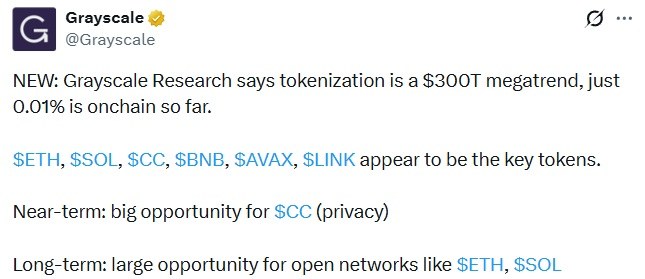
Grayscale Research said Ethereum, Solana, Canton, Avalanche, $BNB Chain and Chainlink are positioned to benefit as tokenized assets expand. The company estimated token assets at approximately $30 billion, up 217% year over year.
Key Takeaways:
- Grayscale identified Ethereum, Solana, Canton, Avalanche, $BNB Chain and Chainlink as main beneficiaries of tokenization growth.
- Tokenized assets reached approximately $30 billion, growing 217% year-on-year, led by government bonds and commodities.
- Future adoption could boost blockchain costs, liquidity and developers, with institutions taking the lead in early and open networks that will be scaled later.
Grayscale Names Blockchain Protocols Positioned for Tokenization Growth
Grayscale Research outlined several blockchain networks that it sees as central to tokenized markets. In an April 29 analysis, the company presented these networks as core infrastructure for a potential shift in capital markets, where assets are issued, transferred and settled on blockchain systems.
“We believe the megatrend of tokenization represents a huge potential investment opportunity… Over time, we believe that a large portion of the ~$300 trillion securities market – along with other asset types such as real estate – will migrate onchain,” Grayscale wrote.
Tokenized assets remain small compared to traditional markets, but growth has accelerated. The analysis estimates tokenized assets at about $30 billion, or 0.01% of global stock and bond markets, compared to about $300 trillion in traditional securities. The market has grown 217% year-over-year, led by tokenized US Treasuries by approximately $15 billion and commodities by nearly $5 billion. Grayscale Research said:
“We believe that the protocols best positioned to benefit from the tokenization megatrend are Ethereum, Solana, Canton, Avalanche, $BNB Chain and chain link.”
Each protocol plays a different role in the tokenization stack. Ethereum supports a large decentralized financial environment, while Solana focuses on transaction speed and lower fees. Canton is designed for institutional use with privacy features. Avalanche enables customizable blockchain implementations. $BNB Chain benefits from distribution linked to Binance. Chainlink provides services such as data delivery and proof of reserves across multiple networks.
Tokenization can boost blockchain costs, liquidity and developers
As tokenized assets expand, blockchain use may increase through issuance, trading, and transfers. This activity can drive demand for blockspace and transaction fees on smart contract platforms. Networks with higher activity can attract more liquidity, developers and capital over time. The market is also divided by architecture. Institution-focused networks prioritize privacy and consent, which can support early adoption by financial institutions. Open networks provide transparency and broader access, enabling broader participation and application development. Hybrid approaches combine elements of both, allowing for customization while maintaining connections to larger ecosystems.
The analysis describes tokenization as a multi-phase process rather than a single-chain outcome. Grayscale Research said:
“In our view, value will accrue to the underlying blockchain tokens – including ETH, SOL and CC – with institution-focused networks potentially capturing early activity and open networks fueling longer-term upside potential.”
“Regardless of how this transformation unfolds, LINK appears well positioned to provide consistent, chain-agnostic exposure across all phases of adoption,” the report said.
Institution-focused platforms can lead to early adoption, while open networks can expand their role as privacy solutions evolve. Chainlink is positioned to work across systems through its middleware services. Overall, the outlook indicates that various blockchain networks will benefit as tokenization continues to develop in the financial markets.