
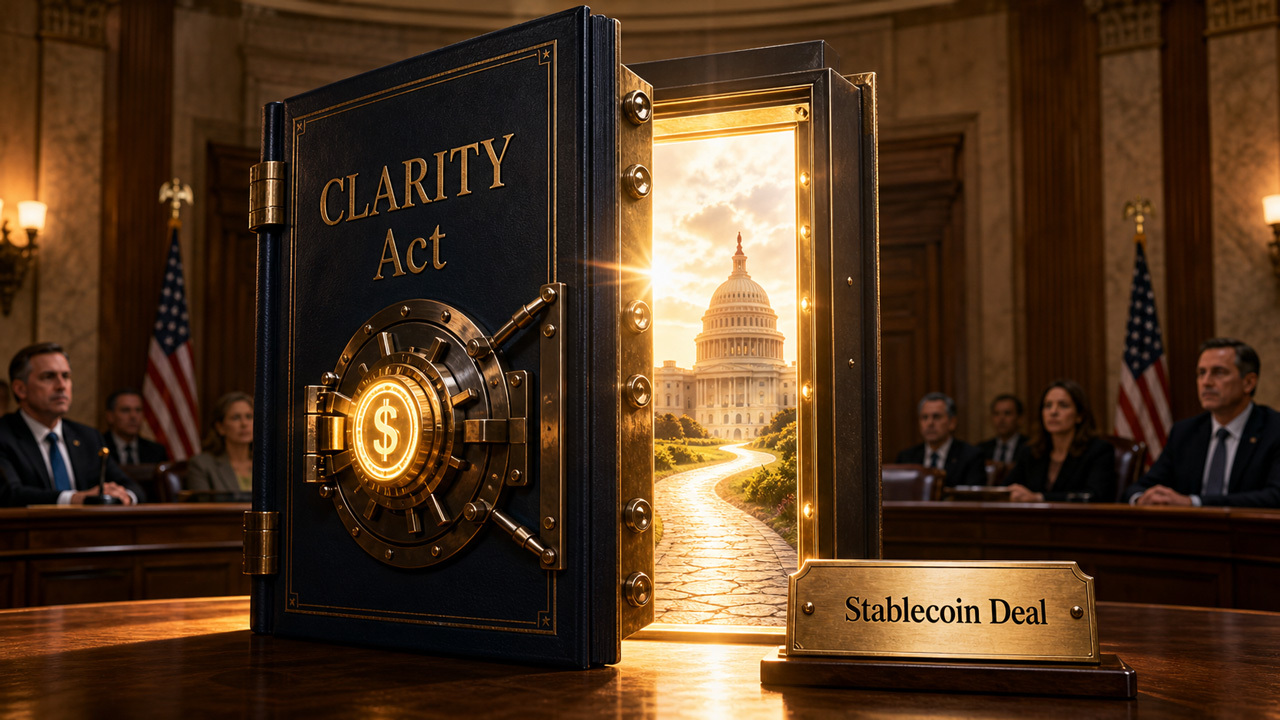
The CLARITY Act is headed to its next procedural test after Senate negotiators released compromise language on stablecoin rewards last week, raising expectations that the Senate Banking Committee could take up the measure as early as the week of May 11.
Alex Thorn, head of research at Galaxy Digital, said the release of text from Sens. Thom Tillis and Angela Alsobrooks was a positive signal for a planned increase soon. He said the compromise was expected, but publishing the language made a committee vote more plausible in the short term.
The timing has become the central question for the Digital Asset Market Clarity Act, known as the CLARITY Act, after months of negotiations over whether crypto companies can offer customers rewards tied to stablecoins.
As of Monday, the Senate Banking Committee had not yet posted a May markup of the bill on its public markup page.
However, the difference between an increase in early May and another delay could determine whether Congress has enough time to send the measure to President Donald Trump before the election calendar begins to dominate the Senate.

Stablecoin rewards were the blocker
The CLARITY Act had been stalled since January, not thanks to disagreements over stablecoin rewards.
Banks have argued that these rewards could act like interest on deposits, drawing money away from regulated lenders and weakening their ability to fund loans.
On the other hand, crypto companies countered that a broad ban would protect banks from competition and limit incentives for ordinary customers related to payments, loyalty programs or platform activities.
As a result of these disagreements, the Senate Banking Committee postponed debate on the bill in January, prompting a concerted effort led by the White House to ensure its progress.
As a result, a new compromise bill was drafted by Tillis and Alsobrooks to give banks stronger language against yield-like products.
The new Tillis-Alsobrooks language also includes a broad ban on rewards offered in a manner that is economically or functionally equivalent to interest on a bank deposit. The text would also direct regulators to develop stablecoin rules, including disclosures and a list of permitted reward activities.
In response, Coinbase chief policy officer Faryar Shirzad pointed out that crypto companies will retain the ability for Americans to earn rewards based on actual use of crypto platforms and networks.
Shirzad said:
“We protected what matters: Americans’ ability to earn rewards based on real-world use of crypto platforms and networks. We also ensured that the US can lead the financial system, which is paramount in this competitive geopolitical age. That’s important for innovation, consumers and America’s national security.”
Coinbase in particular was one of the main opponents of the January draft. The current reversal therefore removes a visible obstacle for the sector, even if it does not guarantee democratic support for the bill.
Banks continue to battle against stablecoin rewards
Despite the compromise, the traditional banking lobby is expected to actively escalate its defensive maneuvers against the bill.
Thorn had warned that the “banks [could] increase their opposition efforts against the new development.
The American Bankers Association (ABA), backed by 52 state banker associations, launched a preemptive strike last week, submitting a joint comment letter to the Office of the Comptroller of the Monet (OCC).
The coalition demands that the agency aggressively strengthen proposed rules implementing the previous GENIUS Act to ensure a watertight, enforceable ban on stablecoin yields.
In a separate, highly detailed letter to the OCC, the ABA warned that most payment stablecoins are distributed through secondary exchanges and intermediaries rather than directly by the issuers.
The banking lobby argued that allowing any form of return through these third-party channels would fundamentally undermine Congress’ intent, turning stablecoins into de facto yield-bearing instruments that would erode the core deposit base that supports mainstream lending to households and small businesses.
Banking associations are pushing for targeted regulatory changes to close what they see as loopholes.
They demand that the OCC expand the definition of “related third party” to include distribution partners and promoters, and ensure that economically equivalent revenue arrangements are blocked regardless of how they are cosmetically labeled or structured.
The ABA explicitly warned that a narrow interpretation of the yield ban would lead to widespread circumvention, significantly reducing the community’s borrowing capacity and reshaping global financing markets in ways that pose systemic risks.
These letters show how the policy battle is shifting. Banks are pushing regulators to close indirect return channels under the stablecoin law, while Senate negotiators try to prevent the same issue from sinking the broader market structure package.
That creates a difficult balance for lawmakers. If the compromise is too narrow, banks may argue that it leaves a loophole for deposit flights intact. If it is too broad, crypto companies may warn that regular customer incentives and network-based rewards will be treated like bank interest.
May formatting becomes the calendar test
Against this backdrop, the bill’s proponents view May as the practical deadline for restarting the Senate Banking Committee process, making the week of May 11 the first real test of whether the legislation still has a workable path this year.
An increase during that week would allow senators to debate and amend the bill before voting on whether to send it to the full Senate.
This step is not the final passage, but it is essential. Without this proposal, the bill remains stuck at the committee level, where disagreements over stablecoin rewards, decentralized finance, software developers and regulators have already consumed months of negotiations.
This is because the remaining path to enactment would require several successive steps: a vote in the Senate Banking Committee, full approval by the Senate, reconciliation with the Senate Agriculture Committee, amendment to the House-passed CLARITY Act, and approval by the President.
That order makes timing crucial. An increase the week of May 11 would give lawmakers a narrow but plausible path to floor consideration in late May or June. A strong bipartisan committee vote would also make it easier for Senate leaders to justify floor time and would signal that the battle for stablecoin revenue no longer defines the bill.
However, an outlier after mid-May would create a different political reality. Each week of postponements pushes the debate closer to the August recess and midterm campaign season, when appropriations, nominations, defense priorities and other election-year demands will compete for floor time.
Banks would also have more room to harden opposition, crypto skeptics could reopen other provisions, and the reconciliation process between the House and Senate would be more difficult to complete before the summer holidays.
Senator Cynthia Lummis, a pro-crypto advocate, has warned that failure to pass the bill this year could push comprehensive market structure legislation into 2030. The warning reflects the risk the industry faces if control of Congress changes after the midterm elections or if committee leadership shifts in 2027.
For the markets, the immediate signal is not that passage is assured. It is that the next measurable test has come into view.
The publication of the compromise text has therefore made the week of May 11 an early indicator of whether Washington’s crypto overhaul still has enough time and sufficient political support to make progress this year.