
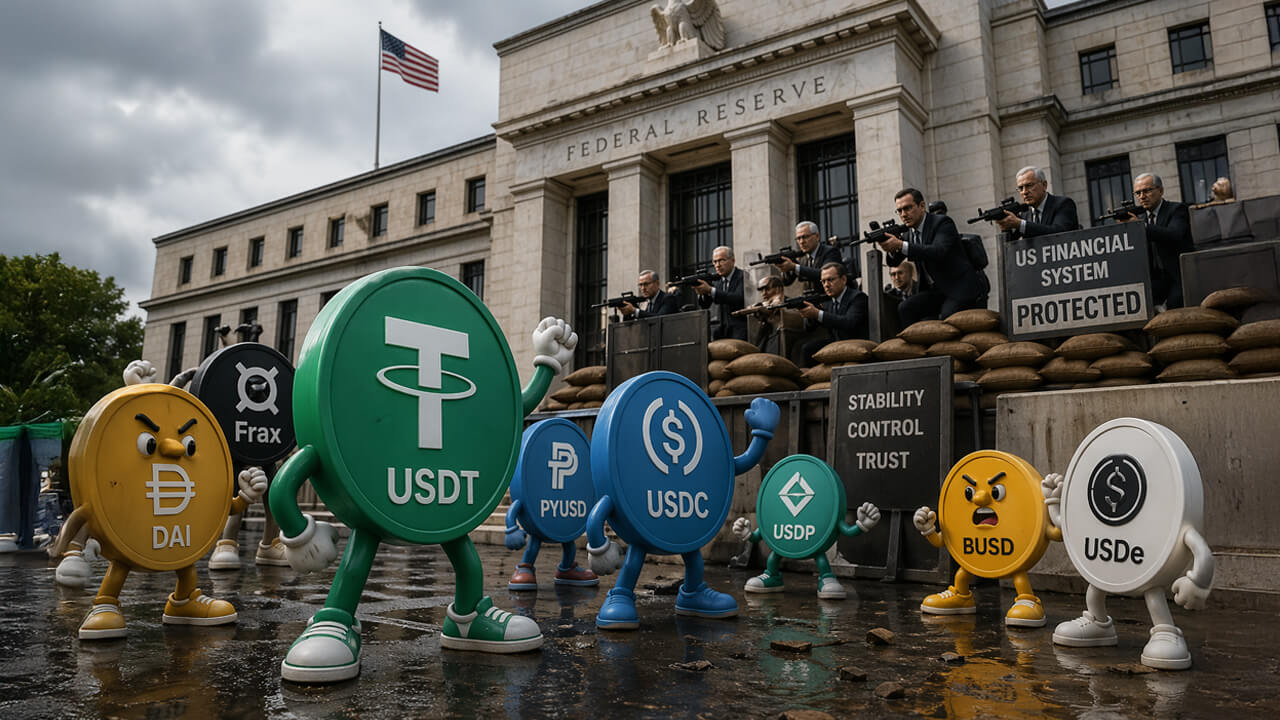
Close Menu
  • News
    • Bitcoin
    • Altcoins
    • DeFi
    • Market Cap
  • Blockchain
  • Web 3
    • NFT
    • Metaverse
  • Regulation
  • Analysis
  • Learn
  • Blog
What's Hot

Research shows Implicity’s new agnostic cloud-based AI algorithm further reduces false alerts even after manufacturer AI filtering in modern devices

2026-04-25

Deloitte Gives Chainlink Top Security Certification, Making It the Only Crypto Oracle with SOC 2 Type 2 Status

2026-04-25

Bitcoin Dominance Surges Above 60% – Weak Altcoin Demand Slows Rotation

2026-04-25
Facebook X (Twitter) Instagram
  • Contact
  • Terms & Conditions
  • Privacy Policy
  • DMCA
  • Advertise
Facebook X (Twitter) Instagram
Bitcoin Platform – Bitcoin | Altcoins | Blockchain | News Stories Updated Daily
  • News
    • Bitcoin
    • Altcoins
    • DeFi
    • Market Cap
  • Blockchain

    Deloitte Gives Chainlink Top Security Certification, Making It the Only Crypto Oracle with SOC 2 Type 2 Status

    2026-04-25

    Axie Infinity’s Ronin Network Migrates to Ethereum Next Month, Unlocking Lower Inflation and Rewards for New Builders

    2026-04-25

    Coinbase reduces fraud response times with a new AI-powered rules engine

    2026-04-25

    Cluster Protocol and Pundi AI launch fully decentralized AI training system

    2026-04-25

    University of Maryland uses Filecoin to secure the provenance of geospatial data

    2026-04-25
  • Web 3
    • NFT
    • Metaverse
  • Regulation

    The world’s central banks are now treating stablecoins as a real multi-trillion dollar monetary threat

    2026-04-25

    The US Admiral Who Destroyed Crypto Now Runs A Bitcoin Node For US Security

    2026-04-23

    The American Bankers Association is calling for a 60-day pause to prevent stablecoin rules from going live

    2026-04-23

    Banks Fund Crypto Attack Ads in Washington, as More Than 3,000 Banks Unite to Stop the Clarity Act from Passing the Senate

    2026-04-21

    Have rate refunds been purchased at 20 cents on the dollar by Cantor Fitzgerald, a stablecoin-backed Treasurys custodian?

    2026-04-21
  • Analysis

    Trillions of dollars of crypto liquidity are concentrated in the locations that US regulators fear most

    2026-04-25

    Can XRP Price Reach $3 in 2026? Prediction websites show the possibilities

    2026-04-25

    Can XRP Price Reach $3 in 2026? Prediction websites show the possibilities

    2026-04-25

    XRP Signals Huge Breakout: $10 Target in Sight as Momentum Grows

    2026-04-25

    Ethereum’s four consecutive weeks of price increases are driving bullish bets at $3,200

    2026-04-24
  • Learn

    Wall Street won’t stop buying. Bitcoin will not break out. What gives?

    2026-04-20

    Changelly launches ultimate DeFi Swap Flow and API for cross-chain and on-chain swaps

    2026-04-18

    What Is Etherscan? How to Use the Ethereum Block Explorer

    2026-04-17

    What Is a Crypto Faucet and How Does It Work?

    2026-04-17

    Crypto Bubbles Explained

    2026-04-17
  • Blog
Bitcoin Platform – Bitcoin | Altcoins | Blockchain | News Stories Updated Daily
Home»Regulation»The world’s central banks are now treating stablecoins as a real multi-trillion dollar monetary threat
The world's central banks are now treating stablecoins as a real multi-trillion dollar monetary threat
Regulation

The world’s central banks are now treating stablecoins as a real multi-trillion dollar monetary threat

2026-04-25No Comments5 Mins Read
Share
Facebook Twitter LinkedIn Pinterest Email

The world’s central banks long ago stopped discussing whether stablecoins are risky. Their main concern now is who will control them and how.

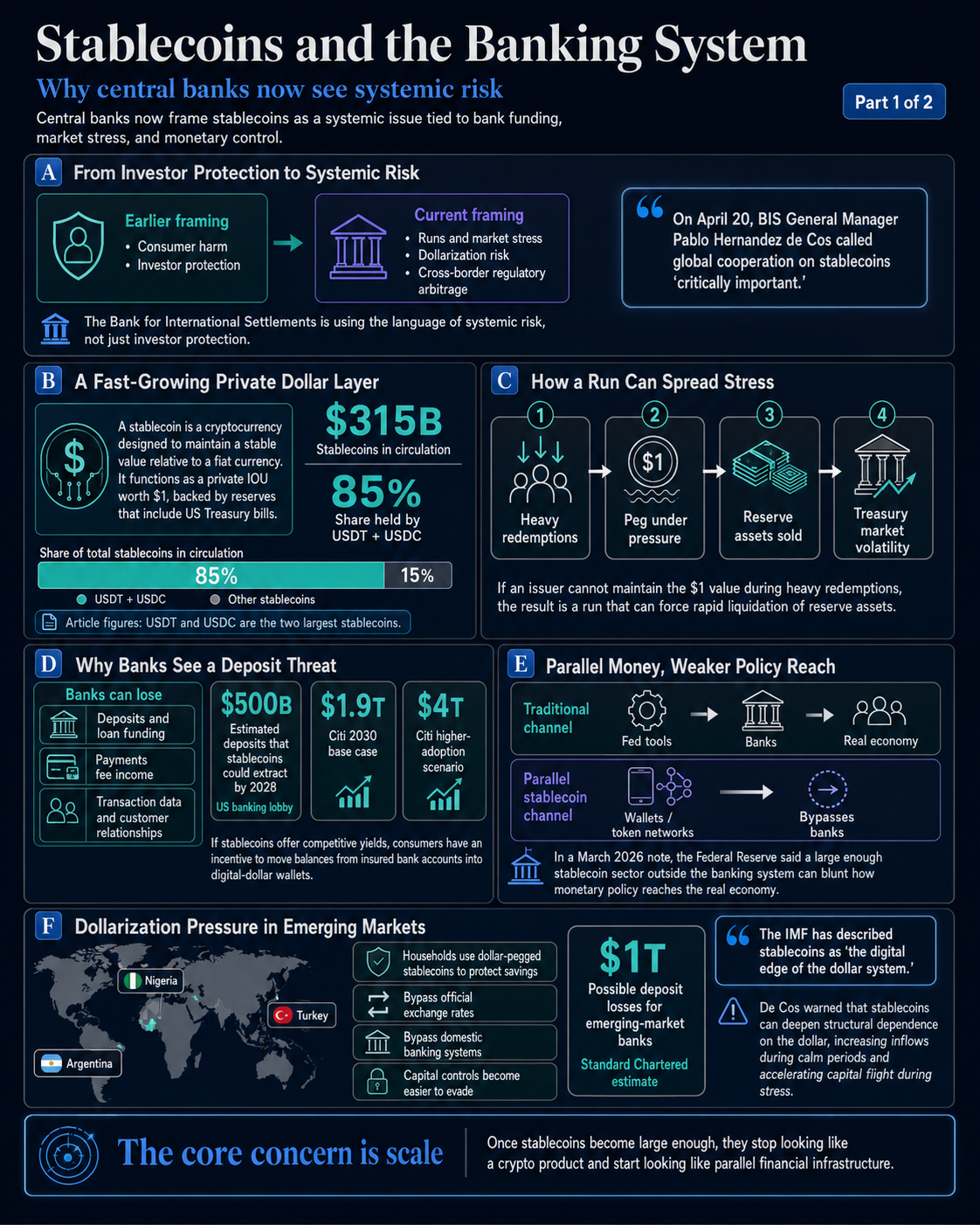
On April 20, Pablo Hernandez de Cos, CEO of BIS, called for global cooperation on stablecoins, describing it as “critical.”

The couch for International Settlements, often called the central bankers’ central bank, has raised concerns about stablecoins before, but the language they have used is much sharper now. De Cos warned of runs that could cause market stress, of dollar-pegged tokens accelerating the dollarization of developing economies, and of fragmented regulatory frameworks that could arbitrage private companies across borders.

That is the language of systemic risk, distinct from the investor protection framework that dominated previous debates.

A stablecoin is a cryptocurrency designed to maintain a stable value against a fiat currency. Tether’s USDT and Circle’s USDC are the two largest, together accounting for about 85% of the $315 billion worth of stablecoins currently in circulation.

Unlike a savings account or legal tender, a stablecoin functions as a $1 private IOU, backed by reserves like U.S. Treasury bonds and built for speed across borders and crypto markets. At that scale, this convenience is exactly what central banks now find alarming.
Stablecoins and the banking system

Central banks worry about deposits, not links

Concerns about bond stability are real: If an issuer can’t maintain $1 during heavy redemptions, the result is a run that forces a rapid liquidation of reserves, injecting volatility into Treasury markets.

The deeper concern, however, is what stablecoins do to the banking system as they grow. When people hold tokens instead of bank deposits, banks lose the funding base they use to make loans. When payments are processed through private token networks instead of bank rails, banks lose revenue from fees, transaction data, and customer relationships.

See also  Is GOAT the next billion dollar memecoin? Early market peak signals...

The ECB has been explicit about this chain: stablecoins could cost European banks all three at once, while dollar-denominated tokens could gain a foothold in markets where the euro is supposed to be dominant.

CryptoSlate reported on the ECB’s modeling in November 2025, when policymakers were warring over what $2 trillion in stablecoins would mean for European financial stability. Their conclusion was that stablecoins at that scale become a direct transmission channel for US financial stress to European banks.

Citi’s April 2026 study predicts that stablecoin issuance will reach $1.9 trillion by 2030 under the base case, with $4 trillion possible in higher adoption scenarios. These figures are now actively shaping the way central banks determine their planning horizons.

The deposit demand has become urgent for banks. If stablecoins can offer competitive returns, consumers have a clear incentive to shift funds from insured bank accounts to digital dollar wallets, and the US banking lobby has estimated that stablecoins could drain roughly $500 billion from deposits by 2028.

The Federal Reserve added another complication in a March 2026 note on payments stablecoins and cross-border payments: A large enough stablecoin sector outside the banking system could dilute the way monetary policy reaches the real economy, because the Fed’s tools work through banks, and a parallel network that bypasses them weakens their reach.

The outflow of deposits is mainly taking place in developed economies, because the problem of dollarization is global. De Cos warned that stablecoins could accelerate developing economies’ structural dependence on the dollar while making it easier to circumvent capital controls, leading to greater inflows during stable periods and faster capital flight during stress.

See also  JPMorgan reveals that worldwide supervisors prefer tokenized bank deposits over Stablecoins

We’ve seen this happen in countries like Nigeria, Argentina and Turkey, where households are already using dollar-pegged stablecoins to protect their savings from local currency devaluation, completely bypassing official exchange rates and domestic banking systems.

CryptoSlate daily briefing

Daily signals, no noise.

Market-moving headlines and context, read in one sitting every morning.

5 minute summary 100,000+ readers

Free. No spam. You can unsubscribe at any time.

Oops, looks like there’s a problem. Please try again.

You are subscribed. Welcome aboard.

Standard Chartered has estimated that banks in emerging markets could lose as much as $1 trillion in deposits to stablecoins. The IMF has described stablecoins as the digital edge of the dollar system, a phrase that perfectly captures both their utility and the structural threat.

It implies that stablecoins are expanding the dollar’s dominance faster and more directly than the eurodollar system ever did, through private companies rather than state institutions, leaving central banks in smaller economies with no practical mechanism to slow the outflow.
Who controls the stablecoin rails?Who controls the stablecoin rails?

The real fight is over who controls the movements of stablecoins

The debate has reached the European political leadership, and positions are not aligned.

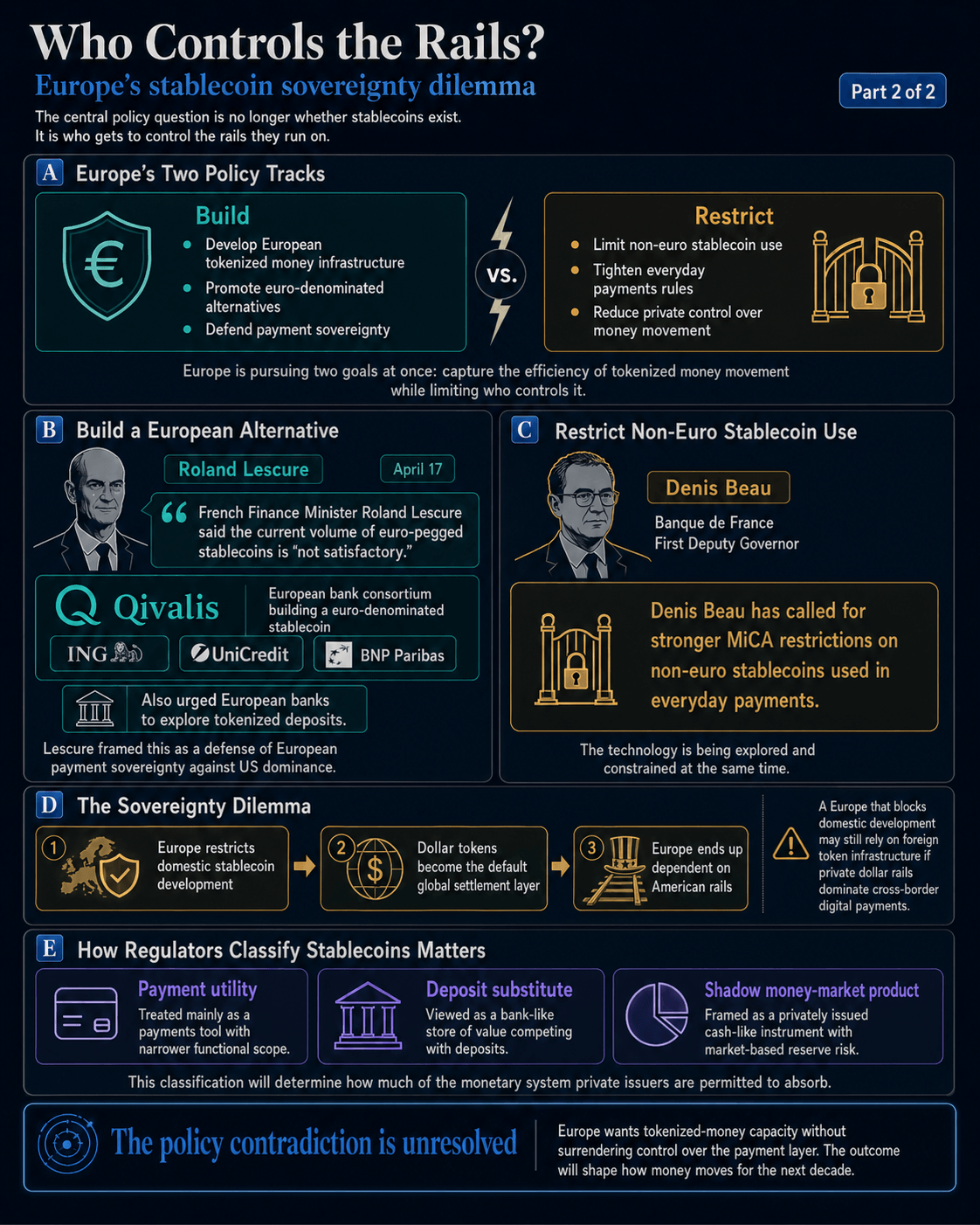
On April 17, French Finance Minister Roland Lescure called the current volume of euro-pegged stablecoins “not satisfactory” and backed Qivalis, a consortium of European banks including ING, UniCredit and BNP Paribas, which is building a euro-denominated stablecoin. Lescure also urged European banks to explore tokenized deposits, describing the initiative as a defense of European payment sovereignty against US dominance.

It’s hard to miss the tension in that position. European policymakers are afraid of stablecoins and at the same time fear being excluded from the infrastructure race. If dollar tokens become the standard settlement layer for digital payments worldwide, a Europe that blocked the development of stablecoins at home will certainly end up on the American track.

See also  China will become the world's third largest Bitcoin mining hub - here's how

At the same time, the Banque de France’s first deputy governor, Denis Beau, has called for stricter MiCA restrictions on non-euro stablecoins used in everyday payments, even as Lescure endorses the technology.

Europe is pursuing two policy tracks at once without resolving the contradiction: policymakers want the efficiency of token money movements, and they are deeply uncomfortable with private issuers controlling this.

Whether regulators ultimately treat stablecoins as payment tools, deposit substitutes, or shadow money market products will determine how much of the monetary system private issuers are allowed to absorb.

That reclassification takes place in real time, and the outcome will determine how money moves over the next decade.

Source link

Banks Central dollar monetary multitrillion Real Stablecoins threat treating Worlds
Share. Facebook Twitter Pinterest LinkedIn Tumblr Email

Related Posts

Stablecoins are becoming institutional as Morgan Stanley rolls out a new portfolio

2026-04-24

60% of banks listed on SWIFT have a connection with Ripple

2026-04-23

The US Admiral Who Destroyed Crypto Now Runs A Bitcoin Node For US Security

2026-04-23

The American Bankers Association is calling for a 60-day pause to prevent stablecoin rules from going live

2026-04-23
Add A Comment

Comments are closed.

Top Posts

This catalyst could send Bitcoin (BTC) flying again in June, according to InvestAnswers

2023-05-19

US Stablecoin Regulation can be postponed if pro-Crypto Democrats attract support

2025-05-07

Ethereum price drops back to $3,200, recovery faces first real test

2026-01-19
Editors Picks

Judge Agrees to Delay $125,000,000 Fine in SEC v. Ripple Lawsuit, Opening Door to Possible Appeal

2024-09-06

Spanish National Museum Thyssen to Mint Exclusive collection of Van Gogh NFTs

2023-07-17

Top Trader Predicts Rallies for Two Dogecoin Rivals, Says Memecoin Season is Heating

2024-02-27

Bitcoin Enters the ‘Buy Zone’ – But THIS Ratio Flashes BTC Warning Signs

2026-03-31

Our mission is to develop a community of people who try to make financially sound decisions. The website strives to educate individuals in making wise choices about Cryptocurrencies, Defi, NFT, Metaverse and more.

We're social. Connect with us:

Facebook X (Twitter) Instagram Pinterest YouTube
Top Insights

Research shows Implicity’s new agnostic cloud-based AI algorithm further reduces false alerts even after manufacturer AI filtering in modern devices

Deloitte Gives Chainlink Top Security Certification, Making It the Only Crypto Oracle with SOC 2 Type 2 Status

Bitcoin Dominance Surges Above 60% – Weak Altcoin Demand Slows Rotation

Get Informed

Subscribe to Updates

Get the latest news and Update from Bitcoin Platform about Crypto, Metaverse, NFT and more.

  • Contact
  • Terms & Conditions
  • Privacy Policy
  • DMCA
  • Advertise
© 2026 Bitcoinplatform.com - All rights reserved.

Type above and press Enter to search. Press Esc to cancel.