

Matt Crosby, chief analyst at Bitcoin Magazine Pro, says traders who rely on Bitcoin’s traditional four-year cycle may be leaning on a framework that no longer fits the market. In his latest analysis, Crosby argued that structural shifts in supply, institutional demand and macro liquidity are now more important than the old halving-induced scenario.
Bitcoin’s old cycle playbook is falling apart
Crosby’s core claim is simple: Bitcoin may already be trading in a different regime. Referring to the fact that there are now more than 20 million BTC in circulation, he said that more than 95% of the total final supply has already been spent, reducing the relative shock value of each new halving. Historically, halvings halved Bitcoin’s inflation rate and helped shape a familiar pattern of post-halving rallies, then declines, and recoveries in the next cycle. Crosby said this pattern may now be losing steam.
“A lot of people look at the previous cycles as a potential for what Bitcoin will do this time,” he said. “We can’t hit bottom anytime soon. We have to wait until at least a year has passed since that peak, because that’s what we’ve always done.” Crosby pushed back on that logic, adding that he has “concrete evidence” as to why the old cycle should no longer be considered a base case.
Related reading
Much of that evidence, he says, comes from demand. Highlighting the size of the accumulation now coming from large buyers of government bonds and spot Bitcoin ETFs, Crosby said Strategy alone has acquired more than 1,000 BTC per day, or about two to three times Bitcoin’s daily inflation rate. He also pointed to a recent day when spot ETFs bought nearly $750 million worth of Bitcoin. That kind of sustained demand, he argued, is fundamentally different from the market structure seen in previous cycles.
Rather than relying on calendar-based cycle models or seasonality, Crosby said investors should pay attention to liquidity and broader macro conditions. He cited a 96.26% long-term correlation between the S&P 500 and global M2 liquidity, along with a 93% correlation between Bitcoin and the S&P over 15 years on a monthly basis. Bitcoin itself, he said, shows an 85% correlation with global liquidity, reinforcing the idea that expansion and contraction of liquidity remain the dominant force behind major moves.
Crosby also disputed the usefulness of seasonality in the election cycle. While Bitcoin’s interim years have sometimes produced strong average returns, he noted that average returns are negative and sample sizes remain small. Gold and stocks, on the other hand, do not exhibit the same kind of purely political cycle pattern. For Crosby, this means that seasonality is a weak basis for market visits.
Related reading
He also argued that Bitcoin looks different when measured against gold than against the US dollar. On that basis, he said, Bitcoin could have peaked in late 2024 and already spent more than a year in a relative bear phase, with a possible bottom around February 2026. That, he suggested, is a sign that the classic four-year cycle is already starting to crumble.
The more useful signals, Crosby said, come from on-chain and macro indicators. He pointed to Coin Days Destroyed and Value Days Destroyed as instruments that have historically marked major tops and attractive accumulation zones, and said Bitcoin has recently re-entered territory previously aligned with undervaluation. At the same time, he noted that US consumer confidence fell to 47.6% in April 2026, which he described as the lowest figure ever, while expectations for manufacturing and liquidity conditions began to improve.
“At some point it is inevitable that this four-year cycle will be broken,” Crosby said. “We’re seeing new liquidity coming into the system. We’re seeing the rally in the S&P 500. We’re seeing more positivity in the outlook for manufacturing, and we’re seeing incredible negativity not just in Bitcoin, but in equity market sentiment.”
His conclusion was not that the risk has disappeared. It was that the market would no longer reward waiting for a “random date on a calendar.” If Crosby is right, the next big Bitcoin move will be shaped less by inherited cycle history and more by the harder forces of liquidity, positioning and continued institutional demand.
At the time of writing, BTC was trading at $78,144.
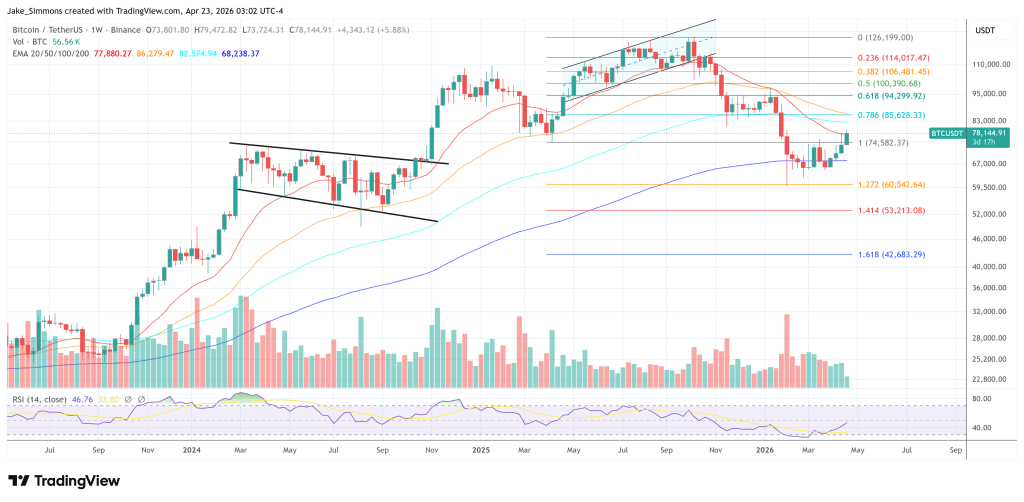
Featured image created with DALL.E, chart from TradingView.com