
E-commerce market in the Middle East
Overview of the Middle East e-commerce market
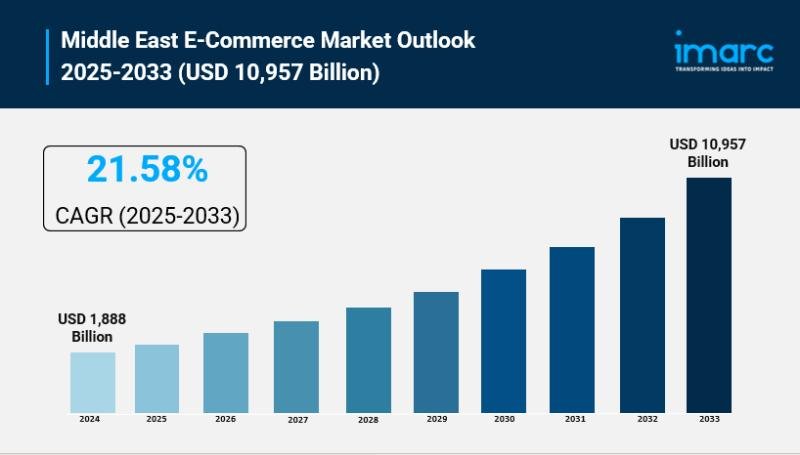
Market size in 2024: $1,888 billion
Market size in 2033: $10,957 billion
Market growth rate 2025-2033: 21.58%
According to IMARC Group’s latest research publication, “Middle East E-Commerce Market: Industry Trends, Share, Size, Growth, Opportunity and Forecast 2025-2033,” the size of the Middle East e-commerce market was estimated at $1,888 billion in 2024. Looking ahead, IMARC Group estimates that the market will reach $10,957 billion by 2033, representing a CAGR of 21.58%. from 2025-2033.
Market overview:
● The Middle East e-commerce market is growing rapidly, driven by investments in digital infrastructure, government-backed transformations and a young, tech-savvy consumer base.
● Saudi Arabia and the UAE are leading regional growth, with platforms expanding rapidly across fashion, electronics, groceries and luxury goods categories.
● High smartphone penetration and widespread internet access have created ideal conditions for mobile-first digital commerce to thrive across the region.
● AI-powered product discovery, digital wallets and buy-now-pay-later services make online purchasing more intuitive, personalized and accessible to consumers.
● Cross-border e-commerce is gaining popularity as regional consumers increasingly seek variety and quality beyond what local platforms currently offer.
Grab a sample PDF of this report: https://www.imarcgroup.com/middle-east-e-commerce-market/requestsample
Trends and drivers for the Middle East e-commerce market:
● Mobile commerce is now the default shopping channel: Smartphone penetration in the UAE and Saudi Arabia is among the highest in the world, driving e-commerce platforms to go mobile-first. Mastercard and Amazon Payment Services collaborated to expand digital payment acceptance to 40 markets in the Middle East and Africa, introducing tokenization and Secure Card on File features to meet rising demand for mobile transactions.
● Social commerce is changing the way people discover and buy: Instagram, TikTok and Snapchat have become de facto storefronts, especially among younger demographics who trust influencer recommendations over traditional advertising. Platforms with localized content, purchasable messaging, and in-app payments win over this audience and drive meaningful conversions.
● Hyper-personalization becomes a competitive imperative: AI and big data tools allow retailers to tailor recommendations, pricing and messaging at scale. Dubai-based AI startup DXwand has secured $4 million in Series A funding to accelerate its multilingual conversational AI tools, reflecting the strong regional appetite for personalized, AI-driven customer engagement.
● Digital payment innovation boosts consumer confidence: MyFatorah – the only licensed PSP in all GCC countries – partnered with Mastercard to deploy a new payment gateway serving more than 75,000 merchants, aimed at reducing fraud and smoother payment experiences across the region’s fast-growing e-commerce ecosystem.
Ask analyst for custom report: https://www.imarcgroup.com/request?type=report&id=20851&flag=E
Segmentation of the Middle East e-commerce sector:
The report has segmented the market into the following categories:
Analysis by type:
● Household appliances
● Clothing, shoes and accessories
● Books
● Cosmetics
● Groceries
● Others
Analysis per transaction:
● Business to Consumer (B2C)
● Business to Business (B2B)
● Consumer-to-consumer (C2C)
● Others
Land Coverage:
● Saudi Arabia
● Turkey
● Israel
● United Arab Emirates
● Iran
● Iraq
● Qatar
● Kuwait
● Oman
● Jordan
● Bahrain
● Others
Competitive landscape:
The competitive landscape of the industry has also been examined, along with the profiles of key players.
Recent news and developments in the Middle East e-commerce market:
● February 2026: Local e-commerce platforms such as Noon and Namshi capture a 60% market share in fashion and electronics through Arabic-first interfaces, same-day delivery and cultural features such as flash sales during Ramadan.
● January 2026: AI personal shoppers, used by nearly 80% of consumers for recommendations and price comparisons, will use native assistants such as Al-Futtaim’s Blue AI to perform thematic purchasing tasks.
● January 2026: Digital wallets are responsible for 20% of online spend in MENA, with mobile commerce accounting for 70% of transaction values through app-based services and biometric security in markets such as the UAE and KSA.
Research methodology:
The report is based on a comprehensive research framework that combines:
● Primary interviews with industry stakeholders
● Secondary data from government and business databases
● Market modeling and forecasting techniques
● Data triangulation and validation
Please note: If you require specific details, data or insights that are not currently within the scope of this report, we are happy to accommodate your request. As part of our tailor-made service, we collect and provide the additional information you need, tailored to your specific requirements. Let us know your exact needs and we will ensure the report is updated accordingly to meet your expectations.
About us:
IMARC Group is a global management consultancy helping the world’s most ambitious changemakers create lasting impact. The company offers a comprehensive suite of market entry and expansion services. IMARC’s offerings include in-depth market assessment, feasibility studies, business incorporation assistance, plant setup support, regulatory approvals and licensing navigation, branding, marketing and sales strategies, competitive landscape analysis and benchmarking, price and cost research and sourcing research.
Contact us:
IMARC group
134 N 4th St. Brooklyn, NY 11249, USA
Email: sales@imarcgroup.com
Tel. no.:(D) +91 120 433 0800
United States: +1-201971-6302
This release was published on openPR.