

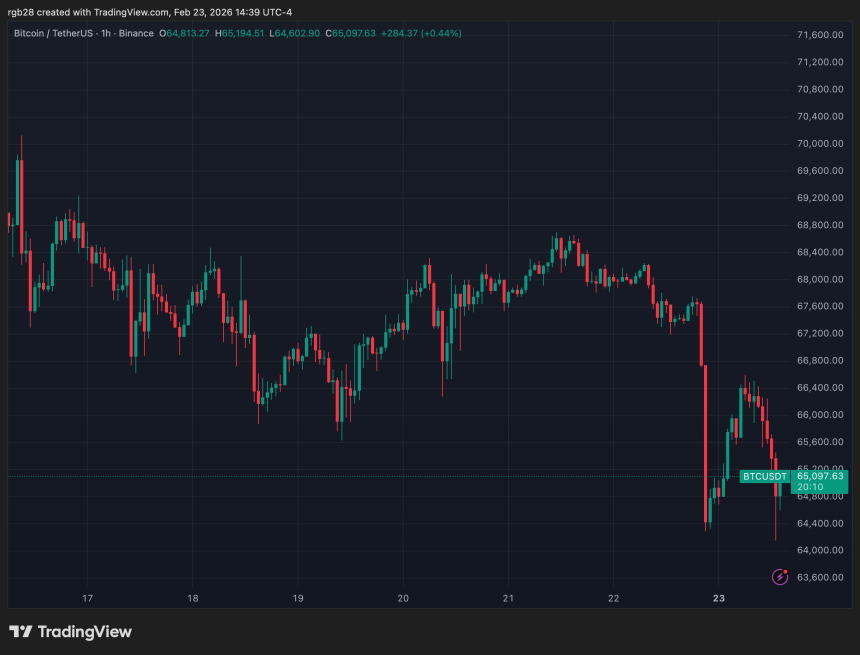
After ending the week below a crucial support level, Bitcoin (BTC) has fallen below the $65,000 support for the first time since the early February crash, hitting a two-week low of $64,152.
Amid this performance, some analysts have warned that the flagship crypto could be on the “eve of a bearish acceleration,” warning that another major crash is looming.
Related reading
Bitcoin loses the 200-week EMA
Analyst Rekt Capital reported this on Monday marked that Bitcoin produced a “historically pivotal” development after closing last week below the 200-week Exponential Moving Average (EMA), which is currently “at the center of a major confluence zone.”
Notably, the 200-week EMA is in line with the highs of BTC’s post-halving reaccumulation range, located between $66,000 and $71,000. Meanwhile, the lows of the post-halving reaccumulation range, around the $58,000-$60,000 levels, define the broader structure of BTC’s current range.
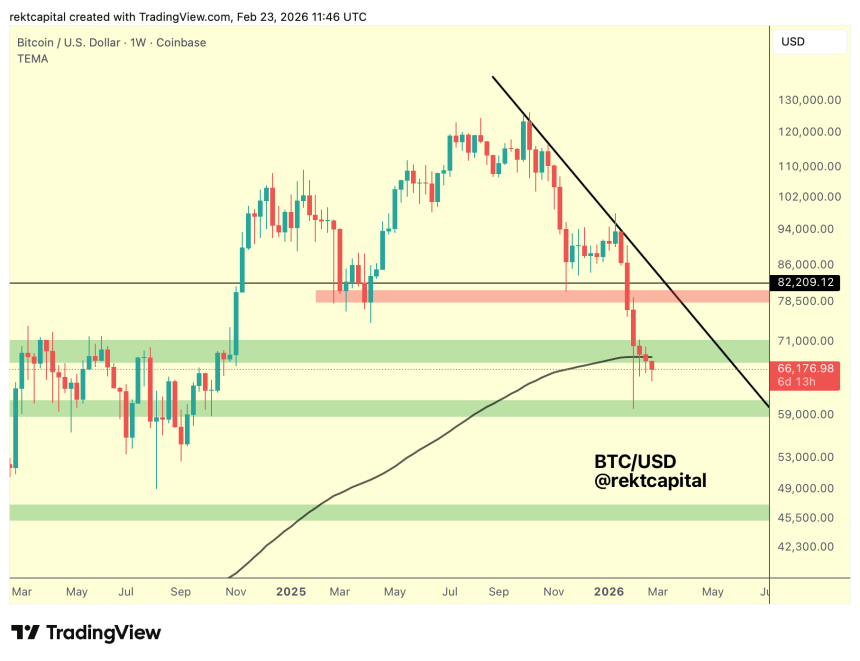
Over the past three weeks, the cryptocurrency has attempted to develop a demand region around this area, which was previously a key supply area. However, this level has not historically been structurally reliable support for BTC’s price, the analyst asserted, noting that it has previously functioned as a 10-month resistance.
“Under the current structure, we have seen three consecutive weeks of increased sell-side volume in this region, with limited meaningful response on the buy-side,” he explains.
According to the post, this imbalance has led to a weekly close below the 200-week EMA, causing it to lose support in this time frame. This suggests that there could be a “continuation of the bearish acceleration into the second wave” soon.
The analyst warned that now that the price has closed the week below this critical level, there is a “high chance that Bitcoin pushes back towards the bottom of that EMA to try to turn it into new resistance.”
If the retest at the downside holds, the structure would shift from defending support to confirming resistance at this level. He warned that if that level begins to act as resistance, a continuation of the downtrend will become increasingly likely.
BTC’s lower target is $30,000
Rekt Capital also noted that BTC’s recent performance closely mirrors its price action in previous cycles. As he detailed, a weekly close below the 200-week EMA in 2018 and 2022 acted as a structural trigger for the second wave of bearish acceleration.
“Bitcoin would try to regain the level, turn it into resistance and then fade lower. That pattern is now trying to replicate itself,” he claimed.
So does Ali Martínez be to the cryptocurrency’s historical performance, but on the three-day chart, confirming that this has been one of BTC’s most important time frames from a macro perspective.
According to Martinez’s post, market observers should keep an eye on the upcoming interaction of the 50-day and 200-day Simple Moving Averages (SMAs), as the crossover between these two indicators on the three-day time frame has historically preceded the final leg of the bear market.
Bitcoin fell about 50%-72% from the cycle tops of 2013, 2017 and 2021 before the death crosses occurred in late 2014 and 2018 and mid-2022. After the 50-day and 200-day SMA crossovers, the flagship crypto saw another decline of 45%-52%.
Related reading
Now, BTC is down more than 52% from its October 2025 peak and is approaching a potential deathcross on the three-day chart in late February. “If history repeats itself – even partially – it could mark the beginning of the final part of this cycle,” the analyst warned.
Based on this, Martinez predicted that another 30%-50% correction from current levels could follow, putting the cryptocurrency’s target near $30,000-$40,000. “If the cross confirms, it becomes a level to take very seriously,” he concluded.
Featured image from Unsplash.com, chart from TradingView.com