

Up about 4% in the past 24 hours, Stellar (
Related reading
However, despite signs of growing real-world usage, XLM continues to trade near a crucial long-term support level, leaving traders divided on whether the token is preparing for a recovery or heading into a new downward phase.
Recent activities in payments, banking pilots and data infrastructure upgrades demonstrate how Stellar’s ecosystem is expanding at a time when the token is occupying a crucial market position. The tension between strengthening fundamentals and a fragile price structure determines the outlook for this month.
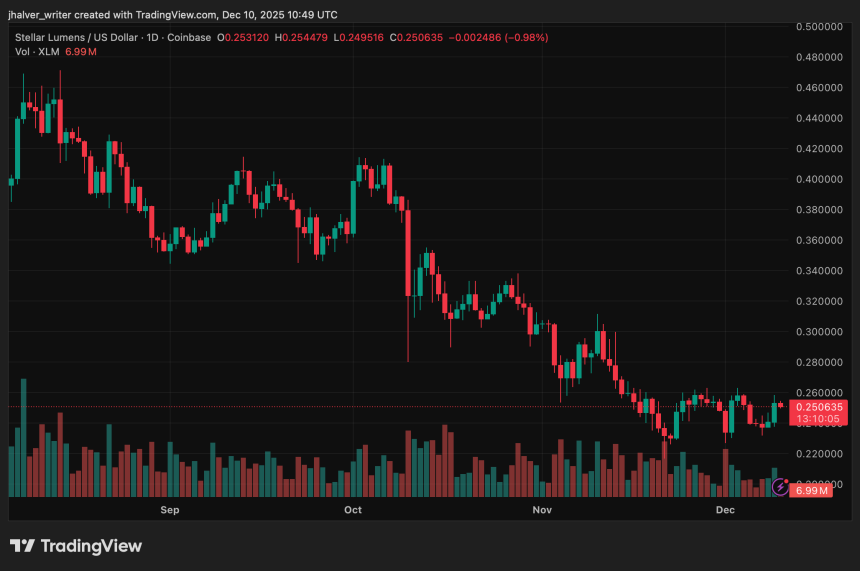
XLM's price trends to the downside on the daily chart. Source: XLMUSD on Tradingview
Increasing utility gives Stellar a boost
Network usage has increased following several developments in November. Wirex enabled USDC and EURC card settlement on Stellar for over seven million users, moving daily transactions to the blockchain and increasing stablecoin throughput.
Days later, US Bank began testing a programmable stablecoin on Stellar, adding an institutional layer to the network’s growing settlement activity.
The recent integration of Space and Time (SxT)which now indexes the entire Stellar network and provides cryptographically verified data to institutions, also strengthens the chain’s infrastructure.
Together, these upgrades position Stellar as a functioning payments network and not just a speculative asset. Initial market reactions were modest, but analysts note that growing stablecoin flows could support stronger demand for XLM over time.
Price provides key support as traders eye USD 0.245
Despite the momentum in the utility sector, XLM remains established in one of the most important technical zones. The token has been on a downtrend since November 2024 and is now trading just above the horizontal support at $0.245, an area that has repeatedly avoided bigger losses over the past year.
The weekly indicators remain bearish, with an RSI below 50 and a MACD negative, suggesting that long-term momentum is still tilted to the downside. Short-term charts show a limited rebound within a rising channel, which analysts view as a corrective rather than a new uptrend.
A decisive break below $0.245 could open the door to new lows, while holding this level would give the bulls another chance to challenge the resistance from above.
Resistance blocks limit upside expectations
Even with potential catalysts of network growth, analysts remain cautious about XLM’s ability to retest previous highs. Multiple reports highlight the $0.26–$0.27 range as the first major resistance zone, followed by a broader cluster around $0.28–$0.31.
Some forecasts point to a possible move to $0.31 by the end of the year as momentum strengthens, although this outlook offers medium confidence given the uncertainty in the broader market.
Related reading
Stellar’s December story is supported by two opposing forces: increasing real-world adoption and a price chart still grappling with long-standing resistance. Whether gains in the utility sector translate into market recovery will depend on XLM’s ability to maintain support levels and reclaim key technical thresholds in the coming weeks.
Cover image of ChatGPT, XLMUSD chart from Tradingview