
According to economist Timothy Peterson, Bitcoin is recent slide could be a short-lived fluctuation if October history repeats itself. He pointed out that declines of more than 5% in October are rare – they have only happened four times in the past decade – and when they did occur, Bitcoin often bounced back quickly.
Related reading
Historic October bounces
Reports indicate that the four October setbacks occurred in 2017, 2018, 2019 and 2021. In the week following each decline, the recovery ranged from modest to sharp: gains of 16% in 2017, 4% in 2018 and as much as 21% in 2019, while 2021 was the only outlier when prices fell another 3%.
Based on these previous moves, Peterson suggested that a recovery of up to 21% over seven days is possible after a big drop in October. MintGlass and market channels have long identified October as one of Bitcoin’s strongest months historically.
Declines of more than 5% in October are extremely rare. This has only happened four times in the last ten years.
October 24, 2017
October 11, 2018
October 23, 2019
October 21, 2021What happened next? 7 days later was bitcoin
2017: 16% increase
2018: 4% increase
2019: 21% increase
2021: decrease -3% pic.twitter.com/mbFs19RbwL— Timothy Peterson (@nsquaredvalue) October 10, 2025
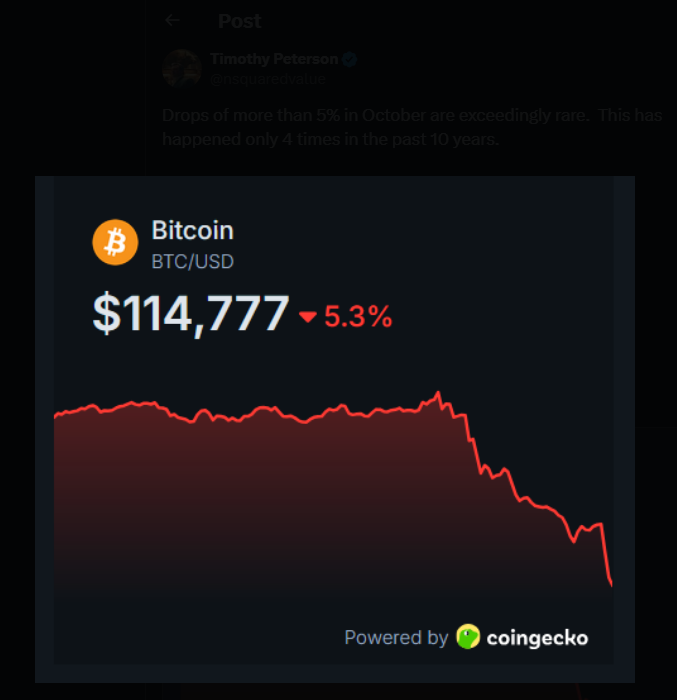
Markets moved quickly this week after a rate shock. US President Donald Trump’s announcement of high tariffs on China coincided with a sudden sell-off that briefly pushed Bitcoin to around $102,000.
Prices then partially recovered to around $112,100. Traders noted that the pullback came quickly after Bitcoin hit new highs above $126,000 earlier this week.
Short-term upside scenarios
If Bitcoin were to mirror its strongest recovery from October – the 21% gain in 2019 – a move from the low of near $102,000 would put the token just below its recent peak, around $124,000, within days.
This math is simple and is quoted by analysts who run many simulations. Some say there are even some chances the month could end well above current levels.
Other market voices expressed different views. Proponents argued that the current dip is a reset during a general uptrend; some called it the bottom of the current cycle.
Others warned that the policy would cause shocks rate escalations could keep the selling pressure in place for longer. Social metrics and sentiment meters moved sharply during the sell-off, and certain altcoins saw bigger losses during the flight to safety.
Related reading
Possible triggers for a rebound
In the meantime, traders are keeping an eye on some clear trends triggers. Headlines easing trade tensions between the US and China would likely calm markets.
Any sign that the US Federal Reserve will accelerate rate cuts could also lift risky assets, including crypto. History shows that panic selling often ends before a strong recovery begins, but nothing is guaranteed.
Featured image from Unsplash, chart from TradingView