
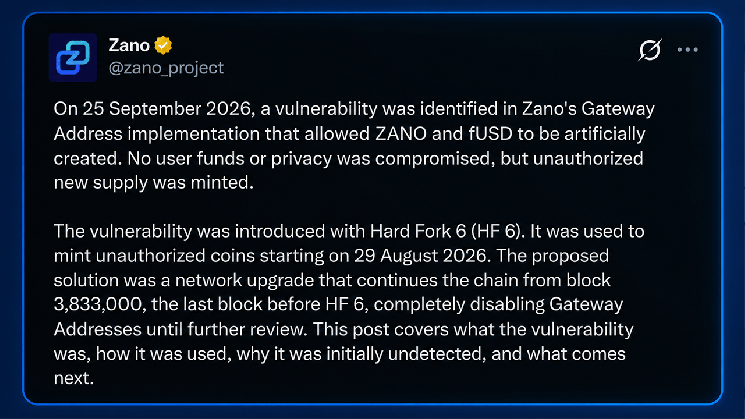
The recent implementation issue with Zano cryptocurrency has sent shockwaves through the community. A critical verification was missing from the system, allowing an attacker to sneak in extra coins while still satisfying the network’s transaction proofs. These coins were not just for show – they were legitimate $ZANO that could be spent like any other.
The attacker made their move on Aug. 28 by registering a Gateway Address and testing the system with a constructed nonexistent asset. The following day, a transaction minted a staggering 18.4 million $ZANO, worth over $100 million. The attacker then made small legitimate deposits to test the ordinary deposit route before creating another 18.4 million $ZANO and using the same tactic with the fUSD stablecoin, totaling over $200 million in illicit tokens. What’s alarming is that despite AI-assisted testing, team audits, and bug bounty programs, the vulnerability went undetected for nearly a month.
The privacy features of Zano, which mix spends with other outputs using ring signatures, made it difficult to trace the illicit coins. The team scanned thousands of outputs and transactions but couldn’t pinpoint the exact location of the unauthorized tokens. The only solution was to rollback the chain to a point before the exploit and disable Gateway Addresses through Hard Fork 7. Affected balances will be fully recovered without altering ZANO’s supply or emission schedule, funded by the development team, personal contributions, and outside help.
Exchanges are now tasked with combing through a month of transactions to ensure the integrity of the system before resuming operations. Users have been assured that no immediate action is required, but vigilance is key in the wake of this security breach. The incident serves as a wake-up call for the crypto community, highlighting the importance of robust verification processes and constant vigilance in the face of evolving threats.